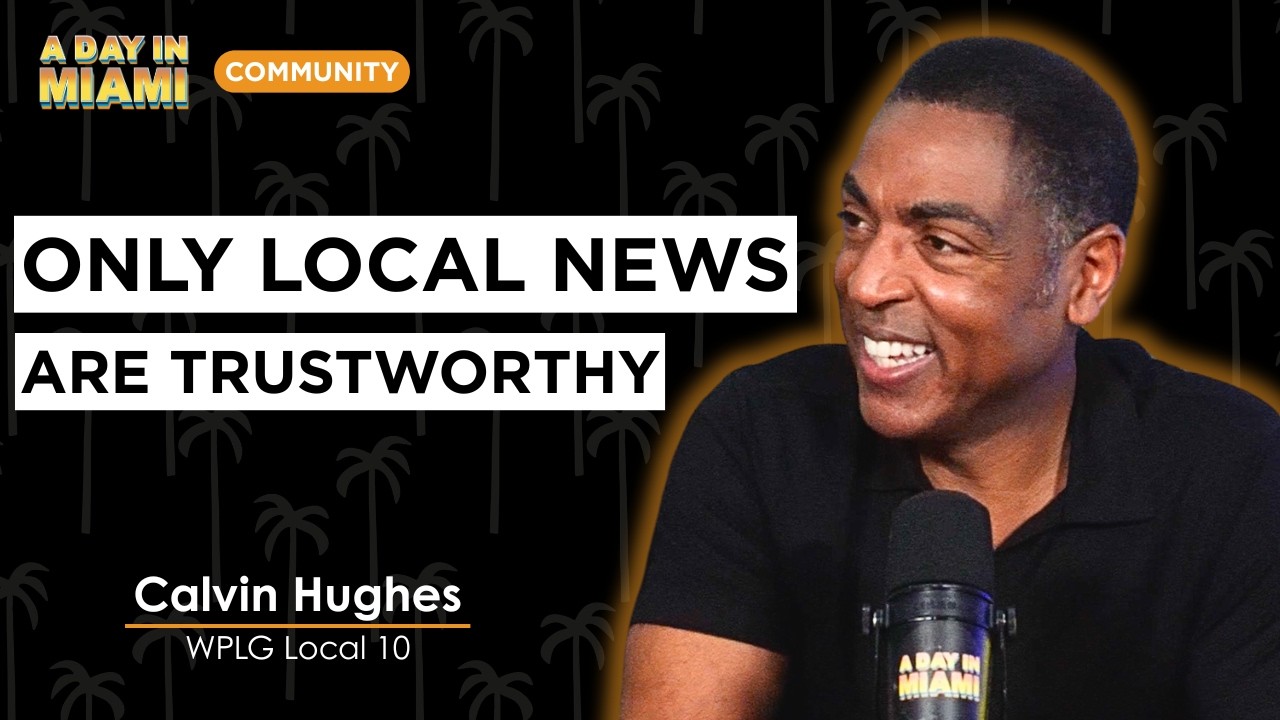
Why People Don’t Trust the Media Anymore | Calvin Hughes
Calvin Hughes shares his journey from reporter to becoming one of Miami’s most trusted news anchors. He discusses how the media industry has changed, why trust...
Sobre este episodio
He also reflects on reporting major events like 9/11, handling viral interviews, adapting to social media, and the responsibility of being a credible voice in journalism.
This episode provides a rare behind-the-scenes look at the news industry and the future of media.
Manny Alfonso:
Instagram: https://www.instagram.com/mannyalfonso8/
Kiko Suarez:
Instagram: https://www.instagram.com/querikoconkiko/
Eduardo Moya:
Instagram: https://www.instagram.com/mr_moya/
Follow Us! - A Day in Miami:
Instagram: https://www.instagram.com/adayinmiami/
Listen on Spotify:
https://open.spotify.com/show/20WEys6jxiliBCLoo9iSID
________________________
Produced by: Ben Schwede
Instagram: https://www.instagram.com/benthecreatorrr/
0:00 Intro
1:56 Beginning of His Career
6:17 Coffee Break
7:21 First Gig as an Anchor
11:05 Reporter vs News Anchor
12:53 Most Touching News Story
15:38 Preparation to Report
17:14 Reporting on 9/11
18:47 How Social Media Has Changed the Industry
22:33 Channel 10 Going Independent
26:52 Importance of Being Relatable and Trustworthy
29:30 Why They Decided to Go Independent
31:51 Monetizing Locally
33:22 Channel 10 Originals
34:48 Viral Debate
36:33 Toughest Interview
39:14 Media Credibility
45:43 Teaching at University of Miami
48:49 Top 3 Restaurants
51:21 Who He Respects the Most
52:05 Outro
Momentos del episodio
Sobre el invitado
Calvin Hughes
Calvin Hughes shares his journey from reporter to becoming one of Miami’s most trusted news anchors.
Hello there Miami family. Here we are back in our podcast.
Today we have another spe Listen, every day we have a special guest, but this is even a special more special guest. And by the way, I'm going to go I'm going to go a little I'm going to go a little bit deeper.
Yeah.
While I introduce this guy,
you know, I'm going to do I'm going to do that voice.
We have the incomparable
the man, our local news anchor from Channel 10.
Yes.
Calvin Hughes.
Thank you. And no,
that was good.
That was really good, man.
That was good, brother. That was excellent.
That was really good. You know, he could be a good actor.
Well, [laughter] listen to me. I gotta be an actor. We've been in moments where he pulls out like I'm like, man, I I would never be able to do that. You know,
that's good stuff.
Welcome, sir. Welcome. I know we've been back and forth trying to, you know, coordinate our calendars. You know, you're a busy man. Yes.
Um, but we are so glad to have you.
Thank you. and and the fact of uh you know just to you know shoot a little bit of a let's say shoot the [ __ ] here you know what I'm saying and the fact of
what is it and how it goes in a day in the life of Calvin
oh man well it you know yeah I that is a good question you know
I try
I think you stole it from the title um of the show [laughter] but uh well it depends on the day so yes you know on a on a Monday is when I teach at the University of Miami I didn't know Yes. Yes. So, I teach
I thought I knew you.
Yeah. Well, I you know, it's a lot of other things you don't know, man.
Kids nowadays.
Um, boy, that's a great question. It depends. I mean, this semester I have a good crop of students and uh for the most part, I mean, great great kids. I mean, they want to learn, but it's a different ballgame because
I didn't have this uh podcast or anything like that. I mean, obviously coming up, you start out in a small market. I started out in Columbia, Missouri and Evansville, Indiana to learn the craft. So, you know, students are looking.
Okay. But before you go to the students, I I want to elaborate on that. Where did you start?
So, I went to the University of Missouri. Yeah. Missouri. Okay. University of Missouri back in 1989 to 93.
Okay.
And I started in radio.
Well, but you you have the voice. I was going to say, but did you always know you had the voice or
No. No.
No. I was actually afraid to talk in front of people. I didn't like my voice for a long time. Wow.
I know. Crazy. I know. They did not like my voice,
brother. I You're missing out. Let me give you a class on the STL situation here, bro. How to squeeze the lemon with that voice, bro. I'd be with a damn app right now. [laughter]
I be on a little I may be on a little Only Fans right now with that voice.
You would have turned into being like the Siri, you know, when you say, "Hey, Siri." Halo.
What the hell? I PREFER CALVIN'S voice in phrase Siri. Okay. Sorry. All right. So, you hated the voice. I mean, I don't know how that happens, but Okay. But I used to practice in my dorm room all the time and um I used to try to be like Peter Jennings, Bernard Shaw,
and uh and some of the other great Yeah. big names.
Good good voices, too, by the way.
Excellent voices, but and fantastic journalists.
Yes. 100%.
So those, you know, were the people who I looked up to. And then I got my first job in Evansville, Indiana.
Wow.
Uh yeah. And worked there. And when I tell you, day and night just work my ass off. Um, and uh, I didn't have much money. I think I was making like $16,000 a year.
Wow,
brother. It was tough.
Yeah.
I had to choose between a new tie
or something to eat.
Wow.
Seriously, it was it was very tough. But then, you know, those kinds of things make you more motivated. They inspire you, you know. And uh so then I went to Lexington, Kentucky.
Wow.
That was an experience.
I know. I mean, listen. Indiana, Kentucky.
Yeah, brother. I was in the Midwest. And from Kentucky, um crazy story, I was um I had sent my resume tape out uh to a lot of agents. And uh the main anchor was apparently trying to get a job. His name is Sam. Sam was trying to get a job in New York. So, he sent his tapes out to a bunch of agents. There was a little snippet of me doing a live report and the agent in New York that he was trying for called me.
Wow.
And said, "I can get you a job in a bigger market." So, he started sending my tapes around. He sent it to Channel 7, WSVN. This was back in 1995.
Wow. Okay.
And uh this is when SVM was kind of changing and uh you know, if it bleeds, it leads kind of thing going on.
Uh Rick Sanchez was there I believe at that time. Yes. Rick Sanchez. Sure.
Yeah. And um and so he sent my tape to Dallas. And so I did the interview with Dallas first. Miami was a second interview. Dallas sent me the contract after my interview. I had a great interview with him. And I had gone from making roughly $24,000 a year to 50,000. And I thought, "Oh my god, I'm rich. What are you talking about, brother?" They sent the contract and I said,
"I can get a tie and a fur." [laughter]
So So yeah. Yes. So, I ended up in Dallas, man. And um uh I cover the Michael Irvin uh drug trial, and that was a real
No way. Okay, brother.
If you look at America's uh team, I I think it's on Netflix.
Yeah, I just saw it. I saw it recently.
You'll see a little snippet of me doing a report about that. Yeah, that was a life-changing report for me. I mean,
do you get credit? Do you get any No,
they don't do it, brother. I My brother told me he was watching it and and sent me a picture of it. Yeah, exactly. I
Nobody called. Nobody told me. Nobody told me.
No credit. you get nothing.
So then when when that happened,
so you know, let let's go down that path after Kentucky. Where were when you got the job?
So from Kentucky to Dallas, right?
I drove into Dallas with everything that I had in my Toyota Tursel.
Okay.
Yeah, it was it was interesting moving into an apartment.
So you Okay, so you were saying Dallas or Miami. You went with the Dallas contract.
Yes. I never even interviewed in Miami. Never never did it because Dallas sent me the contract and I thought I got to sign this. They may change their mind, you know.
So, uh,
you know, there's a saying in Spanish, the the the light in front of you is one that lights better. So, you know, go with whatever light was shining, you go with that one. And that's You did good. You did good.
Count me in. So, uh, so that's that's what
it's okay. We can interact.
Okay.
We're doing coffee while we're talking. Got to have it. That's for me.
Good idea. Thank you. Okay. Thank you, sir.
Is that you? Yes, sir. This is the Cuban coffee.
This is the Okay. Love this.
Yes.
Yeah. This will have me all jacked up. Oh, no. You'll be doing you'll be screaming.
Sorry. I don't know if you like it or not. We do no sugar.
That's fine. Okay. Yes.
That way doesn't get ass.
Yeah. This will this will put hair on my chest right here.
I totally do it wrong. I do sugar.
Okay. [laughter]
I told you to sugar.
Really?
You want more? I would hear.
Okay. No, but that's good.
Cheers, brother.
Cheers, my man.
Yeah. Yeah. Cheers, man.
There you go.
There you go.
Okay.
Yes.
Love it.
Is that good or what? I can feel the hair on my I got afro buck buckweed is on my chest right now. [laughter]
These are these are my favorite podcast. These are my favorite. [laughter] I told you was going to be good.
Oh man, this is good stuff. Oh god.
I drive with com out of the news. So it's a different story. You know sir get into this is the real thing right here.
Funny story Dallas. Go.
So then you're in Dallas. You're covering the Michael Irving trial. I assume that gives you a national spotlight or
Yes. So, right after the Michael Urban drug trial, uh, because it ended up, uh, you know, he ended up pleading no contest to it, my news director at the time said, "Hey, look, you remind me of an anchor. I think I'm going to take you from being a reporter to being on the anchor desk." And I started anchoring the weekend news. And I was working at it, working at it, working at it. And my agent said, "I can get you a job in a much bigger market. Why don't you consider going to Atlanta?"
Good market.
Good market. I became an evening news anchor in Miami at the age of 30.
Wow.
Now I will tell you I was not ready.
I don't think you know for someone who came from a background where
Okay. But in Miami in what station?
I was at the CBS affiliate.
CBS affiliate
in Atlanta. Yeah. And I can tell you at 30 years old if you haven't really traveled the world and really have experienced a lot of things and at that time I really had not because I was too busy focused on my career. Okay,
I don't think any 30year-old should be on the desk, you know, or at least in my case, I was not prepared to do it. And I had to learn on the job and uh and I made a lot of mistakes. I failed miserably. And um but from those
fun those are the fun things. Yeah. You look back now and you're like, you know, I learned a lot from that.
Oh my god. Totally. I mean,
so Calvin, you know, it's interesting you say that because then for me then
what would be what would be the route for somebody wanting to follow in in in this footsteps? I mean, I'm sure you're teaching that in M. Yeah. As well, because for you to say that you feel that you failed
at 30, not that you failed, but that you weren't prepared
because you didn't fail because here you are today and you're on our podcast, so obviously you're fail. But anyway, at [clears throat] the end of the day, it's like what, you know, what would you probably have done different to really prepare for that? I mean,
you know, I don't have any regrets about uh about having started on the anchor desk at 30 years old in a big market like that, but I really didn't know the community and that's where I feel like I failed. Got you. And from that failure when I got here the one thing that I wanted to do was to learn Miami which is
not easy to do because there are many different pockets of community
100%.
So I knew that I needed to get out there and get to know people learn different languages learn to um interact in different cultures. So from that failure it helped me tremendously here now. So when I say and I want to clarify this because there are some 30-year-olds who are on the anchor desk. I don't want it to be taken the wrong
Right. Right. Right. Some people are cut out to do it. In my case, I was just not ready for the moment. So, I want to be
which is, you know, admirable that you can say that because that you
No, but he makes a good point. If you're going to go into a market and you're going to be what they're looking at every day at 7:00 p.m. at night, you need to know the city. You know, if not now, you can't really relate to certain space, I would think, too.
But I was But also, the evening anchor, you feel like that's your friend. That's someone who was in your living room, in your bedroom. So, if I'm mispronouncing some of the names in the community, which I was doing because I really didn't know the community,
the first thing you got to say is this guy's not from here.
Yeah. Who's this guy? Correct. And you kind of want to know
assassinating the names.
So, the other thing, too, is I mean, if you're if if I'm in your home telling you the news, you want to be able to trust me. And part of being able to trust me is knowing that I know your community. So, that's where the trust comes from. You know, I had to build it up here over 20 years, but but at least I put in the effort. And if had I not have failed in Atlanta, I would have come here and would have done the same thing that I did in Atlanta if success came quickly for me.
But I have a uh I don't know. I think for me personally, I would like to be a reporter more than a news anchor. Is it different? Like I I suppose that's really like the upgrade, right? The idea is for someone to go from a reporter to news anchor.
I don't I don't know what's the difference. I mean, there's some people I love being There's some people on the road. No, like it's fun reporters.
Look, the quick answer is yes. When you go from reporter to news anchor, you make more money. Correct. And uh but I'm not a studio cat. I I don't like just being in a studio telling, which is why I've been to so many other different places. Trust me, no one was begging for the Haiti assignment in our newsroom, you know? I mean, that's one reason why I went over there is because a I want to tell the truth. be I want to see what we're covering and why so many people were coming here, right?
But, you know, and most importantly, I just love getting out there and just telling stories and meeting people. So, to your point, being a reporter is more exciting because you're in the action. Being in a studio is quite different because you're kind of, you know, away from the action, but you're having to talk about it as is happening on television. So, yeah.
Well, what would you prefer?
Um, the best of both worlds.
The best hybrid.
What what I'm Exactly. what I'm doing now is perfect for me. I mean, I I'm still able to go out and tell stories and I'm still able to be in the studio at the same time. And if the story takes me out on the road, which it has done, I've covered uh from the opening of Cuba to
correct
the Pope's Obama there, the death of Fidel Castro, you name it. I mean, I've been covered the earthquake in Haiti. I've covered Parkland. I mean, I've covered so many different things. I mean and and I know that you know I mean we could be the great thing with you is that you know I always say that these are podcasts that I I that as said we love that we could be here till tomorrow because there's so many avenues so many arteries that you can go to
but
what can what can you you know what do you out of all the ones that you've covered and you said so many right now there's there's there's some that always that you know you're reading you know what's going on. Yeah.
But there's some that you're talking about it and they're just hitting you right there. you say, "Wow, can I get through this segment? Can I finish this segment?"
You know, it really that really touches you in a sense. I mean, I I'm sure the one of course of Parkland with the kids. I mean, that that I mean, let me listen. I had a scary day with my son. My son goes to
Columbus. Absolutely.
And you guys reported it and you know, thank God it turned out to be a hoax.
It turned out to be whatever. But, you know, when you get that phone call from the wife screaming and this and that and because your son say he's in the room, you know, whatever. And of course, you know, you know, I'm in that situation. And I have my co-host saying, "Sir, why don't you come back to the the table?" But anyway, besides that, you know, at that sense, you know, those things happened. What what's one of those that really can you tell me like more or less has or anything that really has
Oh, man.
I mean, I know the Haiti also.
Oh, I mean, the earthquake really impacted you the most on like on a deep level as a human.
Gosh. Um, well, Parkland I think is probably one of those stories that really sticks out for me. Surfside really sticks out for me.
That's that's huge.
Um, but Parkland sticks out for me because it was just a normal day like today and I was stopping at a local coffee shop. I was getting some coffee and I got a call from the vice president of our news department and he said, "What are you doing right now?" And I said, "I'm on my way in. I'm grabbing coffee." He said, "Um, you need to come in."
Yeah.
And I said, "Well, I heard about the shooting near Parkland and you know, Marjgery Stoman." And he says, "We have inside information that it's a lot worse than what
Wow."
Yeah. [clears throat]
So when I got in, he says, "Don't put on makeup. Don't worry about it. Just get out to the studio." And that's exactly And so the [clears throat] toughest part of that story, I think, for both my co-anchor and me at that time was we were watching videos of people hiding under the desk and you heard the sound of the gunman walk in.
Yeah.
And he started shooting. Um, and we were having to talk about that in real time.
Wow.
So, that was
while you're listening to that, you
I mean, we're seeing it. I mean, our producer said in our ear, "Hey, look, we're getting this new video." Um, and we're not quite sure what we're going to see, but we understand students are sending in videos of what happened. And she said, "Talk about it." And the fact of that you have, you know, you have all these people out there watching you
to take them what's going on because everybody's desperate, you know, either a family member, a family friend, everybody's out there. So they're counting on you to deliver this this point. So yeah, listen. Um I I don't want to be in those shoes in in in that.
Can you tell me a little bit behind the scenes like um your guy comes to you, hey, get in the van, let's go. Are you how are you guys prepping to get over there? Are you reading your notes? Are you like trying to like stay into what's going on? are you getting fed information or is just kind of like typical just show up and report?
So, one example I think is when uh there was a weekend I was just kind of hanging out with my daughter and um the shooting in Orlando happened at the nightclub.
The Pulse Yeah,
Pulse nightclub.
It was it anniversary recently or something. I was actually open to another one
and um once again the vice president of news called me up and said, "What are you doing right now?" I'm like, "I'm just hanging out with my daughter." He says,
"You know, every time the guy says, "What are you doing right now?" We know. Yeah. [laughter] Yeah. Best. He says, he says, "Can you hop in the car and go?" And uh
so my co co-anchor and I at the time we were in [clears throat] the same vehicle and um we were just kind of listening to news reports and they were feeding us information as we were driving to Orlando about 4 and a half hours there. So we had time to prep, but as soon as we got out the car, we ran to the spot. They had the camera set up and we had to start talking. That was really tough because we really didn't know. We were far away from the event. We knew some things but you know and the information was still sort of coming in. So yeah that was really tough.
That was no those those are the moments where you know you see that you really your your expertise and everything comes you know
but you rely on your own humanity too. Correct. I mean so you are I mean as a parent I mean those guys went into the nightclub night thinking they were going to have a good time and
especially when your kids your daughters your sons are out there doing the same thing. I mean,
so that becomes the story.
Were you on during the 911 or
so? And Atlanta, I was on during 9/11. Yes.
How was that?
You know, for me, I think the best part about that is it speaks to how when things happen in our country, everyone comes together
100%.
So, everybody forgets what party [clears throat] affiliation, nobody cares about doesn't matter, you know, everybody unites in in in order, you know, to get things done. I agree with you 100%. So all of the main anchors, uh, Dan Rather, Peter Jennings, Tom Brokhaw, they took over the airwaves, but there was a time when they did allow us to do news for one hour and in Atlanta in 9 for 911, everyone really came together and that is the one thing that I will never forget. But I can tell you when I saw the planes flying into the building, I like everybody, I thought this isn't
Yeah, this is this has to be a mistake. I got picked up from school. you know, every, you know, the the the thing is is that I'm sure and every viewer out there is going to relate to this. Everybody knows where they were.
Yes.
That's something that's going to be, you know, um, you know, tattooed in your brain for for like, you know, I was at the house. You know what I'm saying? I remember that happening. And
I hear, you know, Katie Kirk was in in the Today Show and all I hear is said, "Oh, I Oh, there's a report. I think the plane, you know, uh, hit the tower. It must have been like an accident, whatever." Whatever. And I remember at that time there was really not that much
of the inside information of this whole social media of terrorism. Nobody knew anything about that. So again moments that people will never forget.
How have you seen social media change the landscape of what you do cuz people now get information much faster you know almost instantaneously. And how have you guys tried to compete with that?
You know what um or you just embrace it? Well, my feeling is we have to find a way to have social media work for us because right now we're working for social media. In other words, I think social media has fractured everything that we do. I mean, you can watch news that's happening in your community and never really watch our channel, you know. Um, you can have your own podcast uh that you love. Obviously, this one is the one people love the most. Or you can have other
Thank you. Thank you for that. Thank you for that. you know, you could you could have other, you know, avenues of looking for news. And I think young people are getting their news from their phone. Yeah. Um more now than ever before. We have to find a way to catch up with what they're doing. Go to where they meet them where they are.
It's getting there. I think it's getting there little by little.
I mean, we kind of saw what happened with the Washington Post. I mean, you know, they laid off a third of their staff, you know. I mean, so there has to be a way for us to kind of generate more of an interest in what we're doing.
I think the I think not the I think
Well, listen. Hey, we're always open to working with
channel. No, I think what happens is that your the infrastructure that you guys have,
it's just, you know, it's obviously a much more robust and expensive infrastructure than it is with a guy with a phone, you know.
So, when you guys go to go monetize something, you really need to make it needs to make sense for you. You know, some monetizing on the phone is a lot easier.
Well, to to play off what happened with the Washington Post, I think what people are finding out is that um viewers are not interested in sourcing information. They get it from Facebook and if you share it and say if I trust you Manny and you share the information it's like well well hell I I believe Manny so it must be true so he's sharing it so
that's how people are
right now what you're saying and I want to say this because this so yesterday we were when all this was happening with the school
you know so our producers in in in here had posted already something that was coming out in in in Columbus. So then when my sister calls me and she tells me, "Did did you see what's going on in Columbus?" And I go, "Oh, where'd you see it?" And she goes, "Oh, I don't know. I just saw it in in in she saw it on a day in Miami." So she got the information. She called me. So she's getting it from from from here, from this source before she even had gotten it from from from the news. You know what I'm saying? Which was already attached with a you know, a statement from the sheriff's office. Okay. So again, it wasn't like something that they were just, you know, saying or saying, but I understand the fact the news has to get there.
They they have to start verifying. They have to start, you know, finding out what's going on before they say it. But to your point, what you're saying is that there has to be like some type of happy medium between the social and the thing of, you know, getting it out there a little bit.
Well, and and this is something that I say to my students all the time. I say, "What do you believe in?" So what's your source? What do you trust in?
Right? So if you trust Tik Tok, I mean that's not reliable, right? If you trust Facebook, that's not reliable. If you go to Instagram for your news, when is that reliable? Yeah.
So what is your source? I mean do you go to legacy media? What you know they call ABC, CBS, NBC, Fox.
Um and I think that's what makes what we're doing so important at Local 10 by us becoming an independent station. And I love that because that's that's something that we really want that's one of the things I really want to talk about because I think that we gota we got to explain that we got to explain that that move.
Listen, he's explained it to me a couple times and I still don't understand
and still and at at the same time me talking with with I mean I know I'm understanding other other stuff but you know so for all our our our viewers out there
let's explain okay what was what happened with that with channel 10 ABC affiliate and so on and so forth. Okay. So, every so many years a local affiliate has to renew their contract with Big Brother, which happens to be ABC.
Correct.
Okay. So, that's Channel 10 having to renew with ABC.
Correct. Okay.
We chose not to do it. We chose to go on our own to become an independent station.
Oh, nice.
So, what ABC offers up is obviously college football and all the other programming, your daytime soaps and all that. um Jeopardy and Wheel of Fortune, which we kept on our air, but all the other stuff that you would normally see on ABC gone.
Gone. Like if it's a Sunday Night Football or Right.
No more Monday Night Football. It's on another channel. Correct. I'm not going to say it, but it's on another channel here locally.
We're not going to talk about this.
But how many?
So, exactly. So, what we have is So, we do 93 hours of news per week.
Damn.
Wow.
I know it's a lot. Oh, sorry. Sorry. How many reporters do you have?
Um, oh my god. Uh, we hired 50 new people.
Wow.
Yeah. Producers, directors.
That's Day County or Broward County or Tri County?
Uh, Tri County. Tri County.
Yeah. Monroe, Broward, and Miami D.
So, give me the What are the time frames of news now, Cali?
So, um Oh my god. So, we're on at 4:30 a.m. Uh, and then we go all the way up until 11:00 and then you have Kelly and her husband on from 11 to noon. And uh who's I was Kelly and Mark? I
Right. Right. Oh, okay. So that's that's still on your
that's still there. So Kelly and Mark. So from noon to 1, we're back on again. More news. Then from 1 to 3, we have uh news magazine shows that are on like crime mysteries and all that. Right.
And then from 3 until 7,
yeah,
we're on. And then from 7 until uh 9 7 to 8 is when you have your Jeopardy and Wheel of Fortune still in our air. So, are you guys doing news at 9:00 now?
So, I'm on at 9. Yes. With my co-anchor Nicole Perez.
Well, let me tell you something. I I think that's spectacular because I think at 9:00 is a great time for the news because to tell you the truth, by 11, even though I'm, you know, I I go to bed late, but, you know, I'm I'm catching flies at that time, you know. And I'm like, [laughter]
you know, so I I you know, I don't catch, you know,
I never heard that term before, catching flies. That's a good way. I teach you.
I know. I know. I got you. The thing is is that you know you're you know at 11 I'm like you know I picked up a little piece at 9:00 woof you're good
and it's not 7 where you're rushing home the kids correct you know
so at the end of the day between 9 to 11 how much can happen a lot in Miami but still at the end of the day you report I I I like that I think 9:00 is good
so from 6:30 to 7:00 you have our you have our guy Louie of course he's from here thank you my man and yes and um
and so he's doing world news and then So, uh, at 9:00, you know, the great part about the 9:00 news, uh, and Nicole and I, I think we love the fact that we're on at 9:00 and we're able to deliver news, uh, the first time ever in South Florida where you can get your news at 9:00 is that it's not just, you know, your typical run-of-the-mill stuff. I mean, we're offering up interviews and uh, we're having fun. We're having a good time. Our entertainment reporter, Jason, I mean, he's awesome. So, you're going to laugh. You're also going to get informed. You're going to be educated. Correct. But you're also, you know, you're going to be able to go to bed knowing that you got your headlines.
Can I do like a ride along with you one day or something? Do you do you allow that for real?
You can come and hang out the station anytime.
I would love that, man. I would love to.
But you have to go. No, you want to go with a reporter to hang out. Yeah. I want to see that format.
We'll have to work that out. Okay. Yeah, that's that's
I think I could be a good reporter, man.
I think you would be okay. All right. Well,
I might get a contract for W 10, baby. Tell 10. You got my number.
You might not have a partner anymore. [laughter]
We'll sign it out. We'll sign it out. We'll sign it out.
Subleas me. [laughter]
He signed out. Listen, I think that's important because, you know, a lot of people were confused with this whole thing of the channel. very
you know but at the end of the day remember everybody I feel that everybody what they love is the fact of u and you said something earlier and I'm a true true believer in this
when when you I don't [clears throat] know if the correct word is fall in love or you trust your TV host your TV anchor or your radio anchors those are the people that you want to hear
yes sir
and at the end of the day when when you're listening to somebody And it's not because and I'm not because you're only you're my friend and you know and and you know you're dating a good friend of mine too. Um but at the end of the day, shout out to you know who out there but at the same time
I don't know there's just a sense of calmness.
Yes.
When you do the news.
So for me to watch you not only because you're my friend but I you know I enjoy it. And then that's that I don't know if you know this but you know that's a big thing in the Hispanic community. you know, the Hispanic community has to really trust and relate to their to their anchors or their radio people. You know, I mean, it's it's something that's been because of of what happened in in in a lot of their countries. You know what I'm saying? Because um they were listening to bad news from some other place and then, you know, all other people were trying to give the correct news, you know, from mountains with a makebelieve antenna, something like that. So that's the only way you could really grab your news, you know. So then basically it's very that's always been instilled
at least for me since I was a young kid and especially here that you know I don't call this Miami Florida. I call this Miami USA. Yeah.
You know because I feel like we're own country here you know preach brother.
So at the end of the day you know it's important for people to relate with their anchor.
I agree 1,000% and I think uh and it takes time you know you got to build trust. To me, it does not happen overnight. And if anybody comes into this market thinking that, you know, you're going to get on television, wear a nice suit, and speak well, and everyone's going to love you, it will not happen in Miami.
We've seen it. We've seen it at network levels. And we're not going to get into that. How people have been, you know, boom, boom, boom, turned over, turned over, turned over that you think that, oh, that person and all of a sudden, you know, the numbers and the numbers just don't come out.
And you see it with, you know, all
your guys, you're performance based. you know, if the numbers are down, you're going to get, you know,
but but I also think that one way to really make a difference, not only here, but anywhere, and again, this is a lesson from Atlanta, is you got to get out in the community, roll your sleeves up,
100%.
Get involved with what people are doing. Yes. You know, get out and meet people. And they want to find you relatable, not through the television screen, but also by shaking your hand and finding your real person.
I was going to back to the split, was there a reason why you guys split? uh that you decided yeah that you decided to go independent. Is there a benefit to that? Just kind of curious on from like a business perspective.
Well, I think you know and and that's above my pay grade. But I but
we got we got to bring in the the vice president. I always call him goes where are you now?
We got to bring in that guy. [laughter]
We should call him and go where are you now?
Explain to us. No,
but I I will say there is a business component to it. But I also think that by us being an independent station, we're able to cover things that say maybe others who are owned corporately cannot cover.
There you go.
So we have our independence. Now we're the only station in Warren Buffett's empire that uh that he has. So he has basically said to us, go out and do whatever you need to do.
So none of the other stations locally are independent.
We're the only one.
Wow. Wow. They're owned by uh CBS is owned by the network. Uh channel 4, channel 6 is owned by NBC. It's an O and O.
Uh channel 7 is owned by the Anson family as we all know,
but our station is the only independent in town. Absolutely. Telmundo is under the NBC umbrella.
Correct.
I mean, I'm not sure is you guys are like re you know, you guys would have uh you know, the most real local sources, you know, theoretically speaking, right? Because you're adding the most resources towards that. So not only the resources but say for example um if there is a huge story that happens uh big breaking news story some of the other stations will have to go back to their regular programming. So for example Sunday um with the Super Bowl on if something happened in this community um NBC cannot cut away and focus on that story.
Interesting. They have to. Oh my god. That is the biggest money maker for the network. I mean, they're pro I mean, some of the commercials on Sunday are probably going for not maybe not locally, but on the national level, some of them are going for $5 million for 30 seconds. Yes, sir.
You know, they were doing that last year, so it may be even double this year. So, it's a big money maker for the local affiliates. And so, with that being said, uh they would not be able to break away. We would be able to go on. It doesn't matter. We can go on for hours,
right? So people say, "Let me go see if there's a touchdown, but let me go look what's going on over here."
So So then So going independent, I guess you lose that component of it, but then you you have to survive off of what? Local sponsorships or local
Oh, yeah. Yeah. You got to go you got to do a lot.
Yeah. You got to hustle now.
Yeah. You got to really hustle. There's no doubt about it because we would be able to sell say for example the Notre Dame Miami game. I mean, that was huge here. Yeah. Yeah.
You know, and uh so selling that game is not a big deal. Exactly. But now you got to sell local programming. You got to sell the fact that we're doing parades and um other I think honestly talking about the social media component you guys are on the right path. That's a big move I think in the right path of focusing on especially in Miami. You have so much news you can talk about.
Look it is a reach into the future what we're doing. But I can tell you that long term it'll pay off. There's no doubt about it. I mean our media landscape right now is changing rapidly. You know, but you know what I think you guys are missing?
What's that?
A partnership with like a social media page.
But I already threw that one since the beginning.
You're a little bit too
I knew this was going somewhere.
Listen, [laughter] I listen all I know is is that uh
it should be, you know, one should have that that whole, you know, partnership as as as we've spoken about.
But I I I tell you, I don't know. I I think that for Miami, it's a great fit.
Yes. of how this has has has you know transcribed and how it's you know being laid out now. Um you know because there's always program everybody can go to any program that they want to do.
You can build content and they can build. Absolutely. Yeah. Absolutely.
You know um do you guys do series like that like you know organized like series like docu series documentary series like that?
So we are um I think it's it's a slow build right now but we are focusing on say for example um the 100y year anniversary of Coral Gables. We did something on the build more. Yeah.
Um so I mean we're kind of looking for opportunities to do stories. So I think you guys should go and get into like some you know channel 10 originals or something along those lines. You know
I I don't think look they are planning
again we need to talk to
my job is to monetization of the city you know you know I agree there's a lot of story I mean look just look there's a lot of stories to be told that I think you guys have much you guys have obviously more reach than we would you know um and and I think it's uh something that it's a great
obsiding series on the streets
even focus also on the sense of I I mean, I know a lot of people this is a little iffy conversation, but the political side, there's a lot of local important races that that that that are not focused on, you know, because everybody's always focused on national elections, but listen, there's local elections that people do not know that how important a a a county commissioner is, how much a city or city commissioner, you know. So, there's things that you really need to learn about those people. do a deep dive in who's going to be running your your city or your county.
You know, I think you did some great debates. You know what I'm saying?
Oh, wow. That's a really good debate went viral. That one that one that you took that this that lady, I don't know her name is I'm not even going to go ahead and share her name because she's not worth it or something talking about Cuba.
She got she got over 400 votes and uh my my co-anchor and I were really shocked. Nicole and I shocked.
Those are just 400 ignorant people.
Okay. I just watching channel 10,
you know, but you know, I just want to keep that. Is that would you say that's one of your most viral clips that you saw yourself ever?
Oh, totally.
Yeah.
Oh, totally.
Especially now in this
Well, because I mean, you got to keep in mind we're researching this woman and Nicole says to me, you know, she said that she loves Fidel Castro.
Yeah.
It's he's thinking,
and I'm like, no way. So, I looked it up, too. And so we go out there and she's like, "We have to ask her." I said, "Well, of course we have to ask her.
Sure. Sure."
And so, you know, we just fired away and we didn't know what was
what was going to come out.
Yeah. That was interesting, bro.
That was awesome. That was awesome. [laughter] Honestly, I don't know if I'd be able to do something like that. I I can see where where that the professionalism of being a journalist comes in there,
you know? I mean, I'm like, who does that? I mean, why would you run knowing that this is an issue with a large group of people who are going to be voting for you? I
And by the way, she lives in Little Havana.
Yeah. Well,
oh my god.
Let me tell you.
In Coral Castle.
Yeah. [laughter]
But she she did her she did what she wanted to do. She got on with you. She got interviewed by you. And you know, now she's getting booed by everybody else out there. But
well, out of fairness, we had to interview all of the candidates. Correct. Which is which is what I'm saying.
Yeah. Do you ever had have you ever had an interview where you felt it was your toughest interview? Like, you know, really hard-hitting questions that you maybe felt uncomfortable with that you really had to think twice about?
Cuz sometimes we have these interviews that I'm like, I want to go hard at this person, but you know,
Oh, I can't 60 minutes.
I'll tell you I'll tell you my my heart is my I can tell you my disappointment, but after you say you're disappointed.
No, no, please. No. I'm I'm curious to hear because usually
Well, my disappointment was when we interviewed Jeremy Piv.
Yeah.
Why? Why? because you know I mean it was just it it he wasn't in a good mood. It killed me.
So these are the toughest in
I'm sorry if you have an expectation well when you have an expectation that someone's going to be here and they fly in here and you're kind of like dude.
Yeah.
What that that's what I said.
Exactly. That's what I was and he was you know he's like a real life Ari you know.
No but not that I'm I'm a real life entourage fan. I hardcore fan. I can tell you every episode I would me and Denise will watch binge watch that and I'm sure all the people out there I mean if you never gone to entourage but that the thing is that's mindblowing it's great I'm this one tells me we're going to get this guy I go my god it's great I was prepping from
he was prepping he was cleaning toilets I was prepping you know and everything I said guy sits down and he tells me I don't want to talk about
Harri go
and just kill me I get it you know he and I respect him you know he said I'm an actor I'm stage actor a couple weeks you know I'm a stage actor and everything but
you know everybody I respect the fact of how many films you did in life and everything but the one that really you know came across to me was when you did the series of entourage and you really opened up for a hu a new genre a new you know generation of people embrace it you know they tell me no I don't want to talk you could be him I don't want to be him. But then I'm saying, "Wow, I don't understand this."
We had that on and the the the videos did really well, too.
Yeah. Because there was a lot of people go, "What are you talking about?" You know, there was I love the fact of him being that hard ass agent in in Hollywood and saying, "What do you mean you're not going to get MY CALLS? YOU GET MY CALLS RIGHT NOW." You know that.
Sir, of course.
So, that's that's what made it. But anyway, that was my that was my like hardest thing because I'm trying to get things out of the guys just looking at Mike saying,
"I'm a simple stage actor." I just looked at I go, "Yeah, I don't know." You ask questions now. [laughter]
So, do did you have any stands out?
None that really comes to mind. I'll be honest with you. I mean, I I mean, children are usually the toughest, but uh but I've not had a celebrity who has really
I'm going to send you Ari Gold your way.
See if you can take anything out of that guy.
How um what do you think about what's happened? I'd say what the last 10 years, you know, maybe more since then than Trump went in with the whole fake news and the credibility the media journalists have taken the hit on mainly national to be fair, you know, uh I'm curious to know your thoughts on that, you know.
Well, there's no doubt that uh calling us fake news has absolutely hurt us um over a long period of time because people don't trust us. Yeah.
Uh to a degree. So earning someone's trust is
years, decades.
Yeah. when you lose it and trying to get it back, I mean, it's nearly impossible.
Yeah.
Um I think uh I think if people um have something really bad happen in society, I think they'll have to come back to us because like you were saying, we have the resources to really cover an event. um if you go to your local you know whatever channel you look at on YouTube or uh any kind of social media person that you follow they won't be able to cover the news like we cover correct the news and have the access that we have
but I think over the course of you know your daily grind of just covering different stories in the community it makes it really tough for us and look you know we need people to trust what we're doing democracy will not survive if we won't survive.
As I like to tell my students, and I tend to go back to this quite a bit because it's always on my mind when stuff happens, uh, like, you know, when we're called fake news and all that, and what happened with the Washington Post is that, you know, there's a reason why the founding fathers made freedom of the press the first amendment, not the second, not the fifth, not the 10th, but the first. Because without freedom of the press, without the fourth estate, without what we do on a daily basis, democracy cannot survive. So if you undermine us, you're undermining democracy.
But do you think that there's some case to be said that LA's legacy media kind of brought that upon themselves in some doubt? You know, like cuz sometimes I see reports like 97% negative, you know, news the whole time, you know.
Listen,
and we're not gonna, you know, again, we're going to be here tomorrow, right? But here's the thing. I think what happened what happened there is legacy media and everything for call it whatever reason you know there's a lot of people within the not not not let's say anchors but let's say high administration okay take took sides and that's in some points that that's where you have to out of and they steer
that's more cable news
and that's more cable news and then it got to the point of like okay a president and vice president of programming were uh linked to somebody's uh fundraiser in a party and which you know what if you know it's going to happen you can't go you just have to stay out of it I mean even I know it's hard and maybe you you can despise this guy you can despise the other candidate but you have to stay focused
if anything that what happened there was it was proven that in some cases
some things were altered.
You know what I'm saying? So,
well, my my argument my my counterargument is local news might be the last bastion of objectivity.
Yeah, I think so for sure because after a certain hour on cable news, you got to get hosts. You got to get people who are giving you their opinion mixed with the news.
So, if you don't have a discerning year, it's really difficult depending on who you're looking at.
Exactly.
And I think that they need to do a better job that which they used to do it before, not anymore. Saying this is opinion news. Before I used to see the tags all the time. Now I don't. Now I just kind of like hide it. I kind of blend it in.
But after a certain hour on cable now every every cable is whoever it is you know that these they'll probably bring one purse and I'll be roasting you.
Look with the arrests of some journalists here recently. Yes. Exactly.
I was ask I will tell you that there is a question between are you an activist or are you a journalist?
Right.
And that becomes the issue. So, if I get on my podcast or if I get on my YouTube channel and I'm calling certain officials names and I'm going out and I'm covering a story the next day, what am I? Can I tell you on that point with and because you just said now Don Lemon
when he had the show with Chris Cuomo,
you know, you have to praise I I praise a little bit more of Chris in the sense that Chris well he got let go and everything, but then he came back and he said I was wrong in certain things that he he even said I was more or less steered by whatever cable news this is what you have to talk about. But he came out and he accepted responsibility for a couple of things that he feels that you know what after I found out or this or that in this case I think with this with this gentleman was that he got a lot of his personal personal you know views and and personal feelings hurt by that ad and he said no I I don't care screw the news screw this I'm going after this guy and I'm going to use my power against it which has happened with a lot of the people from Hollywood you know what I'm saying again we can be here tomorrow. That could be another news show, you know. But I mean, I feel also too, listen, if you're paying me, if I pay you $10 million a year
to be the host, you know, on the channel, you know,
where's that station on CNN or whatever?
I'm applying for that.
That's what I'm saying. And then I tell you, hey brother, here's your 10 mill year and this is where you're going to be reading from. You don't get that card now one now. [laughter]
You know, I I see that that I see money in cable news, you know, plays a big role, you know, from sponsorships and everything, too. Yeah.
But I also think that, you know, you have to stand on principle. I mean, and the bottom line is,
you know, you don't belong to red or blue or whatever party. You belong to the truth party.
Correct.
And I think there, you know, I've seen this party go from a lot of people to now down to not very many people who are pursuing the truth and a lot of us are in local news.
Yeah.
And uh and so I I could
stay local. Stay local. Stay local. Well, I I can tell you that I have never a 10 million
I don't want you to go I want you to stay
10 million I got 10 million reasons
10 million reasons too man I'll go national as well
oh is that the agent out there talking STL you know I mean
no I need the guy from
listen no please don't even ask him don't do it no but let me go and and let me you keep on telling about teaching what's the class you're teaching at
so it's uh it's called the fundamentals of news gathering really JMM 208 and uh I've been teaching it for years now. And
so who's taking that class? It's just an elective.
So it's uh it's not an elective. It's actually a prerequisite.
Okay.
I know. I know. I was I was shocked too to learn that. Um but they basically allowed me to format the class however I wanted to. But
I will tell you what my my goal is always to teach them really the fundamentals of of journalism. And you cannot, you know, know the fundamentals of journalism without not looking at All the President's Men the movie.
Have you seen that?
Yes, sir. I think I've seen that.
Yes,
brother. You got to see it.
Yeah. Yeah.
Not only great acting.
Yes.
But to understand what happened with Watergate, you have to understand investigative journalism. You got to understand that sometimes
you don't pursue a story, a story pursues you.
Yeah. I mean, which at the end of the day, I'll tell you this much, the fact of that is real investigating reporting.
Thank you.
Because when you talk about that and going back to Eddie's point of like, oh, you do you like to, you know, either be, you know, a host or you like reporting, investigating, reporting is even wor because that is the persons that, you know, you really have to get in there. You know, you're risking your your life at this point sometimes. You know what I'm saying? So, but how how far we've come from what that investigative reporting was to what it is um you know today. But my hats off to every it doesn't matter any investigative reporting because it's really it's it's tough.
Oh, it not only is it tough but it's lifechanging and if you really get the results that you are pursuing and in that case they were trying to get to the bottom of who actually really committed and commanded the crime to happen.
Yeah. Like who who initiated this? who's a phone call that said go and do this tapping
and they had no idea it was going to result in that and so I think investigative journalism is the way to go
which nowadays you know with everything I see I mean that was like what would that that was nothing for the love of God what I just sat down listen to a tape [laughter]
this is this is very
compared to what's going on now
you got to see it
see I love watching movies
please I mean here people's lives are being destroyed
crazy crazy crazy crazy with So, you know, um well, but I think that it's it's it's important as you said.
I love the fact that this class is being really, you know, that you have to take it in. I think that speaks volume for University of Miami to do that because I think everybody should go through that. Everybody should go through that class. You know, I learned that. I
agree. You [clears throat] know,
I have a question that the the public has been wanting to ask.
Well, but wait, what is it always ask?
We got a whole list there, too.
Is he still a bachelor, single? Oh, what what what is that question?
No,
I don't know. I said [laughter] I said I said bye to him after the mayor's ball to him and he was with somebody there. He seems like he's doing good.
She will not like that. I will tell you she will not
she'll be coming after me.
Yeah.
Okay. Go ahead, brother. Ready? Go ahead.
This is the hardest question.
Uh
oh. What's that?
You got to give us your top three restaurants.
Top Starting with number three and work your way up. Gosh,
you know,
man. Um, top three. Uh, number three. Go. Sunny's.
Oh, but Sunny's is three for you,
brother.
Sunny's number three.
Yeah. Yeah.
Okay. Okay.
You know what? Yeah.
You want leave them three. All right.
So many people have put on number one.
Michael's genuine is what do you like about Michael's genuine? Um just the fact that you know
they're genuine [laughter]
and sunnies.
No, you get No, no, the food is
no reservations. So
great service, food is great. Um and you get to sit outside. It's just it's just a vibe. Yeah. You know, it is I've heard very good things about Oh, you have a you have
I I want to elaborate that that's that's true about Michaels because you're there near you know this
we went to remember we went to a dinner with him that we did where Koso Royo and these guys
Oh, that's right. That's right. It was a great dinner. Okay. Go top that for number one.
Oh man.
Number one. Your number one restaurant.
Number one restaurant.
Number two that you don't.
Yeah.
It could be anything.
Yeah. You know what? Casa is it? Casadon. Casedona. Cased.
Casedon. They've grown. All right. Yeah.
Casedona was great.
I love it's a vibe, too.
Where where are they?
Casadon is over there by the um
by not far from the Arch Center.
By the Miami design.
Yes. it. In fact, it's they're connected
that area. Yeah.
Oh, wow. What's the vibe? What do you like about it?
Oh, brother. It's right by the ocean. I mean,
wow. I mean, you have the outside bar, which you know, it you know, shout out to part of the Grumman group. Yeah. So, it's it's spectacular. You know, the the food is delicious and the Calvin's
the vibe outside, especially with this weather.
Spectacular.
What' you eat?
Well, I had the brunch, so it's a buffet. So, you
can't go wrong with that. You can't go wrong. You can't go with that. I mean that is by far
well listen I I we are we again we want you to come back
you know what I'm saying you got to come back and you know maybe in one of those moments that you like what is it you're in the news what four what times are you in
three no I'm sorry no take that numbers again I am on the news at 4
four five
five
six
six nine
nine
and 11
live like every time you go to the bathroom [laughter]
I would love to spend a day with you there man I would love
between 10 and 11 that's
I want to know because then I want to know there's time that you can come here to the podcast so we can do we do podcast with you. Is there anyone else in your industry that maybe shares your same role that you're like, you know what, I like that person. You know, I want to give a shout out to that person because they've been in the grind just like me and you know, I'd see them from afar. Anything like that or
man,
boy, that is a wonderful question. Um, in my industry, you know,
past, present,
you know, there's a guy who I looked up to. He was at the network level and now he is an anchor in Cleveland. His name is Russ Mitchell.
Okay. He is someone who I mean he's excellent first of all but he's been a friend. He's a graduate of the University of Missouri like me and he's been there for me from day.
Shout out to Russ.
Yes.
Wow.
Russ is a great great guy.
Well, Mr.
No affiliation to Howard.
Yeah. [laughter]
I saw that email by the way.
He goes wishes Howard Hughes. [laughter] Yeah, brother say how I go. Listen, I am Howard Hughes's long long kid.
I would I would love my daddy.
Well, you wouldn't know what personality you were getting first of all cuz I I have many if I were and secondly you we would be talking for my airplane.
Yes, sir. Yes, sir. My in Palm Beach in front of my man. Thank you so much, brother. We love you. Appreciate you.
No te pierdas un episodio
Suscríbete y recibe cada episodio en tu plataforma favorita.
Suscribirte en SpotifyMás Episodios
Ver todos 58:13
58:13
The State Senator Fighting for Her Part of Miami | Alexis Calatayud
sep. 23, 2026
 30:58
30:58
Ludlam Trail Is Just the Beginning - Here's the Bigger Plan | Ralph Rosado & Julio Robaina
sep. 21, 2026
 50:04
50:04
The Man Designing Miami's Restaurants, Strip Malls, and More | Chris Vidal
sep. 14, 2026
 50:57
50:57
Inside the Plan to Save Virginia Key | Robert Christoph Jr.
sep. 10, 2026