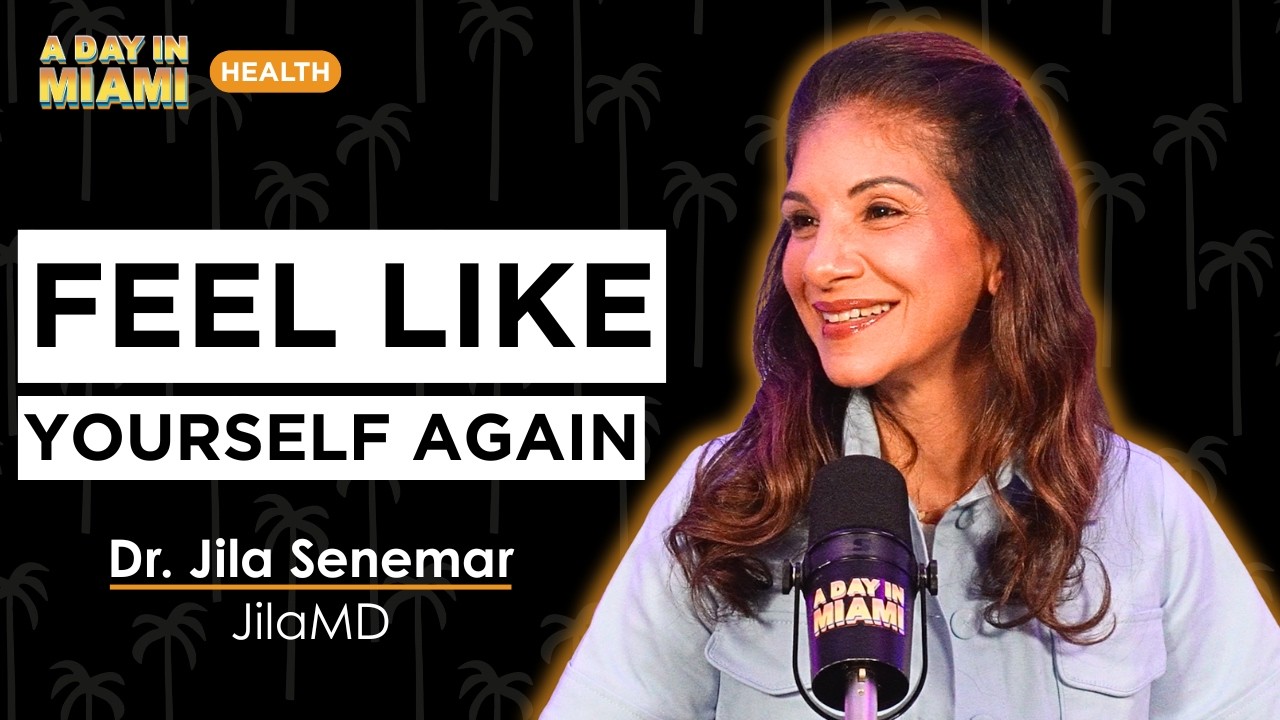
What Every Woman Should Know About Menopause | Dr. Jila Senemar
Menopause is something every woman will go through — yet most doctors barely talk about it, and most women go in unprepared. Dr. Jila Senemar, Miami's leading m...
About This Episode
She also covers strength training, weight management, symptom relief, and why open communication between partners is one of the most powerful tools during this stage of life. Plus her top 3 Miami restaurants.
This is the menopause conversation women deserve — and rarely get.
A Day in Miami Website:
https://adayinmiami.com/
Manny Alfonso:
Instagram: https://www.instagram.com/mannyalfonso8/
Kiko Suarez:
Instagram: https://www.instagram.com/querikoconkiko/
Eduardo Moya:
Instagram: https://www.instagram.com/mr_moya/
Follow Us! - A Day in Miami:
Instagram: https://www.instagram.com/adayinmiami/
Listen on Spotify:
https://open.spotify.com/show/20WEys6jxiliBCLoo9iSID
________________________
Produced by: Ben Schwede
Instagram: https://www.instagram.com/benthecreatorrr/
0:00 Intro
1:04 ADIM Business Network
2:04 Introducing the Guest
2:55 About Dr. Jila
5:30 New Perspective and Approach
8:11 Why OBGYNs Are Not Up to Speed
10:28 What is Menopause
14:00 Why Women Now Look Younger Than in the Past
14:57 Women's Lifespan and Heart Disease Risks
16:01 Why Hormone Replacement Therapy is Beneficial
17:12 Menopause Symptoms
18:21 How Men Can Support Women During Menopause
19:52 Weight Gain During Menopause
20:44 Strength Training is Crucial
24:18 Sex
28:27 Why Communication is Important
31:59 Why Men Start Understanding the Situation After Consultation
32:58 Pink Pill
34:07 Why You Should Reach Out to Dr.Jila
35:59 Top 3 Restaurants
38:15 Outro
About Our Guest
Dr. Jila Senemar
Menopause is something every woman will go through — yet most doctors barely talk about it, and most women go in unprepared.
Are we on? Okay, okay.
Here we go. This is a good one today. I well, I say this is a good one today.
it all the time.
But at the same time, this is not a good one only for this is a good one for us. I'm going to tell you why.
I'm not sure, you know, because last time we had one of these they're like, you guys should probably want to I don't say the same thing with you because they're like, you guys should probably have women on those so people feel more comfortable talking about it, but she's a doctor so she can
But that's okay. That's fine. I I But you're wrong because we're you're going to understand why I'm going to say that it's good for us. So, today's a day that has been, you know, in the works for a while because I've been wanting to really get into this conversation and I had a phone call from a dear good friend of ours, a mutual friend, a a Monica, a a also known as What Up, B? So, uh at the end of the
That's her name? What Up, B?
No, that's a inside joke between us. So, at the same time, she tells me, "I've got the perfect person for you every time you have these questions. We've got the expert in our podcast today and little did we know she's our neighbor."
Yes. Before we get into our guest, I got to say thank you to our business listings. We're getting a lot of people who sign up to our businesses.
You always want to list business listings
Yeah, man. Like
I like him doing that with Kiko.
Yeah, but listen.
[laughter]
Like we we mentioned it today and all of a sudden this morning, shout out to Flight Barbershop, right? Trias Flowers and Events, they've been around forever. Amazing. They just entered our business network. I Drip Therapy and Wellness, welcome to the network. Miami Elite Cafe, Sila Miami. These are all from this morning. Place of Aroma, Truffle Temptations.
Wow.
truffle?
No.
You don't like truffle?
Nope.
Oh, sorry, truffle. We can still come to the office [laughter] and do it. Kiko and I like truffle. You can come to the office and do it. And Blue Fox Elevated Wellness, I know that they're helping Kiko. So, again, if you guys want to be part of our
listing
He He needs a lot of help. So, I I hope those people have a lot of clinical trials. But anyway, that said, thank you for those updates for those great people who have joined our network. Um we've got with us today Dr. I just I'm going to just say Dr. Gila.
Mhm.
Right? Everybody knows you as Dr. Gila.
Call me.
Am I right or wrong?
Dr. Gila, that's what they call me these days. Yeah.
Dr. Jay?
Dr. Jay,
Dr. Gila, whatever you want.
Dr. Jay was Dr. Jay. You could be Dr. Jay in the menopause area. So today I'm going to tell you something. Today is a one of those questionnaires and one of those things that really is going to be in a lot of people's minds. And we've had some great guests here. We've had Christie.
Mhm.
Christie, yeah.
You know
Christie Labour.
Amazing.
We We love Christie and and we I was talking to you before we started how we got into this conversation. So today's going to be all about the profession that you do. So why don't you tell our viewers what is that specialty where everybody can just say, "What?"
Uh-huh.
Go ahead, Dr. Jay.
Well, guys, thanks for having me. And you know, as being your neighbor, this is this was an easy trek over this morning.
you a second. Did you hear about us before you came in?
I I did. I knew about you guys before. Yes.
I love I love it. I love it.
So I'm an I'm a board-certified OBGYN. So my specialty, you know, for 24 years has been delivering babies, operating, gynecologic surgery. I was one of the first robotic surgeons in Miami, female.
Okay.
So I've been doing this work for a long time. And what happened about five, six years ago is there was a shift. There was a movement in women's health where we were really good at taking care of women until they had their kids. And after that, it was kind of like, "Well, it is what it is." And you know, they had a lot of complaints. They were tired. They were exhausted all the time. They weren't sleeping well. They were more moody. And it we would just kind of chalked it up to like, "Well, it's part of life. You're 40-some years old at this point. You have kids, family, life is running crazy, so you're exhausted. So, we didn't have a conversation about perimenopause and menopause, which is what the whole thing was. What was happening to women is their hormones are shifting and changing, and that shift can last up to 10 years, if not more.
Is it Is this part of the factor we can say as men we're saying, "What the hell's going on with my wife?" That you would say, "You know, why why why?" You know, and we didn't we just probably didn't understand the situation.
And mood swings?
Well, I don't know.
You call everything a mood swing. It's It's exactly what it is is It's a physiologic change, but it's been tabooed and so much shame placed upon it. That's just the way society has been. It's in women and has been shown to be a source of decline. You're not You're You're here for reproductive purposes. Once you're done having your kids, you're not really of use anymore. That is the old thinking. That is the way society
That sucks.
portrayed this. Imagine, right? You're You're 45 years old, and now it's kind of like, "Uh, we're we're done with you." Put you to the side, and that you have nothing else to give. So, what do women do? We shy away from it. We're not going to talk about it. We're not It It's not happening. It And no Nope, it's Well, it under the radar. We just suffer in silence, and you just move past it, and what ends up happening is we know it impacts so many different parts of our bodies. It impacts our relationships, husbands, work, friends, you name it. It's impacting everything. And so, what shifted was I realized my patients were asking these questions, and I didn't have an answer back for them. So, I was like, "Okay, wait. Something's missing. We need to figure out what's happening. What do I need to do better?" I started going out to different conferences and learning and re-educating myself, because what happened was when I was in training back in the early late 1990s early 2000s, there was a Women's Health Initiative study that was published. It was a long-term study that the government put on to look at hormone therapy and how it impacted women's long-term health. Well, they stopped the study early because they found an increased risk of breast cancer, heart attack, and stroke. That's what the headlines said. Overnight
that. I remember that.
that? Early 2000, 2002 this thing dropped. We were told no more hormones. It's bad. Don't worry about it. That was the training I got as an OBGYN which is this is my field.
All right.
So, two decades of women did not receive hormones. The implications were drastic. Heart disease, you know, dementia, fractures that they would never recover from. And what ended up happening, the study was misinterpreted. On multiple different levels. And back then there was no social media, there was no internet. So, nobody could really do much about it.
of people verifying, you know, what's going
What was actually happening. So, because of that no one got anything for 20 plus years. But the data was there. It wasn't that there was no data. All those when they went back and reread the study, they're like, "Oh my god, we made a mistake. Sorry." Too little, too late. So, at this point no one's prescribing, no one's taking it. Now, fast forward, we're not trained. So, I had to go out, retrain myself, and bring it back. And that's when I realized, okay, there's more to do here. And I went to different audiences and, you know, different places to to get help to be like, "Hey, let's put on events. Let's educate. Let's educate the doctors." And a lot of pushback I got was, "There's no audience for that." So, I decided, "Okay, I'll make the audience. I'm just going to go out on my own and I left my thriving practice and I built a new one. Centered around women's health only in terms of after reproductive years."
Interesting.
Right? You don't have it, you build it. You create it. And that's really what I ended up doing.
But but but I guess my biggest question would be is like, how can other people say, "Well, they they pushed us aside. They just didn't really believe." I mean, especially when everybody was saying something's wrong with me. What You know, we all talk about that. I guess that's a little bit also like with the men with testosterone. You know what I'm saying? Some people say, "What happens?" You know what I'm saying? Your testosterone could be, you know, lower. And I remember you something you said because I remember a lot of people and I had this conversation. I mean, a lot of you would say, "Oh, you get that thing, you can you can wake up cells that you don't want to wake up, you know?" I've always been been in that mentality. You know what I'm saying? To your point, you know? And and a lot of people didn't want to do that thinking that, "Oh, wait. I don't want to have something, you know, that's dormant that you want to wake that up now with all these new I don't know hormones
Peptides and hormones and things that people are injecting. So, what ended up happening was the the version of hormones they used in the study were all synthetics. Things that we don't use anymore. And the women they used them in were 10 years older than the actual age of menopause. So, these are women a decade older who already have pre-existing disease. Yeah, and they didn't really, you know, take that into factor when they made these, you know, claims which were then taken back. So, now fast forward to today. Women have more of the education of what they need. Providers don't. So, we still have an imbalance. Women are going to to doctors, to their OB/GYNs who they've trusted with delivering their babies. They have full faith in these docs. And they're like, "I don't not sleeping well, and something's wrong, and sex is painful. What do I do?" And he's like, "Oh, it'll be okay." "Oh, it's it's nothing bad. You're still not in menopause." Right, yeah. Which is equated with you you're still having periods, and you don't have hot flashes. And basically, the way it's being you know, handled by some is "Until you're in menopause, we're not going to treat you. But in the meantime, you can suffer for the, you know, 10 years prior to that. So, we need this endpoint in order to treat you." So, really, a lot of these conversations have to be individualized. You have to change the narrative around it.
So, I mean, for I don't want to sound dumb,
No, no.
I mean, listen.
Can you explain to me uh like the process of menopause? Obviously, I've I've heard of it. I know some of the symptoms that happen. Um but like more or less, how does it begin? What do they feel? What age does it start? You know, and a lot of our viewers are majority men. So, it would be interesting for them to know the details behind it.
And I'm excited for you guys to ask these questions. Because we need we need the Listen. As we ALL [screaming] SHOULD BE.
HE'S MY DOCTOR, my own personal doctor.
[laughter]
No, I think I know what it is.
She knows these details we usually don't.
No, but but that's a great question, because at the end of the day, you know, we have a lot of you know, yes, we have a lot of males, but we have a lot of females on our show.
It's like 58. It's like 50 like it's like 60/40.
Yeah. But at the same time, I think it's great for us men to understand our girlfriends, our wives, our partners, to see what do we look for.
Right.
You know, APART FROM LIKE, "SHUT UP. I DON'T WANT TO TALK TO YOU RIGHT NOW."
YEAH, LIKE how to support it, you know.
Yeah, like, "You're chewing too loud. Don't do that."
you should be doing
these things, you know?
Why is the AC so hot in here?
The stage is yours.
The stage Okay, so here the thing. The vocabulary that I want you guys to know is there is premenopause, which is, you know, after women have their periods and they're going through reproductive years and having kids. Then there's perimenopause. Then we have menopause, and then we're postmenopausal. So perimenopause means this 10-year window where hormones are fluctuating. Normally, right now, women have estrogen, progesterone, and testosterone. Throughout the month, it fluctuates. Now, in perimenopause, those fluctuations are more drastic. So some days it's really high, other days it's really low. That's where the moodiness comes into play.
are these usually happening in?
We're thinking We're talking like late 30s, early 40s. So add 10 years, because menopause, the average age of menopause in the US is 51 to 52. So we're talking 10 years before. Menopause is a definition. It's 1 year, 12 consecutive months without a period.
Wow, I didn't know that.
That's 1 day. That's it. The following day, you're considered postmenopausal.
But then, they don't get periods ever again?
Ever again. No more. Done.
they'd be happy about that.
We are, but the lack of that darn estrogen makes us grumpy.
Got you.
We're not sleeping, and we're having hot flashes all the time.
next morning is not going to be a good day for you, huh?
It's not at all. It all feeds into itself.
Correct.
Imagine, you're having hot flashes
Are you talking by experience?
No. No, no, no.
But I think talking enough to women, you get it. This is
I I'm okay. I mean, you you know, my my my and you know, I don't think my wife has a problem with that, but you know, my wife is is she tells me, "I'm I'm in those stages. I'm in those stages already, you know what I'm saying?" So she's she's doing
She's not that old.
Huh?
Denise is still young, no? She's pretty young.
My wife is still young. My wife is still hot. You know what I'm saying?
Sorry, yeah, she's and it's not THE AC COMMERCIAL.
[laughter]
THAT WAS GOOD. I KNOW THAT.
SHE IS HOT. BUT at the end of the day, you know, she is in that in that in that realm. You know what I'm saying? Saying, "Hey,
Something's happening and and But let me tell you something. That's exactly it right there. Just because we're menopausal doesn't mean we're not hot, you know, like hot, not physically hot. It's not and I you know, I I love the Golden Girls, don't get me wrong, but we're not that era anymore. If you go back, they were in their early 50s.
Can I tell you something?
Yeah, tell him.
You are so that is so funny you say that. You know, Denise and I you know, I'm okay, so a little tidbit, that's our show that we put like when we were going to sleep at night, the like, you know, ease into the thing, you know, Denise will put on the Golden Girls, she's watching and I go, "Oh my god, you're going to put this guy know that I think I know the whole story line." One of those she Googled because they were talking about it and then Denise goes, "What age was this lady hot in Golden Girls?" She was 50. And Denise goes, "Oh my god, that woman looked like she was like 60 or 70 years old." You know what I'm saying? She looked older and and to your point
It's changed. Like you know, we've moved forward due to technology and everything else that's going on out there. So, we're not the same 50 that our moms were. So, hence we want to live differently and what we know is women live longer than men by like about 7 years. So, our health span our our life span is longer, our health span is shorter, meaning the extra years we live are in poorer health than men.
Right.
Why? It's at this trajectory of menopause when all the hormones fall off a cliff that our health risk goes up tremendously. And most women think due to breast cancer or other cancers. It's actually heart disease.
Oh wow.
We die of heart disease. That's our number one killer.
For real?
never have thought
Well, but that's always been That's been one of the biggest thing with the women, heart disease.
Yeah, heart disease. So, before menopause, so before 50-ish, men outdo women in terms of risk for heart disease. At menopause, we outdo men by twice. So, we have a twice higher risk of heart disease after menopause, and it's all because of that protective effect of estrogen.
Wow, you just shocked me right now. I had no idea.
Yeah, so again, and that's what most women come to me with.
what do you suggest? Like, uh take hormones to balance yourselves out, or what is that you suggest? What's like something that's preventative or a cure they can do? I mean, I don't know if there's a cure or not, but that I kind of like educate me on that.
So, here's the thing. What's happened is If you have a most people If they have a thyroid dysfunction, hypothyroidism, hypothyroidism, what do we do? We put them on the darn medication. You're on Synthroid or some version for the rest of your life, and we're okay with that.
Yeah.
The ovary is another organ. It's just another gland like the thyroid gland, and it runs everything from head to toe. Meaning, your brain runs on estrogen, progesterone, and testosterone. Your heart does. Your bones, your muscle, your tissue in the bladder, everything down there. All of it is on all these hormones. So, what we need to do is replace it just like we did everything else.
So, you do hormone replacement therapy?
Hormone replacement therapy, and different versions for different people. And again, very individualized. No two people are really going to be on the same exact thing. Everybody has a plan. We got to meet them where they are. What are your symptoms, and how is it impacting your life, and how can we improve it? You asked what were some symptoms. Women really don't pay attention because again, we're just taught to just kind of
Go with
grin and bear it and just do what you got to do. It's sleep disturbances. That's like one of the first things I can No, of like in perimenopause, at the beginning. So like in their 40s, you know, they're like, "What's going on?" It's They're not sleeping at night. They're waking up at 2:00, 3:00 in the morning, tossing and turning. That's number one. Number two is mood changes, more than before. So before the period, you know, your mood shifts a little bit. You have that PMS thing going on and then your period comes, you feel better. Now, exaggerate that where it's more of the month where you're not feeling well.
Yeah.
And then, you know, it just gets worse. And then the other part is brain fog. This thing where you're like, "I can't remember this person. I met them. I know his name, but I don't know who that is." Like, "I can't It's at the tip OF MY TONGUE."
[laughter]
BUT LET ME TELL YOU, YOU GUYS DO HAVE ANDROPAUSE, TOO, which is very similar, okay?
I have no idea that existed.
Yeah, 100%.
What what can our What can our men viewers be doing, Doc, in the sense of to be looking after our our our our women? Like, [clears throat] you know, could we like, you know, suggest, "Hey, could you be going out without being thrown a pan or something?" Or, you know,
good to say like, "Oh, you're just acting like that cuz you're PMSing?"
Yeah, I wouldn't do that.
Okay. Okay.
That That's a red flag. I wouldn't do that because uh you know, you may end up on the other side of that. I I I wouldn't do that.
This is exactly We [laughter] need to be educated.
THIS IS WHY WE'RE educating today is so you guys don't end up, you know, on the on the
So tell us.
in in the dog house. Um really, I think understanding what she's going through and validating it. I mean, like, I get it. I think this is Okay, you're going through something and I'm here to support you. How can I support you? Maybe take off some stuff that, you know, some of the chores that she has to do all day long. Be like, "Hey, I can take care of that." Or give her a self-care day. Women need that. We They don't take it enough. Where they just take a day, go, disconnect, and literally do whatever in the heck it is she She wants to go sit on the beach all day long and veg out, let her do that. They need that in order to kind of feel like themselves again. Women in perimenopause, they're not recognizing their bodies. They're gaining weight. They don't feel good in their own skin, and they can't understand what's happening. And the more we tune in and give them these tools, the better they can do.
So, okay. So, you just said right now something that's a structural. Some of them are gaining weight and something of that sort. So, is it sometimes these people think that, "Oh, well, I'm just on a on a binge. I've been eating a lot or something of that and then now everybody just jumps into the I'm going to go do the the GOP1 and and it's not even maybe the GOP1 they're taking Ozempic or Mounjaro, you know, it's the fact of you really checking your
hormones and everything else. Yeah, because it is a component of midlife changes.
Yeah.
That That fluctuating estrogen actually causes elevated cortisol, which leads to inflammatory markers going up, and that shift in body composition is a component of perimenopause. So, these hormone changes cause brain dysfunction, bone dysfunction, heart, [snorts] metabolism. It impacts everything. It's not just treating hot flashes and then you'll be okay. It's bigger than that.
So, I see a lot on social media, which I'm sure it impacts a lot of women's, you know, mentality, that like strength training, like real strength training, could do wonders for their body. Like bone density. Is that Do you Do you ever recommend that people go to the gym and like actually like not like do a little Pilates class, like actually work out, you know?
Like lift the heavy darn weights. Yes. So, muscle is termed the organ of longevity for that reason. The more muscle you have, the more there's met- metabolic health with that. There's insulin sensitivity that comes along with having more muscle. So, all the weight changes we talk about can be improved if you do the darn strength training. So, as part of like the prescription we give our patients is this is the kind of workout regimen you need to have. You want to do your Pilates? Great. But, you need two to three days of strength training, squats, heavy weights, and incrementally increasing that weight. Not just kind of staying where it is because that's not going to challenge you. And that muscle is going to help maintain your bone and get you stronger in your 70s and 80s.
Yeah, because I mean, I see everybody doing Pilates, which I think it's nice, but I've done some Pilates classes and I I don't even sweat. And I'm like, "What is this?" You know? And then they charge you an arm and a leg. You know, but then I go to strength training. I see some chicks doing strength training and Yeah. You know, you you can tell, you know?
all honesty, there's some girls also like, you know, they have a messed up knee, they have a messed up neck. I mean, you
You have to be careful.
be careful because it's not like you can just go out and do your your stuff of like, you know, doing all those weights.
people like when I go train, right? And I have a personal trainer, shout out to my people at Complex. The first question he asks me every morning, "How are you feeling?" And if I tell him my back hurts, he's not shying away from my back. He's strengthening the spaces around my back and I feel great after. If I say my knee hurts, he's strengthening the muscles above my knee and below my knee and I feel improved.
Yeah, to stabilize that that area. Correct. A lot So, the other component to this is you need to work with a personal trainer who is well-versed in midlife women. You You cannot find a little 20-year-old, no disrespect to them, they don't know this this kind of person, this woman. She got me trained. And this is and there is a big industry with this right now. We have trainers who are specifically for midlife women. They meet them where they're at because some women have never touched a weight in their life. So, you can't really go heavy with them. You have to start at the bottom and slowly go up before hurting them because if you hurt them, then you're out of luck.
Now, some women will tell you that they lift weights, you know, but with the like, you know, Irma's bike.
Yeah, yeah, yeah.
what I'm saying?
Yeah. And that's why again, I I love
Irma's bike.
I'm like that that's fine. You know, you know, we we listen, we all have that habit, okay? There's nothing wrong with that.
I'm not sure if your bone density will increase with that.
I don't know. I think I can I can beg to differ on that one.
Your bone density will go ahead and leave it. That's fine.
That's that's We'll we'll talk about that later. Um that can help with the perimenopausal symptoms.
That does help. I I I suppose it helps.
It can help. It can help. But the strength training again, what I what we need to be, you know, aware of, women are only going to do what they like doing. So, you can't really take away their Pilates or whatever have you. Do it by all means. I need movement 7 days a week, whatever it is. So, if you want to walk with a weighted vest, which is a very popular thing, by all means go do it because it's a good starting point. But please add in the 2 to 3 days of strength training and I can let you do whatever else you want on the other days.
So, doc, you know, to all those men out there that sometimes say, "Well, listen, you know what? Let's talk about sex, you know, and in the sense of saying, you know, you know, they they want sex and they want sex and they want sex and they want sex and some of these, you know, some of your wives or or girlfriends say, "I'm I'm not in the mood."
Right.
You know, don't touch me. You know what I'm saying? I mean I I mean
It's it's a reality of where we're at. Yes.
say some people say it's taboo. You know, it's all those people that say, "Oh, um you know, these Oh, I do it every day. Oh, I do three times a week."
Listen, I've seen some crazy videos of people like which I I I don't know if I believe it or not. You know what I'm saying? They have sex every day three times a day for 10 years, you know. I mean listen, that's amazing, you
Good for you, but good for you.
Like I mean do you even work? I guess my quite first question would be
Well, they probably do work. They just do videos at home.
Videos though, all right. There's something else that they're doing. There's another kind of
I [laughter] could understand that. if that's the question, I'm getting on that damn thing.
Yeah, that's fine.
It would be interesting to put if you can put us in the mindset of a woman whenever she says, "Listen, I'm not in the mood." Because I think that's something that turns men off a lot and it's kind of like
What? And it's a problem between marriages. And the sense of like, you know, I mean I don't know. I I'm not I'm not a psychologist even though, you know, I could play one on TV. Um your question would be, you know, have you seen people get divorced because of this?
Okay, so I'm again, I love that we're bringing up all of these key topics because this is really critical. The average number of people going through divorce in midlife, 45 to 55 is about 45% right now. 45% That's really high. And the other worst part of that is 70% is initiated by the female.
Wow.
So
And I but I always
You see? You see?
I saw a statistics Well, listen, the least divorce rate is gay men.
Oh, yeah.
You know, gay men have the least divorce rate.
I I believe it. I believe it.
I don't know where that came from but that's okay.
I would I always heard that it's mainly because of financial reasons though. Is that still true or not?
That is, but right now because of all this menopause movement
Why did they throw that in there?
That's there too, but it's it's really these shifts and changes that are happening to women and neither one has the the vocabulary to have this conversation in an open way and not feel shame about it. So that needs to be removed. Now you're talking about intimacy, low libido, all of this.
Which by the way, vice versa for the man.
Oh, yeah, it happens both ways,
100% and they may need a little a little push, you know? Right. And low testosterone is very common in both men and women. That's the other part. Like, we don't get testosterone. We don't even have a female version testosterone. That's F- We do, but we also have our own, too. So, yeah. WE GET DOUBLE WHAMMY. WE GET BOTH, BUT we don't have one for women that's FDA approved. So, we have to use your guys' version, but at a lower dosage. Imagine that. But again, besides the point, we have it and we need it. So, in a woman's mind, here's what's going on. She doesn't feel well because now she's gained this weight. She doesn't recognize her body. She's not sleeping at all. So, she's, you know, her temperament is low. She has all of these things to do. The And the last time she did have sex, it painful because it was dry and she didn't feel She didn't enjoy it. It's a negative feedback loop in her mind. And the last thing she wants to do is right now do that. So, that is what's playing on. It's not you and it's not about you. It's about her. Oh. 100% Mhm. Mhm. Mhm. Right. Right. Well, listen, I have husbands coming into my office with their wives.
that's that's another question. I wasn't asking that.
That is important and I I first talk to the woman and kind of see what's going on and what her story is and then I ask if it's okay to bring her husband in.
Right. Right.
And then I have a consultation with both of them cuz it is educating on both sides.
That's impressive.
But if you have that open communication, that changes the game completely because now she understands that you get it. And you understand where she's coming from and she when and we can make her feel better quickly. Like with treatment options, like this can be a thing of the past. I've had women that I treated at So, this is a woman who came to me third time around, meaning like she'd gone to four or five different doctors and finally found me and came as like a consultation. Divorced, went through everything. So, we I found out what was going on and I treated her, you know, with hormone therapy. Three months later, she comes back and she's like, "I feel like a new person. I never really thought I would be this way again.
Wow.
And one reflection I've had is I wonder if I'd done this sooner, if it would have saved my marriage."
Wow, you see, that's that's that's that's a tough one.
That's that's that's heartbreaking. Like, you know, where she was like, "Maybe if I'd done it, then
Right.
They didn't have the conversation. They did They weren't open enough with each other to understand what was going on and that it wasn't about him. It was just she just didn't feel like herself.
Right.
And to your point, you can only say no so many times. And then I have other women who come in and they're like, "I just do it because I have to."
Yeah, I know. I mean I mean, yeah.
[laughter]
SHE'S A TROOPER, BABY. COME ON, BABY. YOU KNOW WHAT I'm saying? I mean, what? WASN'T A NEVER GOOD DIVORCE.
THEY WON'T GET DIVORCED, BUT LET me tell you, you know, coming from a women's health aspect, you know, women should enjoy sex. It shouldn't be just because I have
Right.
Now you're at this point in your life.
GUY. OKAY, I'M GOOD.
OKAY, GOOD. LET'S GO.
I SEE INSTAGRAM CHICKS THAT TALK ABOUT THAT.
THEY'RE LIKE
THEY'RE LIKE, you got to do it. IT'S NOT LIKE
DO IT THEN NO. NO, you have to enjoy it. It's a part of well-being. Like, you know, you're older now. You don't have to worry about getting pregnant. You're financially stable. You love your partner. Okay, let's have fun with this.
I mean, you know, go get a couple of whips and chains. I DON'T KNOW.
I DON'T CARE WHAT IT TAKES. JUST LISTEN. YOU KNOW, EXPLORE EACH OTHER and see what what works.
Go change some outfits.
Absolutely. Absolutely. But
That's all That's all a plus. That for me is all a plus.
Yeah.
I mean, I I I I tell you, you know, because I feel that we had this conversation or actually I had this conversation when we had the Christie and and Gigo and and we were talking about that because she's saying, again to your point, she was saying, you know, a lot of people that I know have had problems in their marriages. You know, that it lead to whatever you want to lead, infidelity. I mean, I don't know what route you really want to go to because that's really, you know, just quickly rub it all with it, you know. It was that really the corporate and then you say, "Oh, you left me because of this. You left me." I mean, that's really now a psychological situation that I think you got to resolve with tequila. But on at the end of the day, it's like, you know, could you go ahead in that therapy that you're doing at at your office
Mhm.
to your point, when you sit down with the men, do some men come out and say, "I get it now" or do they
100%.
No. No, no, no. So the people that I'm seeing, these are people who are educated. Meaning they've seen it. They've heard it on different podcasts. And now they're like, yeah, it is true. And and when they go home with their wife or girlfriend and then in 2 3 months she feels better and they come back. They're like, yeah. The proof is in the pudding. It's right there.
are simple creatures, too, you know.
Okay, okay, good. Yeah. To be honest, we are more complicated than men. I totally agree with that, but I also agree the more I explain it to the male partners, the more appreciative they are. They're like, "Thank you so much for saying that because I really didn't know what to do in this in this situation."
gotten a man say, "BING, I SCORED. THANK YOU, DOC."
NO, you know, so it's funny you say that.
What's up, Doc?
So, I have a lot of different medications and tools that I use, right? So, like there's a pink pill, which is female version Viagra.
Stop. Really?
Yeah, it's been around for about 10 years. It's FDA approved for use in men in in pre- and post-menopausal women. The pink pill.
And a lot of women are on it, you know, that are patients. And then the husbands are like, "Yeah, you better make sure you go back and see her again." Yeah. Yeah, you need to go and get your prescription filled.
Yeah, well, they
That is what's working.
because
Yeah, that's why the blue we have the pink. Yeah. It works. It works. So, it's it's putting it all together, I think, and make taking away the shame and the taboo about these subjects is really where it's at.
I I I think a lot of guys have to take this and strive today, you know, all of our our listeners or viewers and really just go home today and you know, really psychoanalyze this and say, you know, this has been an a good educational podcast.
going to listen to anyone, just listen to this one.
You know what I'm saying? I mean, [laughter] this is great. Dr. Dr. J, tell me then, um how can people what's again, how are people going to reach you and and I mean, I I think there's a I think there's a lot of people are going to probably say, "Listen, honey, I think we should just have a little meeting here with Dr. J here."
Yeah, I was going to say if you could speak into the camera, um exactly what your practice does and and kind of maybe like if people are feeling X, you know, should they be going to you?
So, I take care of women after they've had their babies and in midlife. So, if you're struggling with hormone changes where, you know, you've been to your doctor and they just really don't have an answer for you and they tell you all your blood work looks okay, but you don't feel okay, then that's where, you know, we come into the picture is to really do a full overall evaluation of what else it could be going on and then provide appropriate guidance and treatment options. So, and I'm located right down the street from you guys. Right down the street.
I I I I I I tell you that this is we we I love these things because you even told me that, you know, men as well, you know, you don't you don't treat men.
Right.
But you do, you know, know of a lot of people that go through the male situation too because I think that there's men that go through this a little bit as well. Not that, you know, you know, you had kids, but the end I mean you had kids, but not as as a woman, but at the end of the day that men do go through these little crisis and men need to be checked out as well in the sense of testosterone and all bunch of stuff to see what's going on with that.
Absolutely. The male version is andropause is very similar, not as drastic,
Correct.
but the testosterone is really the key factor in those in those men.
That that explains so much with our other co-host with Kiko of of his problems. You know what I'm saying?
Talking about Kiko.
We have the your hardest question.
Okay. All right. Well, I hope so.
You have to give us your top three restaurants. All right. Starting with number three. Sorry. Serious one up. Number three. And why? Why is
Oh, are you
Yeah.
Okay. Well, okay. I'm old school, so Hillstone is like oh my god. Listen.
a a staple here.
I I go there at least twice a week if and I've been going there for like 30 years. So, you know, even from New York. So, like
Yep. Yep. What do you What do you like from there?
Okay. So, that's shifted a little bit. Okay. So, it used to be the tuna salad.
Okay.
Obviously, start with the spinach artichoke dip and the pressed sushi. Those are like the basics. You have to have that. And then it used to be the tuna salad. Now, I've switched it over to the French dip with fries.
Okay. Wow, but listen.
We do coconut shrimp. I do two coconut shrimps.
Oh, okay. That's a good one. Okay.
I I save my chicken.
Yeah. I do a little rotisserie chicken. Maybe on Sundays I go a little crazy and I do my ribs.
Okay. Shout out to our friends out there. We have Stephanie and our bartender.
Yeah. Yeah. Yeah. Oh, yeah.
Steph, we got Harvey.
Okay. Number two.
Number two. Motai.
Ooh. Motai is amazing.
Motai. And it's beautiful in there.
Beautiful.
And the
It was ranked number one best designed in the country recently.
100%.
They've been doing a very good job.
Yeah.
mixed reviews
Yeah.
from some of the people. You know what I'm saying? But I think it's I think it's great.
Honestly, I think it's a staple here in the Gables.
And I think they brought the chef from Cote
Mhm.
Cote.
And um the food is phenomenal.
And by the way, it varies a lot, too, you know?
And a good little executive lunch now.
Yes, they do have that.
I know a lot of people always, you know, have a lot of problem with the which is true in the sense of our dinner. You know, the lunch. But they have a great a executive lunch now.
And number one. Number one.
Bucatini Sandwich Shop.
Really? Oh, we were just talking about that the other morning.
The boxed sandwiches that comes So, it's in a box. So, it's like your lunch box.
Yes.
It comes with a drink, your sandwich, and chips, and a cookie.
And a cookie. I heard it's like Is it like $30 or something?
It's something like that. But it's so good.
But
It's really And it's a hearty sandwich. Don't get me wrong. So, it's great. No, I know.
I mean, you go to any other sandwiches normal are the new norm now.
Yeah, that is what it is.
You know what I mean? Listen, Doc. I love this. You got to come back. We got to we we, you know, I I I don't know. You got to come back with maybe we can give a a lesson of some treatment or something out there.
I love it. I love it.
It was a real pleasure, doctor.
This is this is great.
We we
I learned a lot in this one actually.
No, no, no, there's there's there's a lot there's a lot to learn and as husbands and boyfriends
That's right.
we got to try and understand our partners.
Yes.
You see the sensitivity in this in this podcast how we are?
Yes.
You guys are good. You guys are good.
Thank you. Thank you for having me, guys.
All right. You got it.
Never miss an episode
Subscribe to our podcast and get the latest episodes straight to your favorite platform.
Subscribe on SpotifyMore Episodes
View all 46:22
This Israeli Entrepreneur Saves Miami Developers Millions on Insurance
Nov 18, 2026
 1:07:52
The Attorney Saving Miami Businesses From Expensive Mistakes
Nov 17, 2026
 56:27
What Miami Could Learn From Denmark | Jesper Møller Sørensen
Nov 16, 2026
 1:04:23
How Bizzy Is Changing the Way Miami Students Save Money & Go Out | Evangelos Milionis
Nov 16, 2026