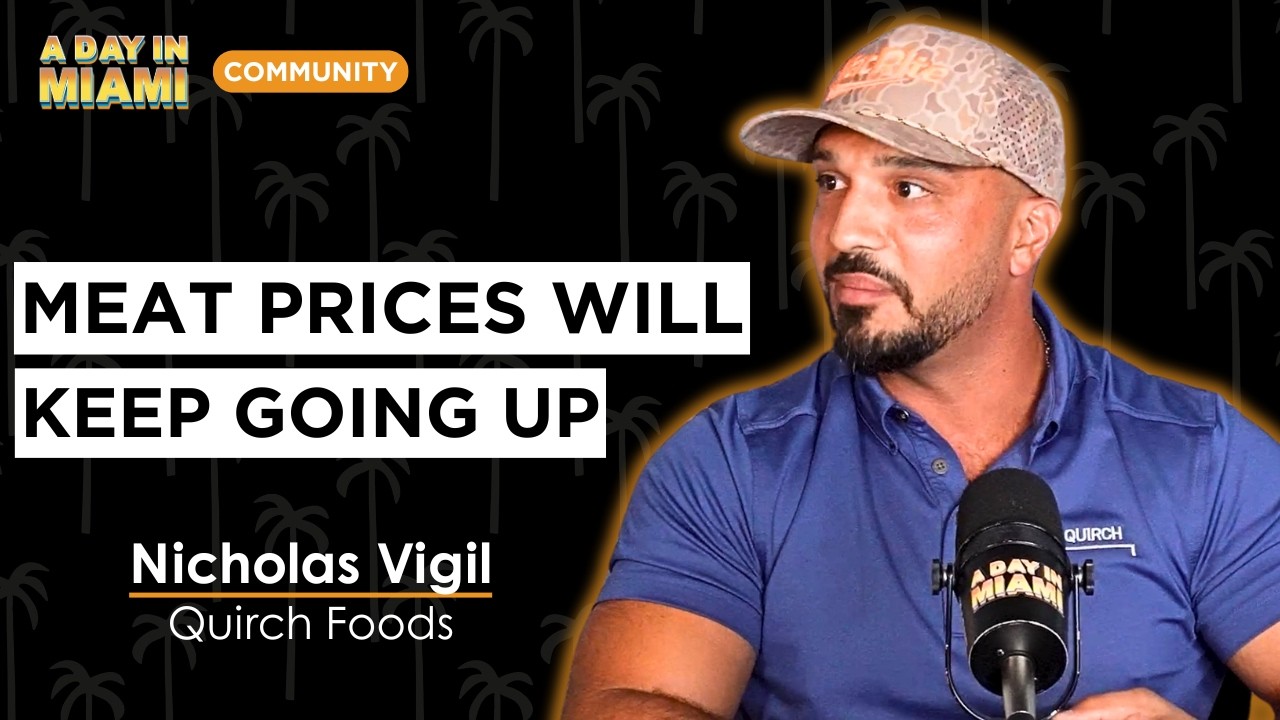
Everything You Never Knew About the Meat Industry | Nicholas Vigil
Nicholas Vigil of Quirch Foods joins us to break down everything that goes into getting meat from the source to your plate. He walks us through the meat grading...
About This Episode
We also get into Wagyu, never-frozen meat, which countries produce the best beef, chicken processing standards, and how the shift toward healthier eating has changed the entire meat industry. Plus a look into his second business, Vacrite and Vac It Up, which handles grease trap cleaning and hydro excavation for restaurants across Miami.
This is the meat supply chain explained by someone who lives it every day.
A Day in Miami Website:
https://adayinmiami.com/
Manny Alfonso:
Instagram: https://www.instagram.com/mannyalfonso8/
Kiko Suarez:
Instagram: https://www.instagram.com/querikoconkiko/
Eduardo Moya:
Instagram: https://www.instagram.com/mr_moya/
Follow Us! - A Day in Miami:
Instagram: https://www.instagram.com/adayinmiami/
Listen on Spotify:
https://open.spotify.com/show/20WEys6jxiliBCLoo9iSID
________________________
Produced by: Ben Schwede
Instagram: https://www.instagram.com/benthecreatorrr/
0:00 Intro
0:41 Vacrite Headquarters
1:25 Quirch Foods
2:55 Food Prices
5:48 Nicaraguan Tomahawks
6:38 Quirch Foods’ Focus on Distribution
7:27 The Process of Producing Meat
12:14 Why Quirch Foods Doesn’t Get Into Retail
12:57 What Meats Do They Sell
13:51 Meat Grading System
19:54 Wagyu
22:05 How People Eating Healthy Impacted the Meat Business
25:58 Deli Meats
26:49 Eduardo’s Healthy Habits
28:54 Never Frozen Meat
30:08 Which Country Has the Best Beef?
31:36 Chicken Processing
32:39 What Type of Chicken is Best
34:11 Presidente Supermarket
36:53 Do They Work with Walmart?
37:26 Publix Prices
38:41 Prices of Meat Will Keep Going Up
40:22 What Are Grease Traps
42:20 Why Grease Traps Are Such a Hassle
43:12 Vac It Up and Hydro Excavation
46:11 Origins of Vac It Up and Vacrite
47:25 Training and Certifications to Operate Vac It Up
49:14 How Often Do Restaurants Clean Their Grease Traps
50:10 Future of Vacrite
52:40 Top 3 Restaurants
56:44 Outro
About Our Guest
Nicholas Vigil
Nicholas Vigil of Quirch Foods joins us to break down everything that goes into getting meat from the source to your plate.
The question is, Ed,
where are we?
Beautiful.
Look how beautiful.
Kirst Foods.
Give away the location, bro. You're giving away the location. We're not at Kier. We're at Vacride.
We're at Vack Right.
But look at this. Tell me you don't like this mural. This is We're in the office, guys. Today, we're on the road. We are with uh Nick Vigil. This is a beautiful office. We'll introduce you now. What do you think? You like it?
I do like it a lot, actually.
I like how it's designed. Well, you know, some of us were working here, you know, production and stuff, but I've had a moment to, you know,
to captivate it and see it.
It's really nice, actually. Who drew this?
It's really nice. To be honest with you, I have no idea who drew it,
but it was somebody.
There's no signature, so I can't, you know, give anybody credit for this right now.
Nick, tell everybody where we're at, brother.
All right, so right now we're at the Vakrite headquarters. Vacite and Vitadub, they're sister companies. Vacitub is hydro excavation and then Vakarite is pump trucks. You know, they do anything that requires dewatering, you know, whether it's a septic tank or grease traps or a manhole for, you know, infrastructure to be done underneath. That's what Vakrite does.
I like the name, too. Back it up. Back right.
Back it up. Back it up.
And the trucks you see them working.
Tell everybody what's your name.
My name is Nicholas Vigil.
And your title here?
So, my title here is owner slashpartner, whatever you want to say, because I have multiple partners on these businesses. And then I also am a sales representative at Kier Foods. He's definitely the owner because I said I got a nice hat. You got one, too?
Yeah. Yeah, I got a nice hat, too.
Are you excited? This is nice as well.
I'm very excited. But I wanted to talk a little bit about um Kier Foods. Like, tell me a little about the history, I guess, how you started there because you've been there for a long time. I was researching you on
a little online. Yeah. And you had some good good information about you, bro.
Yeah.
Yeah. So, Kier, I've been there for 13 years now. Um, so Kier is a food distribution company. It's really simple. It's the UPS for me. You know, boxes come in, boxes go out. I've been a salesperson there for about 11 years. I started off as a as a merchandiser, which is basically like whenever somebody orders something to a store, you know, I put it in for them. And then two years after I started at Kier, I became a salesperson. And I've been very fortunate to be there, I've sold hundreds of million dollar, hundreds of millions of dollars in my career. You know, last year I broke a record for myself personally and I sold $88 million.
Damn, Nick. Yeah, you guys are always worried about meat prices going up. This is where they're going, bro.
Look, it's breaking records every year selling meat, bro. Prices keep going up. Of course.
A little background, Kier has been a big sponsor of our pig roast. Uh they have a whole beautiful pig uh department that my buddy John has runs to. So, I know he's one of your guys. So, I've known Kier now the word is out because Kier is tell us it's kind of like behind everything, right, brother?
Yeah. So, I mean, just a little bit of background about Kier, they do about five billion dollars a year nationwide. We also export to the Bahamas a whole lot. South America, you know, we've actually done a little bit of exporting for the first time this year to Europe.
We do a lot of cruise line business as well. Um, and it's funny you say about meat prices because a lot of people don't know this, but in the meat industry, it's kind of traded like the stock market.
Yeah.
And what that means is basically like when when meat prices are traded, you know, the prices are constantly fluctuating based off of supply and demand, right? And that's why like when people talk about like prices prices like when we buy something a lot of times like we'll buy it for like $4 and you would think like oh they make a 10% markup on it. No it's really small. It's funny you said that because you know me and you we have a friend in common Ricky Meats here locally
and he's always told me he go to meat games bro it's it's pennies. It's pennies that you're making. You know, a lot of people think that, oh yeah, they're selling this at the restaurant, but but what you guys are paying for is just up there in price and so much that we had the other day uh me and Ed, we had uh Raheem Cely from Drinking Pig.
And one of the topics we talked about that some of these spots are are eliminating brisket off the menu.
Yeah.
Either going with Peaks or Lesser or something because beef is so expensive. People are always sending us, oh, we love that restaurant, but who's going to pay $600, $700?
Yeah.
What is going on with the meat? And so much so that Trump is now importing.
Yeah. So, so
I wouldn't say we we've always been big import like Kier sells domestic, Australia, Nicaragua, Costa Rica, Brazil. We sell meat from all over the world. You know, we also bring in a lot of the majority of the pork bellies that we sell Miami wise is all imported. It's Polish. It's Brazilian. Like nobody ever wants the American brands cuz like the meat to fat ratio on those to like to make chicharon is not good. People the chich the chicharon that people want they want the one that has carne you know a little bit
you know but the domestic brands they don't do a good job at doing that. They're thicker.
Yeah. They're so it's a lot more fat than it is meat. And the reason that is is because the majority of the American brands here in the US they chop it up to make bacon. They rather further process it into bacon and sell it in the stores like that. They make more money you know. So Trump importing meat,
they got a lot of heat from our local
farmers. Yeah. But the thing is, you need to bring prices down. So how do you do it? You got to provide more supply. Supply and demand.
And and that's that's another problem is that, you know, four four years ago, they were harvesting like 630,000 animals a week. Nowadays, they're like at 530. You know, the fact that prices aren't even higher to me is actually
should be higher then, huh?
Yeah. It's actually kind of shocking. Like for example, this time of year is typically the cheapest time of the year for two cuts, which is ribe eyes and fililelets.
Why is that, bro? That is incredible knowledge.
Yeah. And the reason that is is because right now it's what is it? It's back to school, right? Like right now we're having this podcast and it's back to school. So naturally, people aren't going out as much and eating out as much. So they're eating more at home. So naturally, the restaurants are not selling as much fillets and ribe eyes and whatnot.
Takes a dip. That That's interesting. I've been seeing a lot of Nicaraguan meat coming in with those tomahawks that everybody's selling now.
Those are Have you tried those?
They're pretty good. They're good. I always say that they're my They're old school prime, but but they're pretty good. It's from Nicaragua.
Like I'm not a big fan of the tomah. There's so much fat in it, you know? Like the way you break it apart and it's expensive.
But like a good weekend barbecue, you know? You have some friends over. I mean, I break down a tomahawk like if it was a ribeye anyway. You know what I'm saying?
Me, too. I do the same thing. I think every time I put in the barbecue, the fire just eats it up, bro. And it burns.
He's still He's still a novice, but That's okay. That's okay. We We'll get there.
You put so much work into it and then you have like two or three little good slices, you know?
Yeah.
One that you guys move so much product at Kirst. I'm I'm familiar with you guys as well. I've never met you, but I've met your your your partners. I've been to the warehouse, which is like
10 Walmarts, right? And and it's 50° in there. So, the electric bill was
hamble. Yeah. Uh yeah.
But but I'm I'm I just want to clear something up. You guys do not uh produce or farm animals, right? You guys are just distributors.
We're just distributors. Yeah. So, we buy from the far from the plants because the plants aren't even the farmers. Like, so there's farmers that raise the cattle and then the plants buy the cattle from the farmers and then they further process the meat into like everything that I just showed you guys into the cryovax and then we buy those boxes from the plants and then we redistribute them to mostly I think 95% of Kirst's business is retail supermarkets. Oh, so the restaurants is like a secondary thing.
The restaurants is very it's like 2% of the $5 billion that we do. I think it's it might be a little bit more now
and then I mean again very interesting and I think this is something that you know people would like to know. How long do you even know is that process between like the animal or the cow getting slaughtered or being shipped to the processing facility for it to be in like the supermarket? Like do you have like a time frame of how that works or
It's actually really pretty fast.
Try to give me like the most detail possible of the supply chain. I'm going to show you the supply chain. Okay. So, I'm going to give you the details of the animal arriving to the plant and from the harvest to the to the box to our warehouse to the supermarket. I'm going to give you that.
And if you can include like more or less, do you have pricing? Like do you know like what things go for or no? Like I can more or less like listen this usually a farmer will sell something for this like that stuff.
So the so the animals are sold for like you know I think it's like $2. I I can't don't quote me on this. It's like $2 a pound for the entire animal. Got
right. So when they buy it from the animal and it's all it's all done on auction. So they buy them at auctions. Right.
So they buy it at auction. Right. Then they receive it at the plant. Right. After they get to the plant, they start the the harvest. You know, we don't want to say slaughter, we say harvest.
So, when they start the harvest, you know, they, you know, they knock the animal, they knock the animal unconscious. They, you know, they drain it, right? Then they the first thing that they do is they take off the hide and those hides are that's big money, you know, and nothing of leather. That's leather.
Yeah. Nothing of the animal gets wasted. Wow.
Nothing. Everything is used.
Everything is sellable.
Everything is used. Yes. Forget about loving the animal. Everything is selfish.
No, but that's good too cuz you know you're not killing it for you're not harvesting for no reason.
So they take off the hide, right? And then they they gut the animal. They take out all the intestines, the hearts, the kidneys, the lungs. They take out everything. I think actually, you know, I think the lungs. I'm not sure if that's I I think that's the only part of the animal.
Yeah, I think that's the only part of the animal they don't use, but I'm sure they use it for something. After they do that, after they skin the animal, they have to like they have to let it hang for like a day or two, right?
Yeah. After for a day or two, it goes to the to the processing floor where it's basically it's hung on its foot all the way down and you have each particular there's one person down the line for each particular muscle of the animal.
Wow.
Yes. So everything is done like that person is cutting the brisket out every single time and then this person is cutting the the the knuckle out every single time and so on and so forth until the animal is completely processed. Right? in that process after they what they do is they grab the meat and they throw it on a conveyor belt, right? And on this conveyor belt and I've seen this whole process from start to saying you've been you've been
I've seen this I've seen this multiple times.
Incredible.
Yeah. Yeah. It was actually Oh, man. That's another story, but we'll talk about that after I'm done.
So then it gets on the conveyor belt and it goes into the cryovac right
in those. And this is something else a lot of people don't know. Like how how long do you think a piece of meat lasts in a cryovac like that if you had to guess?
Six hours.
No, no, no. Like I'm talking about like from when the the cryovac leaves. No, no, no. Fresh, not frozen. If it in the cryovac from the harvesting floor to like your refrigerator,
it takes about let's say 4 days to get there from the harvest.
It'll last you, just so you know, from that process in your refrigerator for 56 days fresh.
Wow.
Equal. You might even be able to push it if you really wanted to because and that's why I mean when you age meat, what do you think that is? They're aging the meat and then you know obviously you have to cut out the bad parts but in a cryovac it'll last you almost two months just like that
keeps the freshness
right. So then it gets into that cryovac it goes into a box from that box to our warehouse it probably takes like four days. So from re arriving at the plant processing down into the cryovax into the boxes to our warehouse maybe four to seven days. The cryovax you mean is those little the the papers that are just like the sorry the the packaging that's no air inside of it.
Correct.
That's the air. Okay. That's what you call cryovac
cryovac which what you just showed us earlier those packs. So they put them in that packs at the ware and they send it to you guys
and they send it to us and then so from there to our warehouse to a supermarket you're talking about eight days because a lot of times I mean listen so our warehouse is 150,000 square feet. So just imagine that warehouse gets emptied three times a month.
Wow. I mean, you're talking about millions of pounds of food being it's it's incredible.
You guys have 20 forklers running at the same time.
It's it's like honestly like that's one of the things that has made Cur so successful over the years is, you know, customer service, you know, efficiency, you know. I mean,
I always have a great experience cuz sometimes I pick up hogs over there on my own and and I grab and it's in and out and have that little office.
You guys allow people to go to the to the facility.
Special VIP. You see Kikos VIP? No, I thought you had maybe like a little storefront or something like that. You guys have never wanted to get into retail yourself.
You know, I It's funny. I've actually spoken to this about them multiple times. The reason we haven't gotten into that is because it's a little bit of a conflict of interest. You know, we're going to be competing against our own customer,
you know, and like
our customers at the end of the day, if you talk to anybody that owns a supermarket, they know exactly who Kier Foods is and they love us. Like, and like as great as a salesperson as I am, I'm not the only one. There's a bunch of great sales people at that company that have been working there for many, many years, you know, and then the John Hazards of the world. He's not a salesperson. He's a buyer. But I mean, if you know John, he's one of the greatest people that you'll ever meet.
Yes, he is. He's helped us out with pig rolls many years and and will continue to. What's the biggest cut of meat that you guys sell at Kier? Like maybe top two,
something that out the door, you can't hold it in stock
or like just honestly I want to know everything that you sell. Like what do you sell? Like do you have like 30 pieces or just meat or chicken or
So typically a beef. So a beef. So we sell beef, pork, chicken, seafood, uh thank you bags like say when let's say a restaurant wants to give you a to- go bag and it's we sell the thank you bags. We sell the plastic containers that they put the food in. I mean we sell everything. Eggs,
we sell hot hot dogs. No, we don't do we do frozen
frozen.
We do frozen produce. We don't do any dry goods.
Gotcha.
That's the easy like we don't do any beans, no rice, nothing like that. But we sell everything like we sell from a filt that's a util a utility fillet is like a is like a cow and then a certified Angus prime fillet is like the highest quality. So we sell everything from the worst to the best and everything in between.
All right. Can you explain it to me because again I know that this guy knows all those details and stuff like that but what is considered like the worst which is what I guess you know regular whatever
utility
and then what is the best and can you kind of like explain each one? What's the difference between them? Because I can't I don't understand the difference between them. Utility is worse than select.
Yes. Yeah. Ut utility. Okay.
Go break it down for a break.
Yeah. Break it down. Go. Go by one by one. Go.
So utility is cow. All right. When you think of cow, you think of milk. So basically eventually, you know, when those animals get to a certain age and they don't produce milk,
they got to they got to go.
Older animal.
An older animal. And typically it's typically a dairy cow.
Gotcha.
Right. So they process that animal. And then that's And the reason that it's not as high quality is because the older the animal is, the less marbling. Marbling is like the the the fat in between the muscles. You're going to see me and
like me as older.
No, but
not as much muscle
deteriorating.
And then
nice marbling though.
So there so that's considered utility. And then as far as a graded program, the animal has to be a certain age. I'm pretty sure they have to be between like 28 and 32 months of age in order to hit a grading category. And then there's so there's I'm going to start with the lowest grading which is called a no roll. The reason it's called no roll is because back in the day whenever they were grading a cattle they used to have a roller and they would roll it on the cattle to give them their choice grade or a prime grade. So if it was an ungraded animal they don't get a roll. So that's considered noc bottom of the barrel.
That's the bottom of the barrel. Then there's select. Select is
terrible.
No, it's not that bad.
Terrible. I throw it out. I can't even shoot it. It depends what you buy. Like for example,
I was buying from Kier.
It depends what you buy. Like if you buy an Angus Select, depending on if you buy an Angus Select, if it's a an Angus Select, Have you ever had an Angus Select fillet?
Have you ever eaten an Angus Select?
I have.
Have you Have you seen it? Have you had a utility filt?
No, I can't. I can't even.
It's actually It's actually good. It's really good.
Isn't that kind of me?
No. Carneaba is like kanya. They braze it kind of like gummy that you kind of braze. You don't even want to
Yeah. No, no, no. So like so like carne bomb bababa is like a kanya.
We should do a go ahead finish your thing. We should do a great tasting.
That's what I was thinking right now. It would be cool to do a great taste.
I'll do it for you guys. I'll give
get all of them and just like I would I for me listen I eat anything. I'm not like a really picky eater so it's hard for me to train. I'm trying to understand you know like like you tell me select Angus that sounds good you know like that's probably a little bit of marketing too but all right so go back to it
after after select after select there's choice. Now choice is a little confusing
but why is it select? What's the difference between select and choice? Like why is that?
So select is is less marbling than choice.
Gotcha. So it's really comes down to the marbling.
It comes down to the marbling and the way that they the way that they know the grade is they cut the animal between the ribs and they have like a camera that takes a picture of the ribeye and it'll tell you what grade it comes out to be. Yeah. Back in the day it used to be a guy looking at it. Oh, this is choice. this is, you know, but if they even they get paid in Japan
and and then that depends on what the way that they eat or the grain that they eat or
it's the it's the grain that like for example the reason grass-fed is so like people the reason it's the healthier alternative as far as meat is because when an animal is grass-fed only, they just don't have that same fat content within their muscles to give it that flavor, you know? And so like when you get a grass-fed ribeye, if you ever look at it, you'll barely see any fat in that muscle. And it's very chewy. It's very And that's why it's the healthier alternative because at the end of the day when you eat that fat that those are like extra calories that your body's taking in that you don't that you're not there's nothing good out of it. Got
you know. So when you have a filt like fililet is one of the best pieces of meats that you can eat,
you know.
But cook it in butter cuz it doesn't have
All right. So So then select then prime.
No. So select then choice and then choice. So choice has five different levels.
Wow.
Yes. This is the this is where you can choose
and the most popular cut for restaurants and and not for restaurants for supermarkets.
Yes, he's right.
Nice choice.
That's usually what they have.
That's 90 90% of the time every even like the lowest end supermarket will pretty much only carry choice.
Gotcha.
So there's five levels of choice. There's bottom two/irds and then the No, I'm sorry. There's bottom uh there's there's upper two/3s and then there's the rest of the complex. Now, upper twothirds choice will be graded certified Angus beef most of the time. The only time that cert won't be graded certified Angus is if the animal carcass is over 1,500 lb.
If it's over a 1500 pound carcass, it it like because of the qualifications, the the classifications that are required for certified Angus, it won't fall into that category.
Off the scale, K.
Yeah, it's it's off the scale. But what a lot of packers will do is because they get extra money for the upper two/3 choice. So what they'll do is they'll repack it into like a high river Angus box or they'll repack it into like for example Cargill is one of the I think it's the biggest privately owned company in the world. They have a sterling silver program. Tyson, they have something called chairman's reserve which is what they put their upper twothirds if it doesn't grade certified Angus. So, in my opinion, the best piece of meat, the best bang for your buck that you can buy is certified Angus. And everything that I bought you guys today is certified. Let's go, bro. Certified. It's a It's a more detailed.
Yeah. It's like a less kosher grade like like like they're paying attention more.
Yeah. And then after choice, there's prime and then prime is the creme de la creme. And that basically comes down to there's more marbling in prime than there is in choice.
Yeah. But even though it's unhealthier, it's just more of the taste then.
Um, yeah. And I mean, when I say it's when I say it's unhealthier, it's just a little bit more fat, you know? It's
I think we need those fats now instead of seed oils. I think it's it's perfect.
Why? Cuz you let it cook, you don't cook, you don't put oil on that. You just let the fat cook itself or
No, I mean, you can do it in a little butter, add a little, you know, like binder to it. But no, I mean, yeah, if it's a nice ribeye and stuff like that, you don't need to. You create your own fat. Not to get into the whole A5 Wagu and Australian because you know
Yeah. So you know that's just like that's such a small like we do a little we do very little Wagu because because and the thing is Wagu is more restaurant driven than it is supermarket driven
you know like for example Milm's markets they're they carry Kobe and Wagu beef but like compare on their spectrum of cuts of beef that they carry it's like 1% of what they sell.
I love them. I like Mal they're very good. Listen, I think that whole waggle thing is just like another marketing thing. Like you order that stuff, you can't eat a lot of that thing. You eat like two or three slices and you get like it gets it gets like pugnant, you know, like fatty repugnant, you know?
Listen, the biggest gimmick in the world is a Wagu burger.
It's the biggest gimmick. And the reason it tastes so good is because it's a more fat than meat.
You're getting less meat.
You're getting less meat. And that's why it tastes so good because you're literally eating a sponge.
Yeah. Damn, man. You just crushed a lot of people there right now, bro. No, but it's true. It's
two wagoo burgers though.
You want a little bit, but you don't want a full like
I just don't understand. You know, I I get the marbling like on a on a prime or a choice, but like sometimes you see these waggu things and it's more fat than meat in it. So like
you're supposed to really eat like 4 ounces only a small even piece maybe less, bro. And it's like ridiculously expensive, you know? I just think it's they got the marketing. It sounds fancy and you know. They've done a great job like promoting it, you know, and oh, it comes from Asia, from Japan, from Australia. So then you're like country. It's like exotic now, you know. So you're like, "Ah, let me get that piece." But I've eaten it before, man. And I don't think it's worth it.
Yeah. And it's for it's for the pintyang, you know, like when you're ordering a $200 piece of meat on the menu. You look like the big baller, you know, like I want the I want the Kobe A5, you know, like, you know.
No, no, no. I I got I slipped up with that the other day, too, at a restaurant and I was like, "Here I go again, bro." He went to 18 uh to 1986,
bro. Oh, you know, it's funny actually.
And he started ordering all the good cuts, which is a great restaurant, but he's like, "Yo, bro, like it was expensive."
I actually ate there for the first time like a week ago.
It's good. It's good. My buddy Stefano owns it.
Really? Oh, dude. I
too. They already too. They're It's a really really good restaurant.
Yeah.
Um have you seen like people are now like the other day we had some uh we had some alcohol companies pitch to us, right? How people are not drinking as less. There's more like a health trend now even with like kids my my son's age or 16, 17 who are really taking it uh a step forward and trying to eat healthy and wellness.
Yeah.
Is the food business changed for you? Do you people see buying more protein and not really listening to like meat is bad for you kind of?
That's good. Like I would assume that's a good question. I would assume like bacon sales have to be down and stuff like that. No.
Um you know so further processed food sales which is anything that's like a sausage or a bacon or a hot dog, those sales have definitely come down fast. But
this guy RFK came out when he flipped the pyramid and he said it's like a level three carcinogen. It's really it's it's rough.
Listen, but we've always heard since we were young that hot dogs were not good for you.
I don't No, no, but I don't know. I don't know. Listen, I care now. I'm getting I'm 40 years old, bro. Like, so
explain to us. I mean, maybe this doesn't not, you know, something goes against like maybe your business model, but but like Are these things like actually healthy to eat? You know, like is there any nutritional value into like these hot dogs and these sausages?
Cancer, I think is what it was.
Are you Are you selling cancer, Nick?
And and for someone like me that I felt guilty the other day eating a sausage. I was like, "Damn, bro. I ate a sausage."
Listen, give me like the feedback behind the This is coming from somebody that eats very healthy on a regular basis. I mean, I really watch what I eat pretty regularly.
No, I can tell, bro. Yeah, he's not jacked up. eats working.
So, listen. Do I eat sausage like once every couple weeks or 3 weeks?
Absolutely.
You'll throw down a little sausage.
I'll throw down a little sausage. You I I'll eat a hot dog like once every six months.
And And when I say eat a hot dog, I'm going to eat seven. Like
I want to eat a hot dog right now.
I'm going to have seven hot dogs that day. You know,
is it unhealthy? Yes. If you overexaggerate it. If you're having hot dogs every single week, yeah, you're playing with fire. And it's the same thing with red meat. If you're eating red meat for breakfast, lunch and dinner, obviously if you're eating grass-fed organic red meat, you know, we're talking that's something else. But if you're eating like prime meat, you know, breakfast, lunch, and dinner, all those systems, you know, your body needs to rest, too. You need to implement some fish, you need to implement some chicken, you know, that's just I always tell people to do what they feel is best for them. Like for example, for me personally, whenever I eat sweet potato or broccoli or asparagus for lunch, that's what I eat every single day. I feel like a million dollars at the end of the day. I have to work for Kir. I'm also helping my partners on these businesses here, you know, like I can't have a burger at 12 in the afternoon. I'm going to be like, you know, you know,
I can
listen.
I can have two burgers. Jay,
listen. Listen. Um,
I had a question.
While he gathers his thoughts, I also have been on a health journey myself. So, I see myself now
really striving like not to eat the wrong thing, right? Because if you're putting the work in in the gym and waking up and and he has a lot to do with my motivation. He rags on me and stuff, but he's my boy. I've been watching him.
I I need this guy to last another 40 years, bro. Yeah, dude. I I do too. I love I love watching him on the on the on on social media.
But I uh but I I really wanted to, you know, be more health consscious. Like we went to Moroc's Pizza yesterday. All my boys were eating pizza and I went with a little churaco and salad, you know. It wasn't
Yo, bro. Let's go.
It wasn't a big sacrifice even though I wanted to slam down two pies. I I think everybody is kind of getting the trend now of eating healthy. Like somebody posted
the other day, uh is anything safe to eat now, you know, in the United States. And and yeah, we eat sausage, stuff like that, but what goes into a sausage? Not so much. Sausage maybe a little bit more, but like a like a hot dog. I love hot dogs. But that's like a nitrate stick, right? Like like they tell you it's bad. They tell you it's going to give you cancer. it, you still eat it. You know what I'm saying?
So, bro, but I don't understand how it's whatever. Listen, that's I guess politics. How about like I used to love sliced ham, sliced turkey. I used to love those things. And after RFK came out with that stuff, I haven't I haven't bought deli meats since last November when this guy came out and say that stuff. I stopped eating it.
Yeah. How I I would stay away from I would stay away from deli meats.
From deli meats. Yeah. Do you have you seen them being processed before? Do you know how I've never seen them processed? It's just
a lot of salts.
Yeah, man. And and and it's just like
I rather live a longer life.
Yeah, bro. Because if all this is longevity, right? You don't eat this, don't eat this, and you're 110 miserable.
And I checked out at 76, bro, with a picture of two tomahawks happy as a So, it's like, what do you want, bro? You know what I'm saying?
I'm not saying I'll be health conscious. No, I'm not saying I'll be health conscious
because look, he said it right now. Oh, I haven't even deli meat or like that. In the last month or five weeks, I see this guy every day, at least six times a day. Yeah.
He's shredded. He's got a more muscular build. You know, he's got more veinage. Yeah.
Like it's changed for him. So, whatever he did, bro.
Whatever he eliminated worked.
Yeah. Like, so what are you doing that? Like, what what what changes have you made in your life to like
So, number one, strength training steroids. Strength training. No steroids. Uh strength training uh has really changed uh and it's more for like the mental aspect of it. And honestly, man, I just stay away from greasy foods. any fried foods, any bread, uh large amounts of carbs. I ate a lot of veggies. Uh shout out to Mei's Kitchen. I have a meal plan with her. Like I've been eating that a lot too. And it's I've I've been
Gable's Cafe too, bro. My boy at Gable's Cafe. Steve, dog, like the protein. I've been doing all these little like juice shots. Yeah.
And what I've learned to do is portion sizes,
brother. I was a person who I would like eat a large amount of food. Now it's just I'm okay with a little bit of bite. Like we went to yesterday which we went and I'm a fast eater. So I went yesterday to story new restaurant which they want you to go check it out.
Uh they just there was a guy who he um Andre he opened now he's over there at phenomenal place. Yeah. Phenomenal place man. Like I went with my boys my boy introduced me to him. He said can you want to you want to come to dinner? Bro they have some nice cuts of meat. They have some nice pasta. They have some nice crocettas. It's all like um coastal Italian food, right? Some muscles and stuff and I just didn't overdo it, you know? I just ate a little bit, ate a little bit, ate a little bit, and I just measured.
That's my game right now, bro. I'm starving right now, man.
No, like you got to you can't overdo it.
Morning. I had a little bit. And it's true. Portion control.
So, like at my house, I have a scale and I weigh all my food.
Oh, wow. I never I haven't gotten to that point.
Yeah. No, you honestly it'll change it'll change your life. And it's like I work here. So, I pick I pick up all my food. It makes sense. It makes sense. And I weigh all my food. Like for example, all those fillets and stuff that I have there, they're all weighed out.
8 oz fililelets, 16 oz ribe eyes, 16.
Yeah. But nobody eats that Highland grade for lunch like you, dog.
Hey, I have another question that I'm always confused about.
That's amazing.
I think it's like a marketing thing. What's the difference between like fresh, never frozen? Is it really never frozen? Like cuz how are you going to tell me you're bringing something from Nicaragua that's not frozen?
Well, because think about it, it doesn't take that long to get here. You know, it takes seven days to get here on and they bring them they bring it in on a
refrigerator. Refrigerator. Yeah. It comes in a in a refrigerated uh boat. Yeah, because we bring a lot of meat from Nicaragua. I mean, you know, think about it. Like, so
I just didn't think that was possible.
Look, bro, these these Nicaraguan cows came on the seaw wall like maybe less than 5 years ago.
No, they've been doing it for No,
they got popular just recently.
They got popular because prices are out of control.
Like to be honest, when I got that Nicaragua tomahawk, I'm like, "Bro, what is this What are they going to know about beef?" Then I tried it. It wasn't, you know, whatever. But it was like, I could do this again. I could do this again.
You know what I'm saying?
No. And definitely so like so like for example a nigarawa filt will cost us like $9 to to buy. So that means that we have to sell it for like $950 or 925. You know we have to make our markup on it course.
And then an American prime ka will cost us like 450.
So you're saying to myself, so wait, I can get a nicarawa fillet for double the price versus a prime kiada. That fillet from Nicaragua is going to eat way better than that prime kiada. And it's just because of the different cut of animal that it is. You know,
do is there any country that you guys work with or purchase from that you're like they have the best meat?
I see a lot of stuff coming from Brazil.
US for sure by far. Like not even close because the way that they the way that they do it is, you know, they have very strict guidelines, you know, like they don't mess around like, you know, and they have that that and it's a USDA inspector that's in that plant
and they're so tough,
you know, and they're tough on it. They're
they have those automatic washing systems now that clean the floor.
I would never have I thought you would have told me something else. Incredible. US does it the right way and I mean and honestly you see it around the world if you go to Colombia they advertise certified Angus even in Japan bro
they advertise certified Angus certified Angus is huge across the world
I'm a bigger fan than than what he said certified Angus prime that I am of a wagu somewhere else
so one of the one of the only supermarkets that you can get certified Angus prime at is mys is one of the only supermarket I think I think they're the only one I can't
I live right down there I live I live in Pomeo Bay right by Pineers I love
Mil they really do a nice job the way they produce and the way they they they present their foods.
Yeah. And then also the everything that they sell there is the best of the best quality. So they have, you know, certified Angus prime, then they have certified Angus beef, which is all the beef that they sell there. They don't do their ground beef is certified Angus, too. They don't do anything that's not certified Angus. And then when it comes to their chicken, the majority of the chicken that they sell is organic.
Is that the number one sell? I mean, chicken is right. Isn't that the most popular protein? Probably.
Yeah, by far. Yeah. Can you think and I I this is mindboggling to me you know anywhere at any point on earth in any country in any spot in any supermarket in any restaurant you can order chicken
yes
like how many chickens are being
processed
a day like like how many chickens are being processed a day
question is dirty business cuz they get sick and bro it's millions
I think like every day you can eat chicken anywhere on earth
yeah it's millions Is that the number one protein?
Oh, by far. So, just so you have an idea, I sold $88 million last year. My average price per pound was $2. So, that means that I sold 40 million pounds of food last year.
Wow.
Majority of chicken or you break down?
Majority of the majority of Nick, what you charge me for?
For what? What?
Contacts for all these restaurants.
I'll get I'll listen to be honest with you. That's a lot of food.
I'll give it to you for free.
That's a lot of food, bro.
You eat chicken like crazy, dog. That's you. You're chicken. But what type of like is there is there like a a level of of styles of chicken as well too? Like choice, prime, anything like that or not really.
So there's no the only thing that you want to look for when you buy chicken is air chilled organic. That's it. That's what you want. And a scam, right?
Exactly. Explain to me the cage free range.
Cage free and cage free is not a scam, but it might not be organic.
I heard cage free is that they have a door. That's it.
Yeah. I see online.
Come in and out. Correct. That's the only thing that makes
No, that's free range.
No, no, but he's he's right.
Out in the open field.
Yeah, free range.
Cage free is you have the option of leaving the cage. Correct. Got you.
Which is free range. They're moved into a field. They eat all the trees, all the little all the little things, and then they move to another place.
So, no, no, so so they don't even move them. So, what they do is they have
they thing. Yeah, I've seen the videos. They move like the whole thing.
Yeah. It's like a cage, you know? They got to keep moving. For me, I would do it. You know, like Shire pork that we talked about, they have their animals, you know, free and and wild and then until it's time to harvest, they they don't see the animals, they just go and
that's the way it should be. You know what I'm saying?
The the only chicken you should ever want to buy is Bell & Evans. They're by far, in my opinion, the best brand of chicken. And
Bell &
Bell and Evans, but they are more expensive.
Bell and they are more expensive. A significantly more expensive.
I don't see I don't see Maria and Sweetwater buying. So Sanos sells Bell & Evans. Sedanos sells Bell Evans.
You know, shout out to Sedanos cuz they do always have a good solid butchery, bro.
Yes. Always.
It's all fresh. It moves a lot. So nothing sits. They always always And people always, oh go every time I go into and they have a nice little food court there. But the butchery, bro, tell us about that.
Latin
businesses that we grew up with, precedentes, all these stuff. Those guys you work with.
So I was lucky enough I sold precedente for four years. I no longer sell them, but shout out to my friends at Presidente. They were great people for a long time, you know. Um, so preceded, it's funny, they I always thought preceded cheap cheap cheap a little bit.
Me too. Yeah, me too. I thought it was like fugazi and stuff. Yeah,
that's what people think cuz it's a, you know, a little bit lesser quality products that they have
that and the shopping experience like everyone thinks Publix is the best because of the shopping experience in a clean, nice, neat, bright, you know,
our roots are in Sos when I sold Presidente they only bought pretty much I would say 75% of the meat that they bought for me was certified Angus. And the funny thing was is that as long as I sold them, they never advertised it. They always just put choice on the label. Now when you sell certified Angus, you're allowed to put a certified angles label on it. They never did that.
They were printing Palomas. Imagine how much Palo they saw. That's how we grew up. Whenever whenever when I did ads with them, like if it's like a regular week, I would sell them, you know, what 200,000 pounds of chicken drumsticks in a week.
In a week.
They don't need the advertising like crazy.
They really don't. And it's funny because the their best store is in Little Havana. It's Presidente number three, which is like their
on a street.
Yes.
The big one. It's like a corner of
across the taco spot.
It's it's across from uh Toro Loco Street. Yeah. Yeah.
So, there's a little lady that runs that meme market. That lady, don't mess with her, bro.
She has a little attitude when you're going to order.
Oh, yeah. But let me tell you, she plays that persona because, you know, she's got to keep a salesperson like myself. You got to keep me on my toes. But, she is a sweetheart. Let me tell you something. I'll never forget. I used to send them like 15,000 pounds of food on a Saturday. I forgot to put two boxes of ribs on her order. Wait. I went I was so scared of her that I went all the way to my warehouse. I picked up the two boxes and I drove it to her store.
She was going to call you out. She was like, "She needed that product, bro. She's moving product.
Don't mess with." So that store, they only buy certified Angus. They only buy Tyson pork. You know, they sell the
Tyson chicken. So Tyson So Tyson owns So Tyson owns IBP.
So IBP does pork and beef.
They're huge.
They're huge.
And and Tyson's always been a good chicken, bro.
Yeah. Right.
Yeah. Tyson does a really good job. I mean,
is Purdue the same thing or
Yeah, Purdue. Purdue is the same thing.
Yeah. Supposedly there's only like a handful, like five or six like major major.
I'm very picky when it comes to eating media, so that's why I'm here today. But but but I am and it's important. Um what's the number what's you work? Walmart and the bigger ones, bigger chains or
so I don't know if we still
Sam's Club stuff like that.
So I don't know if we still do business with Walmart, but we used to I know that for a fact. We used to
up a little bit too. I mean it's not the best, but they have solid selection as well.
We we used to do a lot of business with Publix as well. We used to do all their frozen fruits and whatnot. And it's funny because they actually got a recall on their fruits and I'm like oh thank god that wasn't us because we used to do it with them but we don't do it with them anymore. Um but we it's mostly independents. I mean we do do we do do some like like Kroger. I know we do a lot of business with Kroger around the country, you know, but it's mostly independent.
It's not here. I've heard that Publix is now more expensive than Whole Foods, bro.
Bro, listen to me. I used to I I I go to Publix only.
They they they put that out there
and the Churaco is like ridiculously like $27 or I don't know.
It's insane. I mean, the Churaco that So, the Churaco that I got you guys, I paid like $15.99 for it,
you know? So, I mean, they're if they're selling it for 27, I mean, that's you're talking about like a 50 60% markup. my last question.
But they're breaking records and sales and revenue, bro. And they're and they're opening them all over the the place and they're tearing down the existing ones and reopening them for two floors.
Listen, the best thing that ever happened to those people was co
cuz everybody just started controlling the market now. Everybody just went to shop there.
I know. The thing the thing about Publix is that Oh, yeah. That's a one-stop shop. You can get
I love him. I love Yeah. Yeah. I like I love when you go when you go check out that when you go check out and you buy.
Did you find everything okay today? That's the first thing that they ask you when you get there.
Yeah. my my bank account didn't but I have
and you have like eight pieces of content it's like $300. I'm like
I have a game with my kids on how expensive it's going to be. What's the bill going to be? And and and it's true. It's it's it's expensive. It's
ridiculous. Like and then you go to a place like Aldi, you know that it's amazing, you know, like you know, you just got it's it's not the best like you know just find what you're coming to get.
Yeah. You know, but
um do you see the meat market changing a little? Do you see prices coming down? Like where are we bro? Because a lot of people are concerned about that, bro. It's not
Prices are not coming down.
They're not coming down. You think they'll stay how they are? They're going to keep going up because actually people are going to stop eating meat if it gets too expensive.
They're they're going to stay going up
for the foreseeable future. I don't see I don't see why you say that
because the So, for example, Tyson IBB, they just closed a plant.
They just closed one. I mean, so when you It's all
Why are they closing plants instead of opening them?
Because believe it or not, with as way the way meat prices are, these packers are not making a lot of money.
That's what I'm saying. the the process of buying the animal, having those facilities kept, you know, the cleaning cleaning those facilities, it's not easy.
So, like maintaining them up to code and regulation
and then and then also, you know, like the the kind of employees that you need to have at these plants, I mean, listen, if you ever walk into one of those plants, it's not an easy job, bro. So, like to keep the employees there working on a regular basis,
that's dangerous, bro.
You know, and then at the same time, they can't just pay them like $40 an hour, you They have to they have a business to run at the end of the day, you know, so they're not paying they have to they have to find that middle ground and they just haven't been able to find it.
Yeah, bro. Sometimes I've gone to Ricky's meets, man, and these guys are cutting.
He puts the videos up and I'm like, I wouldn't be able when he's doing the beef ribs. I was like, girl, that's crazy.
It doesn't look awesome, bro.
It's amazing. But I see that and he just does it like just and there's some there missing fingers. You You have no idea how many meat managers I've dealt with over the years that are missing fingers.
Like I I can't even put them on two hands. I'll tell.
That's why I want to be a butcher. Boy, you're missing a finger. You're a badass.
Yeah. I know, bro.
Yeah. So, restaurants, like I said, um we've had a lot of guests uh that own restaurants, a lot of experts. The opening and closing of restaurants, it all comes back to the grease traps, bro. You do grease traps.
It's a dirty business. I've heard physically and contractally. contractually. Contractually, I explain to us that whole dynamic and world, bro.
Yeah. So, basically what a grease trap is, for those of you that don't know, it's it's a fog collection trap that's built into the ground or under the sink, depending. Most of them are built under the ground.
What fog is is fats, oils, and grease. And the reason that they have those, like any supermarket that you walk into, any restaurant you walk into, they all have like these drains in the floor for when they're done, when they're done for the day, they clean it real well and all that water falls into those drains and then all those drains lead to their grease trap. Now, the reason that they have those grease traps in place is because they don't want any of that getting into the water system for
the aquifers water supply of my Yeah.
You know, they don't want any of that stuff getting, you know, and then also that causes like major backups. Like I had one of my customers called me. They're like, "Oh, listen, Nick. I got this problem." I called my partner. My partner went over there, you know, and he had a major clog in his line. So, they had to clean out the grease trap. They had to put a huge hole. So, it's like a hose that shoots a a thing forward and then it has four like five little hoses shooting backwards. So, it travels through the line like that and it'll basically unclog it this way because obviously you don't want to shoot it forward. You want to shoot it backwards. So it shoots for it like drills and then as soon as it gets to the clock it goes around the clock and it pulls it back.
It's actually it's actually a really cool process. I'll show you a video of it.
Interesting.
So, you know, and that's a major problem for restaurants, you know, especially like, you know, the high-end restaurants like Carbone and all these people, you know, they they probably get their grease traps cleaned on a weekly basis cuz they're moving through so much food, you know, and they can't afford Yeah. They can't afford to be shut down for a day. A day. Not even a day. You're talking about hundreds of thousands of dollars that they're probably not going to make just from being closed that one day.
Why are they so expensive and so hard to get permits for? That's I mean, especially for smaller businesses.
You know,
you've gone you've done you've gone through that whole process before, right?
I've, you know, I I've never gone through that process because what we do is we just basically maintain those grease traps. But, you know, it's just, you know, it's just Miami date county being a pain, you know, like cuz that the grease traps are is not that difficult. That's what it always felt like.
It's not that difficult. So, like, have you ever seen a septic tank? It's the same thing at a restaurant or a supermarket. It's the exact same thing. It's literally a big cage in the ground and you have pipes from there to here to there to there and that's it. That's all it is. It's not that difficult. But the permitting process, I just think they're understaffed at the at the government. That's all they some of these traps aren't really up to date though, too, cuz they leak into the environment. I think that's where
that's true.
Comes in deeper. You know what I'm saying?
Fact, right?
Yes.
Does the grease traps. Yes.
Back it up. Does what?
The So they do f We do five uh hydro excavation. I'm sorry.
Explain that.
Hydro excavation.
So hydro excavation. How do I explain this? So for example, we had a job for FPL at a substation. A substation is basically one of those big plants where all the you see a bunch of
FL 40 years.
Yeah. So you so you know what uh Okay. So we at that substation they needed to rewire some new machinery that they had just planted. So obviously you can't have a huge excavator go in there and dig up the hole that you need. So they call one of these trucks right here. And what that truck is, that truck has a big hose at the front of it and they will dig the hole with the hose and then they put the vacuum in the hole and it'll pull out all the dirt and debris.
So the pressure is insane.
The pressure is insane. So that those trucks work on 3,000 CFMs. A pump truck, a regular pump truck will only work on like 800 CFMs. A pump truck is what does like the grease traps and stuff. And then the vectors, the vectors are 3,000 CFM. So it's like, you know, like for example, for storm drains and stuff like that, whenever somebody needs a storm drain cleaned, like we send a vector to go clean because think about it, a pump truck can't do it. A pump truck can't pick up dirt and debris properly. You can, but it's not like if I send a vector to go do it, you know, I can knock out 20 storm drains in 4 hours.
You get hired for that a lot?
A lot. Wow.
I mean, think about it. The thing about all the supermarkets that you know that they have like a storm drain in the middle of their
park in the front and the mess is crazy. Is it explosion? You guys like
no capture?
No. So no. So no no. So when when it come when it comes to the the storm drains, we don't even have to use the manga. It's just a bunch of dirt and stuff that's been accumulating there. So you just put the vacuum in there and little chupo and that's it.
And where do you guys go dump that? So there's places in Broward County and there's another place uh in Blackpoint. It's down south by uh by the marina by Blackpoint Marina. It's a water treatment facility and that at that treatment facility you go you dump your gray water which is g which is grease trap water and then also the debris from whatever you pick up like sometimes we pump manholes for like FPL and for mastc for them to do work underground. So we pump all that water out of those manholes and they go and they do whatever work that they have to do because think about Miami. Think about all the infrastructure that's underneath our feet all the time. You know, there's cities down there. Like, I've seen them go and they walk, bro. It's like a It's It's incredible.
For real. You've been on the ground like that before.
It's incred. I would love to do that.
I don't, bro. It's scary, bro. I don't know. I've always wanted to do that.
Another world that it's hot as balls.
It's hot as balls, bro. How about you walk out there?
You can like walk under 130°.
Yeah, dude. Unbearable.
It's impressive, man. Like, for example, in the beach, there's a whole city underneath.
Bickl.
Yeah,
have you uh And do you guys ever go on the ground or No,
no, we don't. I don't not anymore. I saw one time I I went down the ladder meet it right back up. That's it.
I would love to do that, bro. Tour
like a like a dirty Jobs thing, man. Like a dirty jobs.
It's It's a really dirty job.
I see I see when I pulled up here an insane amount of trucks.
Yeah. So, we operate
How many in your fleet and when did it start?
So, we operate.
It's it's it's a crazy story. So we operate on the vac it up side we operate I think 14 vectors and then on the vacite side we operate seven pump trucks. So I think it's 20 in total. I we might have one or two more but I I don't know I can't keep track of them anymore.
Um the way that I got into it was because when they decided to open up Vakrite you know naturally I've been in the food business now for a very long time you know so my buddy called me. He was like, "Hey, listen, Nick. You think you can get me in contact with all your restaurants and all your supermarkets?" And I'm like, "Yeah, of course." And this is a best friend of mine since I was like in second grade.
I'm like, "Yeah, sure." And then out of curiosity, asked him, "Oh, what are you doing?" He's like, "No, I'm going to open up a grease trap business." And I'm like,
"Is there a space for another partner?" You know, like, and naturally, you know, my friends know me really well, and you know, they know that I'm a hard worker, that I'm very knowledgeable. Like, you know, I have I've always had a, you know, I've been working my whole life. you know, everything everything I've done up to this point is to set set me up for like my next opportunity
and uh they didn't even hesitate. They're like, "Yeah, sure. We'll do it together." So, I'm partners with him on this business and luckily lucky for us it's gone really really well.
And do these guys that run and operate the trucks like you know are they obviously you train them there? Is it is it is it difficult to like run these trucks? Like do you really need to know what you're doing or just kind of just put a hose in and ch?
No. No. You really need to know what you're doing because, you know, especially those hoses, you know, those hoses to cut those holes are incredibly powerful. It'll kill you. You know, it so it cuts through rock. So, like if you were to put that over your foot, it'll cut off your foot.
Wow.
Yeah. It's it's
talk about a rash.
Yeah. It's really powerful. So, like you really need to not only do you need to know some you need to have somebody that knows what they're doing, you need to have someone that's careful because you can be you can know what you're doing and aloo. So,
you need certification to operate these vehicles. So, you do you need to be a CDL driver because naturally, you know, when this when those when those trucks fill up, you know, there's 40,000 pounds of water or like for example, our 5,000 gallon tankers, you know, when you fill it up with water or sewage or whatever's in there, they go from weighing, you know, 15,000 bottles to 45,000 lbs,
you know, and you you notice a difference while driving that.
Oh, absolutely.
It's you have to beid so careful. Yes. And that's another that's the thing. It's liquid. So momentto get you turned. You have to be careful because if when the liquid swishes it'll push the truck and
Wow, bro.
Well, no. That's what h that's what happened on the expressway not that long ago. That's that everything. It was a septic truck. No, it was a septic truck.
Oh, yeah. But it was full of fuel, bro. The one off of uh
off of the Palmetto. No, off of the story. Wasn't the story.
So, no, it was a septic truck that flipped over. Oh, yeah. The driver died. He stole him.
No way. And it was and it was on its way down the black point to go dump and it was
but there was one on the graty and it was a tanker truck. I think it was like almost 10 years ago. Yeah.
And that burned for like 18 straight hours. You couldn't even
Yeah. So I mean Yeah. The
It's very dangerous.
The the grease trap business. It's a dirty business. You just have to get your hands dirty and that's all it is.
How how often are you doing these uh grease trap cleanings?
So every customer is different. You know like for example supermarkets like busy supermarkets typically do them once a month. You know
the ones with the cafeteras and stuff like that are really
Yeah. Like, bro, every single Presidente probably does it once a month. Ray Chavez, he does it once a month. Like, for example, Motech is a a very popular restaurant out here. We service them. They do it once a month as well. All their mo all the all their restaurants.
Like Carbone, they do it every week.
That's how busy they are, you know? It's it's it's incredible. We had the we had the pleasure of touring all their restaurants like two weeks ago, and they showed us Mario, too.
I did not meet Mario. I didn't have that luxury. I met I met a gentleman by the name of Raphael. Okay. He's like their He's like their maintenance guy for all of them. He was really nice guy.
Invite me to Carbon.
It's funny. It's funny. I was talking to my partners like, "Hey, listen. If we get this business, you know, like we'll do it for free. We just get coupons, bro. Like we here every single day.
Whatever it takes." Uh, what's the future of VCR? Cuz I know Vakr's the new one. Back it up. It's kind of been around a little bit already.
Yeah. Yeah. So, Vakr, the future of Vakry is bright. I mean,
what year are we in?
We are in year one.
Year one.
We We're in year one.
Year one. So if I wear the hat all the time partner too now or
you're a part Lizzie you're a partner.
So you you and your partner see something that that you got a good thing going.
Yeah. It's gone is so far for us. I mean we we started this business I would say like nine months ago and it's gone a lot better than I even anticipated. You know you guys know being business owners yourselves. You know getting new contracts is always the hardest part.
The hardest part you know and like starting any business you know.
Are you guys looking for people employees? Are you growing or kind of have your
Yeah. So, we actually ordered another truck for our fleet, you know. So, right now we have 20 trucks. We're expecting another one to come in and you know, we're already looking at another one after that, you know.
And you signed up to our business network on a daymiami.com.
No. Yeah. But I'm going to do that.
You can definitely find some drivers there.
Yeah. So, that's what it's for.
I think I think one of our producers was uh licensed. You're getting your CDL finally or
Yeah.
He's been wanting to do that for a while. Yeah.
There you go, bro.
I got you a job, buddy. Whatever you need. Yeah, but you're probably better off with them, man. To be honest with you, they're doing really well.
He likes to work. He like He likes this, but he likes to work with his hands, bro. He likes to be He likes to be out there, bro.
Yeah. This is too foo for you.
Yeah. He's like be on the phone and stuff like that. No, you know, he's learned a lot, though.
Yeah. So, the the future's bright, man. I'm excited. And, you know, a lot of people, you know, at the end of the day, people want to do business with people they like, you know, and I've been doing this for so long. A lot of people that I've reached out to, that I've sold to in the past, it's like 90% of them have just jumped over. And listen, I one thing I've noticed in the grease trap world is that there's a lot of neglect. Like, you know, you send out an employee to go do the grease trap, you know, sometimes they don't do it as properly as they should. Oh, really?
So, when we get out there and we do the work and my employees, you know, and we're on top of our Yeah. We're on top of our employees. I always tell them like, listen, you're getting paid by the hour. Take advantage of me. I want you to get out there and I want you to do a good job. you know, usually for the first time, my partner will go out with them, you know, to make sure everything's done, you know, especially if it's like a new client that we have coming on board, you know, and also to get that first assessment, you know, after you get that first assessment done because sometimes they do it once every 3 months, you know, when we see that grease strap when we clean it three months ago. Yeah, maybe you should get it done more often.
I like what you said though where I pay you by the hour. So, just take whatever it takes, get it right because everything you screw that up one time,
they're looking they're looking or talking about you. It's simple.
Oh, you ready?
Yeah. Is he ready though? Did you didn't tell him anything? No.
No.
All right. Oh,
I'll go.
Nick Vigil, restaurant food guy and restaurant cleaner guy.
Oh my god. I already know.
Your top three restaurants that you like to go.
Starting with number three and why you like it or where you like to eat.
Man, this is this is so hard. All right. Number three.
I know you've seen this show. You got to be ready a little bit.
A little bit. But the thing is there's so many different restaurants in the world.
That's why it's a hard question.
It could be like your go-tos right now. Number three, so you don't offend anything. Number three and why you like number three. Hole in the Wall. No, it's not called Hole in the Wall. It's called Express Sub.
Express Sub. First time we hear that word.
Yeah. Sub.
Express Sub. All right. Do you remember where the Portuguese gym used to be on Miller and 100?
Yes.
Right next to that old gym. There's a little spot there that they only do like healthy food. And that's my go.
They have subs there.
So, it's funny. The store is called Express Sub, but I don't eat any subs there. The only thing that I eat
They do have subs. They do. But what they're known for
What do you eat there? Cuz I'm eating healthy now.
Okay. So, look, I always get eight ounces and they weigh their food there. They weigh your food. I do 8 ounces 8 ounces of ground bison and I either do like brown rice or sweet potato. That's what my go-to lunch will be there. Or for breakfast on Thursdays. Every Thursday, they make a brisket. So, me and my partner, we have our our meetings are every Thursday at like at 9:00 a.m. So, we go there for breakfast. No way.
We go there for breakfast.
Gatekeeping that whole time.
Damn, bro. That's in Kendall. That's in K Town, bro. That's my hood. It It's one. Wait. It's It's tiny. It's I think this space that we're in is bigger than
What are you saying? What? Express subs.
Express subs.
Shout out. I'm coming to you. Okay. Number two.
Number two, Nick. And why you like it? And what do you eat?
Motech.
Motech.
I like a lot. My daughter loves MCH, too. Motech. Motech is fire.
The flatbread with the with the procido.
And I've been told that they have a nice happy hour in the Gables one, though.
Oh, yeah. Motech. Mult is so good. It's funny cuz I actually just started eating there a couple months ago. And I'm so I'm because the thing is in in the Gables I work in the Bikardi building. The number one place I used to always go to was Hillstones.
Ever since I found Motech,
it's like I love Hillstones, don't get me wrong, but a multime multidotech.
All right. Number one for Nick Vigil's restaurant that you like to go and what you eat.
So number one, and it I know it's a chain.
Don't get mad. If you're number one, don't say McDonald's, bro.
It's not.
Do I look like a McDonald's guy? No, no, you don't.
Don't say flat against I said it. I don't care. Go ahead.
Sushi saki.
Sushi saki.
Sushi saki, brother. Sushi saki.
And the Listen, I eat there at least twice a week. And the reason I eat there twice a week is cuz the sushi sagi right there on Sunset and 97th is right next to my house.
Yeah, it's a good one.
And they're so consistent.
My buddy owns two of them. Kim Mas, he owns Cutler Bay Sushi and Homestead Sushi Center.
Oh, nice. Nice.
I mean, listen, I just feel like they're a little expensive. No, like you get what you pay for. At the end at the end of the day when you go
No, but I'm eating like fried rice and stuff like that. I I don't you know I haven't been there in a while.
Why is it so expensive for rice?
And ordering on Uber.
Violent, bro. Like violent orders on Uber, bro.
That's always going to
So So that's my number one. I mean
never had sushi. I like sushi. Yeah. Go all the time. The color is like
I go to the one in Gables.
Yeah. I go and because it's right next to my house and my son devours the chicken fried rice there, dude. Like
it's amazing. It's amazing.
If he had a bad day,
I have two two kids. Two boys. Two boys.
How old?
Three and like 6 months.
So they eat all six months.
Yeah. Yeah. Yeah. Yeah.
Damn.
They're going to be major beef eaters.
Oh, 100. My son already is. Funny story. My nephew and niece came over. They were and I was making dinner or whatnot and I was making some chicken and they looked at me. They're like, "Wait, we're not having steak?" And I'm like, and I looked at them like, "Are you kidding me, bro?" Like Moon is broke cuz every time they come to my house, they have prime fillets and rico. And they were like, "What is this?" Like that's great,
bro. That's great.
You know how to throw it down. You know how to cook good.
Listen, I don't know how to cook. I don't know how to cook like that, Bill. You can't mess up a steak. But you just have to get the temperature right. That's it. That's all it is. If you have a ther If you have a thermometer, you're never going to mess up a good piece of meat.
Yo, Nick, this is pretty dope. I learned a lot here.
You got a lot on your plate, though. You do a lot. I thought I was busy. I thought I was busy. But you you got two things going on, three things almost. So,
it's been awesome to have you in here. Thank you guys. And I got to give you a shout out. One more thing. The AC in this place cranks, though. I'm an AC guy. Amazing. Big vigil, guys. Thank you so much.
Never miss an episode
Subscribe to our podcast and get the latest episodes straight to your favorite platform.
Subscribe on SpotifyMore Episodes
View all 46:22
This Israeli Entrepreneur Saves Miami Developers Millions on Insurance
Nov 18, 2026
 1:07:52
The Attorney Saving Miami Businesses From Expensive Mistakes
Nov 17, 2026
 56:27
What Miami Could Learn From Denmark | Jesper Møller Sørensen
Nov 16, 2026
 1:04:23
How Bizzy Is Changing the Way Miami Students Save Money & Go Out | Evangelos Milionis
Nov 16, 2026