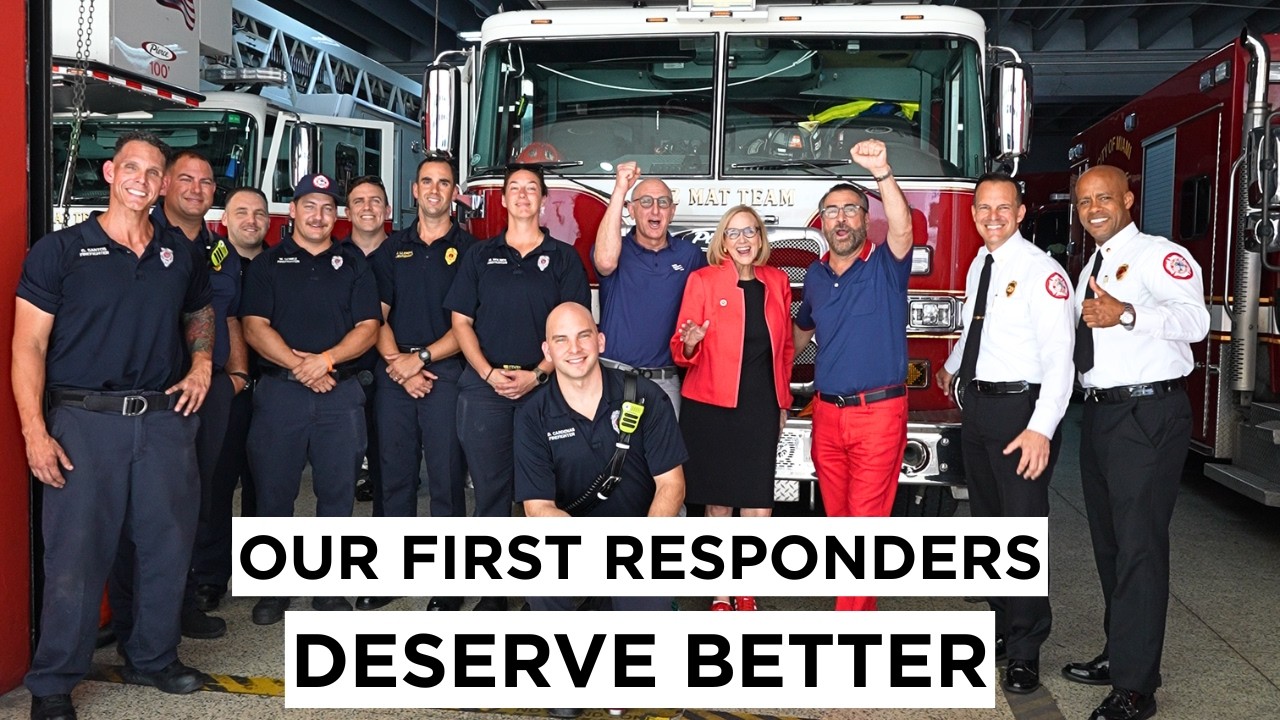
The Shocking State of Miami's Police and Fire Stations with Mayor Eileen Higgins
What does it actually look like inside Miami's police and fire stations? We went to find out — and what we saw was hard to believe. Mayor Eileen Higgins persona...
About This Episode
These are the men and women running into burning buildings and responding to emergencies around the clock — and this is where they're being asked to do it from. Mayor Higgins gives us the full context behind years of deferred maintenance and lays out her plan to finally address it.
Once you see this, you won't be able to unsee it.
Manny Alfonso:
Instagram: https://www.instagram.com/mannyalfonso8/
Kiko Suarez:
Instagram: https://www.instagram.com/querikoconkiko/
Eduardo Moya:
Instagram: https://www.instagram.com/mr_moya/
Follow Us! - A Day in Miami:
Instagram: https://www.instagram.com/adayinmiami/
Listen on Spotify:
https://open.spotify.com/show/20WEys6jxiliBCLoo9iSID
________________________
Produced by: Ben Schwede
Instagram: https://www.instagram.com/benthecreatorrr/
But we're going to start it off with the fact of from where we ended when we did our podcast on New Year's. And then we're here. Mayor, we're here to see all those concerns that you spoke about and now we're here we're going to take a look at it.
Yeah, well, we're here at Miami's Police Headquarters. It's uh 50 years old, right, Chief? More than 50 years old. And when this building was built, we only had 560 officers and we're closer to 1,400 now. So, obviously, we're still in the same facility that's a little squished. But more importantly, um the building's falling apart. There there's leaks, there's flooding, um from time to time there's raw sewage running through and
the word I love the word you used in What was it? Deplorable?
Deplorable, shambles?
Shambles?
Yeah. And listen, we're just we're in this cycle of constant emergency repairs, right, Chief?
Absolutely. And listen, not only is it the unsafe conditions of the building, but we we've already outgrown it, like the Mayor mentioned, but also we're at capacity. We can't even add one more computer cuz it will overload our electrical system. So, these are a real hazard situation to have the finest law enforcement officers in the nation working under those conditions. Not right.
What's it doing to your morale here?
So, listen, they the men and women of the Miami Police are dedicated. They want to serve the community. They come in each and every day, but they do feel it. They feel the impact of having to come to work and you're sitting there and when it rains, and you know how Miami rains, it might be short, but it's violent. When all those downpours come down, we'll have water intrusion through the entire department. So, we've we've tried. A lot of folks will say, "Hey, how come you guys never fixed it?" There's been a a an initiative or a strategy of deferred maintenance, so we only do what we have to. But in the last 5 years that I've been here, over $21 million and we can't keep up.
You could have built a new building.
We could have Well, it's a down payment on the
That that's a down payment. So, we're going to go ahead and take you guys now on a tour. So, we're going to check this out so you can see what's going on here right here on the podcast of A Day in Miami. This is beautiful. Chief, tell me a little bit about these uh all these awards.
history of the Miami Beautiful. Yes, absolutely. Absolutely. You know, these are great things that we like to show the people of the damn Miami because everybody doesn't understand that when you're, you know, what's at the police department? People think it's just a jail.
No, it isn't. As you can see, we have amazing activities through the police athletically. There you go. So, this is the 911 center. Right? So, we have police over here. We got fire on the other side, fire rescue on the other side. Obviously, it can never go down. No.
Right? Never never go down. You guys are taking You guys are looking at this live right now what's going on right here. So, it's incredibly active. It can never go down. Right? Our lives are in danger if anything goes down here. And I can tell you over the years there have been times when water intrusion and flooding in the building has forced us to relocate us. As the chief said, rely on the county instead of our own people. And then, we do have a backup 911 center, but that's even worse. It's in a 100-year-old building instead of a 50-year-old building. No, I really understand. I mean, this is crazy. I mean, to the chief's point, you know, having a thing like the city of Miami Police Department. I mean, not for anything. I'm taking a look at this place right now and you can really tell this is has a lot a lot of years on it. I mean, this roof alone, I mean, this is I I'd be a little bit claustrophobic, you know, answering calls here on a on a constant basis like this.
These folks are like miracle workers.
Yes, they are. Yes, they are. Yes, they are.
But the facility is always at risk of being shut down due to water intrusion and flooding.
Wow. Wow. This is really, really impressive. Really impressive. And Chief, you have other facilities here. You have You have your shot detection system here.
So, we have a real-time crime center. And anything that has to do with the centralized operations of city-wide activities in the police department runs out of this building. We have two satellite stations um that handle the personnel for the South District and the North District, but this
is the hub.
This is the place. If this goes down, your hub's down.
We're done.
Yeah. This is everything.
This is sinkhole.
Yeah. Well, let's come on. We have more to see.
We discovered after the last um time you were here, Madam Mayor, is that there was water intrusion in the bottom of the elevator well. So, we're hoping that there was not electrical issues. So, yeah.
I have my rosary beads with me, so don't worry.
And listen, in any case, if we get stuck in the elevators, we give the firefighters something to do.
Exactly.
Don't be telling me that.
It's a team effort.
I'm not an elevator guy.
Get in.
Okay, this is the the the electrical panels that are at capacity, and if you look up here, you'll see the rest of the electrical pipes and the water
Oh, this is crazy.
Wow.
You know, as a developer
Yes, sir.
Let me study this. I'm good at water leaks.
You are good at water leaks.
Do you want a job?
Andy, what what what do you assess here?
I'm in the middle of repairing one building with water leaks. You want me to take on a second? For you, I'll do it.
Okay.
What's your assessment? What's your assessment?
Well, there's water there. You see that there's been water in there.
Yeah.
Right? The question is what's the source? Is that What's above us?
The roof.
The roof. So, that's the
Our helicopter pad.
Yeah.
For many, many years, we couldn't use cuz there was a structural issue on top.
Mhm. Yeah.
You can have the City of Miami police under these conditions. Look at this. This is crazy. This is what we love to do. We love to come and bring this to you guys. We did it with the airport. We're bringing it out with the police department and we're going to show you in a little while the fire department. You know, I know everybody talks about this and about that. But these are the people that protect us. If you have for or against, whatever you are, but you can't have the people that protect us being in these conditions. We're going to continue looking to bring you and you make the decision. Come on.
Can I just point it out this Orlando or our our trusty wizard that makes everything happen with duct tape and bubble gum.
Bubble gum.
This one they just had to kind of putting a little chimney because the water was coming in.
Wow.
And just in order to protect the equipment we had to put a cardboard box in there.
Can I you know, I hate to say this, but I but I but I feel but I feel we're in Cuba. You know, like you know, mending little stuff like this. What the hell is this?
You can see this is old equipment.
There's something.
equipment.
Yeah.
and because it's old equipment, it's more expensive to maintain.
Can I ask a simple question, especially you're an engineer. Is there mold here?
We've had lots of issues with mold, but
Well,
I mean,
The fifth floor you all cash.
This is fire this is
That's fireproofing, yeah.
But you can see you see where the fireproofing is gone from the ceiling? That's cuz water got in there. Water water eats through it.
Yeah, there's water intrusion everywhere. And it's just this constant cycle of emergency repairs because the city has for decades not done what it needed to do, which is build a modern public safety building.
What I you know what, you know, I I I said to Anne, you know, sometimes I want to ask the question, but at this time, who cares about right, who cares or what happened, why didn't anybody take care of this? I think it's something that you know, I'm glad you're taking initiative in this because at the end of the day, I mean really, these are the people that protect us and serve for us. Come on. These are not conditions for that. It's not conditions.
These are not the the highest paid folks in our community.
No, but they deserve our
100% We're going to continue going. We're going to We're going to to see you the whole chaos.
Yeah, but
Do you see that garbage can that's right there?
Oh, let's go. We're putting that in there.
They're damaging the tile any further.
Yeah.
it open cuz we know it's an entry point and we have the city of Miami water recovery system. Um which is our our garbage can with a bag just so we can get the
You know, at least Well, at least with what you have, you're productive.
It's double bagged, too. We We
It's double bagged.
It's double bagged. And listen, we recycle the bags. We don't throw the bags. We just throw the water.
Yeah, maybe we should get some donations in bags.
We could. I'm telling you, every time I come in here, this is there. You
more stuff.
You literally can't move it. And you'll see there's duct tape all over the windows to keep the water out. It's It's It's something else. It's something else.
I hear you. I know.
They don't make the parts. We got to manufacture our own parts for the windows. You're going to see on the other side where we have that duct tape just to try to prevent the water from coming in.
How much are you guys spending on duct tape?
I'll give you that answer tomorrow. We'll We'll take you to our duct tape warehouse.
I mean, the duct tape This is in This is This is You know what? It's not deplorable anymore. This is just embarrassing. That's the word.
because it's We We shouldn't have people working in here.
I I agree with you, but that's what I'm saying.
if this building fails, Hi.
Hello.
If this building fails, the safety of our city is at stake.
So, yes.
That's the And it's not going to last another 5 years.
So, question that Andy So, Mayor, so question that Andy and I had, would code enforcement close this place right now?
I'm afraid to ask. The water is damaging
Look at this. Put this in there.
that it's so expected that they put this emergency blanket on it just to funnel the water into our
There's the helicopter
This is the extra large water recovery system. Um
The good thing is that with all this going on you guys are innovative. So you guys have you know invented good stuff anyway. I mean
We've kind of graduated a little bit before when the leaks were here before we used to have kiddie pools. So it was the fifth floor we used to joke that the police department had a swimming pool in the fifth floor because all our pools were were flooded.
We've upgraded.
Above us is the helicopter landing?
The roof on the landing here.
And I take it the patches of the roof are no longer working.
So the problem is the water intrusion is coming from everywhere. It's hard to find to detect it. Now we we a lot of folks will say hey why don't you use redo the roof? We tried. It's just coming from everywhere. The pipes, the everywhere. So it's just no no way of finding that, you know.
This is incredible. I mean guys really look at that. Ben's going to focus into that right now and you're looking at that. Come on.
Miami's a world class city.
This is a little embarrassing.
How are you going to have this world class city with
with all the beautiful buildings going up around us.
But also it's about safety.
100% yes yes.
First and foremost yes.
that is making us and has transformed us into one of the safest big cities in America and in the entire world. And we put all that at risk if this building fails. All that's at risk. And we need to act now. We have the opportunity to act now. And I'm sure that we will. I'm very excited about putting this bond on the on the ballot in August.
You know the the purpose of this today was after we had that podcast and everybody asked well you know what what is really going on? This is the purpose mayor. We wanted everybody to really check this out. Like I always say you know you can have the news cycle and everything come here they do what a 10 15 second you know piece. This is This is we want. We want everybody to take a look. You know, our viewers are really engaged and they really want to see. We did this with the airport. You know, we went to the airport, we visited, we showed, and that's what we like to show here. We want everybody to see what's really going on behind the scenes of what the mayor's been talking about.
How much does the city have to spend to put the police station in a manner that it needs to be?
So, this building is over 50 years old and is not repairable. So, we need to build a new public safety building. We would do it differently and that's the intention. It's not just to have a police headquarters. We would build a new police I I'm sorry, a new public safety building where our police headquarters would be, our fire rescue headquarters would be. We would also have our 911 call center there and importantly, we don't have a CAT 5 ready emergency operations center for hurricane preparedness. So, that building would house all four of those capabilities in one location making communication easier, response times easier, leveraging technology.
Makes sense.
That's the idea and certainly cheaper than having these things all over the place. Uh
Makes sense. 100%. So, let me check out the bathrooms.
And the cast iron pipes are under the slab, right?
Come on. Look at this, guys. This is This is This is nasty. Andy, did you see this? Have you seen this? This is crazy. This is crazy to me. I I I You know, I am like in an awe because I have not been to this building since 1990-something that I think I used to come here with meetings with Maurice. I This is This is ridiculous. Guys, look at this. Guys, look at this.
Ferré years.
Look at this. Look at this. Look at this, guys. This is ridiculous, man. How can this be a city
This is an unpleasant
of Miami police
environment
building.
So, this is the evidence room.
our property evidence. We have over a million pieces of evidence. so every incident that we find to identify anything that has evidentiary value our officers bring in here and we're responsible to keep it until the end of the criminal case. So, as you can see space is at a premium here. One of the issues that we have as you come in here you can look
Thanks.
We're We're probably about 4 ft under uh the streets.
Wow.
So, what we have is a very when this was built in 1976 the water table was not this high. Right. So, it is a lot higher now, so what we get is a lot of water intrusion from the broken pipes underneath. The water comes up. So, we have to kind of eliminate in the areas that we now know flooding occurs
Imagine.
This could be sunny day
Right. And in the evidence room.
Yeah.
That's crazy.
No, it's
As you can see we have to clear out the bottom. See the water coming right through the wall? It's all water.
That's all water right through the wall. So, we're not able to use the space that we have because we have to just prepare for when we have sunny day flooding or massive rains that we're above ground where we know you know, that we're on higher shelves.
You would never believe this story unless you see this. You know, Mayor we we really thank you for you know, bringing us out here because this is nobody would really believe this if you know, how are you know how everybody says oh this has happened this is happening. You know, and having both you and the chief giving us access to this and the viewers to see first hand of what they're looking at. This is This is just crazy to me.
But Manny, you made a good point which is we can't go back. The mayor pointed out $21 million went into this building.
Yes, sir.
And everyone online's going to go well, where'd the money go?
Correct.
And and the answer is that was with prior administrations, right?
Correct.
We can't look back. We got to look forward. What's the solution?
You want 100%? 100%? And this is the solution. Because this is what we're going to do. I mean, it has to be done. I mean, this is crazy to me that there's packages here that have been probably even, you know, destroyed because of all the water that's been busted and coming in here. This is just It's crazy.
What the hell is that? That's for the mold. Look at that. It's for mold.
I don't know.
Look at that.
I wouldn't want to be that guy with the evidence.
I don't Yeah, wear gloves. Go into the real-time crime center. The technology that they have there, it's world-class, right? Which is why our city is so protected, but that world-class equipment is sitting in a facility that is so vulnerable to leaks and an electrical system that is so overloaded. As the chief said, we can't even add another employee with a computer here because it's at capacity.
goes in, something needs to be unplugged.
So.
Well, that puts us at risk, right?
Yeah.
Just that alone puts puts the community at a risk. A manageable risk right now, but a risk.
And not for the future. And the future, when you're talking about building a public safety headquarters, that's going to take us a couple years. We're in the middle of designing and scoping it out now, but the construction is going to take time. We have to do it now. We cannot put this off any longer. It's been put off for several decades.
Well, not to com- compare this potential project with the courthouse project. That courthouse project took 20 years.
Yeah.
Right? How do you get this project to move faster?
Well, first of all, there's we're already working on the design. Go into the real-time crime center. The technology that they have there, it's world-class, right? Which is why our city is so protected, but that world-class equipment is sitting in a facility that is so vulnerable to leaks and an electrical system that is so overloaded. As the chief said, we can't even add another employee with a computer here because it's at capacity.
Yeah, something goes in, something needs to be unplugged.
So.
Well, that puts us at risk,
Yeah.
Just that alone puts puts the community at a risk. A manageable risk right now, but a risk.
And not for the future. In the future, when you're talking about building a public safety headquarters, that's going to take us a couple years. We're in the middle of designing and scoping it out now, but the construction is going to take time. We have to do it now. We cannot put this off any longer. It's been put off for several decades.
Well, not to compare this potential project with the courthouse project. That courthouse project took 20 years.
Yeah.
Right? How do you get this project to move faster?
Well, first of all, there's we're already working on the design.
Okay, here we are. Our next stop, Mayor, where are we now?
Fire Station number one.
Okay.
first fire station. Obviously, Chief, tell us about the history.
This station is has incredible history in Miami. 1962 is when we moved in.
Wow.
oldest fire station. But you know fire rescue, right?
Yes, of course.
Well, I'm going to tell you something that you probably don't know that everyone in Miami should know. Everyone in the country should know. That the birthplace of fire rescue was right here where you're standing. So, before um 1962, EMS was provided by EMTs and FHP. It was really not like modern EMS. They did like very rudimentary
you.
They put your arms over your head.
Not really.
Anything respectable. There was a doctor at the University of Miami, Dr. Eugene Nagel, an anesthesiologist, who saw fire rescue or the fire department go on a call and do these basic life-saving steps that really weren't
Correct.
and had an idea that maybe I can teach firefighters. First guy to think of this. I can teach firefighters to do skills that up to that were only performed by doctors in hospitals. So, he met them here at this fire station, 144 Northeast 15th Street, met the firefighters and got their buy-in, had to get the buy-in of the fire chief at the time, Chief Clarence Kenny, buy-in of the city manager at the time, the buy-in of the commissioners, and started teaching them how to do IVs, taught them how to intubate, taught them how to defibrillate, and eventually that was the birthplace of fire rescue. Firefighters had never done that in the world. So, this is the birthplace of fire rescue, the first time anyone was ever defibrillated. You seen that shot.
Correct, of course.
outside of a hospital, in the United States, was in July of 1969 in the city of Miami by Miami firefighters.
Pretty cool.
Right? We have a lot to be proud of.
That's awesome.
A lot to be proud of. Now, can we drive a truck?
Yeah, no, no, no, no. Do you have a commercial license? No, no, no. Don't let him anywhere near a
Andy, Andy, Andy's the bigger kid in this family. Let's take our our damn Miami family and let's take a little tour of this, you know, I mean, who's not fascinated by fire trucks?
Yeah. This station is particularly an important one for the city because it's, you know, it's at the urban core, it's in the middle of downtown. It's a big fire station. The easiest way I can explain fire departments is if someone's committed a crime, you need someone arrested, you call the police department. But, for everything else, call the fire department.
100%.
Right? So, whether someone's hanging from a building, if someone's underground, if someone's in a car accident, medical emergency, fire assist the fire department. This station, in addition to just regular firefighting and EMS, is the hazardous materials team for the whole city.
Wow.
out of this station. And the tanks, the air tanks that the firefighters wear are all maintained at this station. So, there's a lot that happens at this station. It's a big fire station.
You can see the age of it, the terrazzo.
Oh, yeah, the tile.
The the tile on the wall.
This has not gone through plastic surgery.
No, no, it's got its original uh knees. But, I will say this station is, you know, it's it's our oldest station, obviously, it's well over 60 years old. And we'll we'll show you around. This is such an important place to respond be from park, all of our big events, which our fire rescue team are very important making sure that people are safe. And and we've got a lot of structural issues, we've got roof issues, uh and and just they're built in a way that they don't separate the trucks and the exhaust from where the men and women in Miami Fire Rescue work. So, let's go inside and and take take a look.
Let's go, guys.
So, th- this is something that you don't see uh um in a
the chief?
Yeah. In a modern fire station is a this pole here.
Oh, yeah, you prob- YOU
THE POLE!
THERE'S THERE'S A REASON THOUGH.
ANDY, YOU SEE you you uh people will see you
I'm going upstairs to slide down.
Yeah, no, you won't. Wait until you see what's up there, you won't like it.
So, so I'll tell you why not. So, look you have exhaust in all these trucks.
Correct.
Right? Well, you look here is the porthole, you go in right up there is where the living area of the firefighters. So, I'm going to show you, you know, why a modern fire station doesn't have the the trucks connected by you know, an open porthole to a living area of a firefighter because all this exhaust comes into it. So, we've learned a lot in the last 60 years in building construction and safety and in the way and you know, it's applied to to fire stations as well. So, when we go up there, we'll take a look at it. So, you can see what it looks like.
you do with the CO2 from down here?
So, it's gone through many iterations. What we have now are called Airhawks. Let me show you one. This one right here. And and the original design was a firefighter would come up and plug a hose into the exhaust, right? To the to the tailpipe essentially of the of the truck. But, it would require you remembering to do that. And it failed. So, across the United States, they went into these passive systems that automatically recirculate the air. When the doors open up, they kick on automatically and it circulates the air. But, still as you'll see when we see the top side of that porthole, they're not as effective as we need them to be for the proper yeah.
station, too. It's not It wasn't designed for this. We are retrofitting for this. And at some point in time, you just can't keep retrofitting.
Yeah.
You got to change it.
Yeah.
This is the hazmat team. They have a lot of them.
Yeah. This is shocking.
Right. So this is um
Yeah.
will be able to see this, but obviously there's multiple electrical panels. This is one of the electrical panels for the station. You could probably put a light on it.
Hold on. Little light over there.
So this is the actual panel working for the station, right? Pretty old. Um sometimes these breakers fail and we have very crafty logistics folks that go on eBay and go on online and try to find used ones cuz can't find these anymore. They don't make them anymore. So we find used breakers and put them in to make sure that the lights stay on in the fire station. We have multiple of these panels. You can see what it looks like and why the electrical system in these stations need to be updated.
That doesn't even look like it's going to stay working for a long time.
Well, this is why we
I'm not the biggest electrical guy, but that looks nasty.
I'm going to send my electrical crew here. This and the CO2 sensors. My my treat.
You know, usually the captain of a station is the officer who's has the highest rank, but they say the captain is not the most powerful person in the station. Most powerful person in the station is the cook.
Of course.
Yeah.
So So the way it works you have at this station 14 firefighters on duty. Right. One of the firefighters on a truck that responds on emergencies will volunteer to be the station cook. So in the morning here they all contribute $25 and that cook is responsible for cooking breakfast, lunch, and dinner, having the snacks every day for the course of the day and going on emergencies in between. But you know, they're either well loved or very hated. It's a tough job. Yeah. Most of our cooks are exceptional.
to think about it if you want to volunteer for this.
Yeah. Yeah. But it's there's a lot of pride in it.
it.
All in told.
Well, but okay. That that's I love that, but can I just say something and be very honest with you? This is not the place I would expect you guys to be.
It's not the Taj Mahal.
But
Well, I'll tell you something. You know why these uh means these are open here? Take a guess. So, the sh- the shower I'll take you I'll show you the bathrooms. There's a shower stall that can't be used cuz it leaks into the to the dining area of where the department is. I mean, that's crazy.
No, it's
I I I tell you right now, I can't believe this. I have I have never seen this.
No, I mean, this is crazy.
This is This is just for me, really. I personally think that
look at the rust up there.
I mean, for for for for for the for the you know, our first responders, our firefighters to be you know, under these conditions, I mean, I think it's just crazy.
Yeah.
I mean, I and I really I I praise you guys because you guys are just like, you know, happy and smiling and talking about the chefs and but I I I feel this is I mean, I think we've let down
Yeah, but there's leaks everywhere.
crazy.
I I mentioned the station was built in 1961. They moved in in 1962. And EMS didn't exist. Dr. Nagel came a couple years later. And now it's the Hazmat team, the air program, EMS, all stuffed into the same station. So, a lot of these stations are dated. They just, you know, they're they're at capacity. This is a essentially you see as a a mechanical room that has been converted into a storage area
Wow.
for for medicine, right?
That's no way.
But we have to put a we have to put a, you know, a wall air conditioning unit here, but it's hard to control the temperature. So, inevitably what's happening
is that it starts growing mold around the air condition. We try to control it the best we can, but essentially you're in a you're in a mechanical room that was redesigned to be an EMS room. These are all packaged, so they're safe. Um but you don't want to be working here too long when you when you have mold growing around this.
here. Right.
This is I mean, I have no words. And for me not to have words is tough, but I have no words. This is crazy to me.
Right.
And you never know. We were at a different fire station a week and a half ago and the air conditioning and they're so old the air conditioning blows out and then we have to they have no air conditioning and then we have to find portable air conditioners.
So, yeah. The The example she's given is a is a horrid one, but it's but it's a really telling one. We had a fire station in Allapatah, one of our busiest fire stations in the city. Air conditioning goes out. We have to bring in portable air conditions, right? The portable air conditions. And they run And they run on 220 voltage.
Well, you saw the panel.
Yes.
So, the panel can't handle the 220 voltage. So, then we had to bring in a portable diesel generator to power the portable air condition to power inside the fire station.
Listen, she was here a week and a half ago and saw that.
Every week there is something breaking in these old fire stations. We have 17 stations, right, Chief? And let's see if I get this right. Eight are over 50 years old. Two are over 60 years old. We built four in the past 45 years. And we have three that are in trailers because of failed P3 projects where a private developer said, "You give us your fire station land, we'll build you a new one." They haven't bothered to do that in a timely fashion. So,
Well, why is that, Mayor? Why How did that happen?
explain the past. The past was all about Well, but somebody has to tell me, you know, how did that happen? They They did these deals. They were all the past administrations were all about making a deal. And so, they would give up land that our fire stations were on so that a private developer would theoretically build They'd demolish our fire station, build a build a temporary one, build a new one, and build whatever housing or office space, who cares, on top. But in the meantime, what they do is they demolish our fire stations, put us in trailers, which are very vulnerable and cannot survive in a hurricane. We have to evacuate. You're going to see some later today.
I don't know, but I want to know I I think the damn Miami fans want to know who those developers are.
I I mean, it's just ridiculous.
I'm not a liar. Are you?
Which is one of the reasons I you know, for me, I think putting this bond on the ballot and just saying to our residents, "Please let us under our current bond millage
Right.
fix and build I expand what we need to keep you safe for fire rescue without having to risk these things with corporate partners that don't fulfill their promises."
That's an important point. Let's clarify that. It's the current bond millage. It's not a new ask for new
It's an extension.
Yes.
It's not adding on
Correct.
new dollars.
And the voters already approved that millage.
They did?
Right. Yes. It's already been approved by the voters. You have to have it approved by the voters. But what we're going to do in August is ask the voters, "Can we add police and fire and emergency response into that bond millage so that we can make sure Miami's prepared
I know. But here here we go with many sayings in Spanish. Se cae de la mata. For one to say, "Yes, of course." How can our residents from the city of Miami not approve something like that? Especially
They will.
I mean, guys, listen. I know Ben's going to be taking it, but I'm just looking at this wall and this is just crazy to me. That is just crazy. This is crazy to me. Where the where the storage with you know, look at this.
One thing government's supposed to do is give us our police and fire, right? It's not a money maker. It's not a profit center. That's what we need to do and we need to give them tools and the environment to do it.
These are the guys that when you call 911, God forbid you have your son, your daughter, your mother, your grandmother, these are the people you call 911, they're there before anybody. How are we not going to support this? I mean, it's this this is this is incredible.
This this comes before the commission?
Yeah. Yeah, we'll be We'll be doing that next week on Thursday.
Okay.
They're going to support it. I mean, everybody knows we can't continue like this and
No, no. I mean I mean, it's a no-brainer.
Yeah, and then we're I mean it's a no-brainer.
I mean I know everybody I don't know what anybody can say or anybody else can talk about, you know, when you see this. I mean,
Yeah.
Downtown Miami, a lot of visitors in downtown our fire department is a historic fire department with a lot of history and tradition I spoke about that. You open up an EMT book, you chat GPT. Go do it Go ahead, grab your phone, chat GPT. What was the first fire department in the world to train firefighters as paramedics? Look that up and it will say Miami Fire Department. Go ahead for any of your listeners. So, we have a lot of history. These are all fire departments firefighters that come in from all over the world. You can see these all over the to visit Fire Station 1 cuz they want to They want to be here and see where it all started. Kind of cool. A lot of history.
find yours here, man.
From Poland. Oh, there's one here from Poland.
You see?
Oh, here.
There you go.
What you really do? I don't know. Ben's everywhere. Could you imagine the fact of Mayor, all these firefighters I'm just I'm just grabbing this a little bit.
It's heavy.
And this is crazy to me.
Yeah.
And then the fact of having a place like that where you have to dine or eat I mean,
Or work.
Or work
Or plan, respond.
What one has to do I mean, this is crazy to me. I mean, again, when you have these conditions, you want to have the best conditions possible for your first responders to have, you know, the ability and and the moral and the strength to come in. Look at all these things up, guys. These are the things that save lives in our community.
Yeah. It's It's so important and minutes count. We're going to talk about that a little bit later because response times This is the other thing, the city Miami has not built new fire stations in 45 years, more or less. And as a result, we have several neighborhoods in the city of Miami that have extremely slow response times. For example, the northern part and the southern part of Coconut Grove, also western parts of Allapatah, we have East Shenandoah, the roads, all of that area, and then Liberty City. The response times are over 10 minutes. And that is too long. We're supposed to be at 6 minutes. And that I mean, the chief can tell you minutes count, they save lives.
So, will we able with this bond to build new fire stations?
Yes, we have four new fire stations as part of it, and the goal of that is to make sure that no matter where you live in the city of Miami, our response time meets the national standards of 6 minutes.
The four stations that we're building new don't exist today. Okay. So, two will be rebuilt, this is one of them, and station 10 in Flagami, but there's four areas that we know our response times. We know where we're taking too long to get to. And we created a GIS heat map to show where those areas are. We also know there've been two major studies, one published in the Journal of American Heart Association, another one published in the Journal of Emergency Medicine, that kind of say the same thing. One is if we take more than 8 minutes to get to you in a medical call, your chances of survival are cut in half. You have twice the chance of survival if we can get to you within 8 minutes in cardiac arrest, right? That's the Journal of the American Heart Association. Another Journal of Emergency Medicine said if you don't have a fire station within about a mile of you, your chances of survival are decreasing. So, we overlaid our fire stations and our and our times and know precisely where we need to build fire stations. It's the four fire stations we're proposing to build to fix that issue.
Wow.
This is the original boiler of the station.
This is still in service?
No, we've had to bypass it with this water tank here.
Uh-huh.
But
They didn't have the money to take it out.
tapped into the existing system. Let's go and let's look at it.
Oh, yeah. That's
Do we need to take that leg off? Do we need a suit to get in here, Chief?
No, we'll get we'll get you one of our hazmat suits.
You're in good hands.
So, this this is the the water tank, but if you see up here, we've tapped into what the into those lines with the original boiler system of the station.
Wow.
So, if you're in a in one of the remote areas of the fire station, it could take you over 10 minutes to get hot water. Cuz it's all coming This is the one tank for the whole station cuz of the way the the way the plumbing is.
You know, imagine you come back you come back from a from a a long day's work, and who doesn't want to go home and take a nice hot shower?
Well,
You know what I'm saying? And and and and these
Yeah.
the people are waiting 10 to 15 minutes to get hot water. That's just crazy. I mean, you know, I always I always enjoy my nice hot shower, boom, ready to go.
these aren't nice hot showers. They've have been out responding to calls, responding to fire hazardous situations, and they're coming back here. They're trying to shower to relax.
Yeah.
They're showering because they've been out helping out.
100% what I'm saying.
And you've got to clean up.
So, the firefighters that are here today, that are on duty right now, are going to be here 24 hours. They started at 7:30 in the morning, they're going to get off at 7:30 in the morning. And it That's the cycle 365. And then we've been doing this is our 128th year.
Wow.
Right? So, a long time we have that.
you guys, you know.
When a firefighter goes on a call, they may respond to a fire, they may respond to a medical call, they may respond to a traumatic injury. They got to come back. If they were in a fire, we want to get we want that stuff off of them. We we them in clean gear. We want them to take a shower because they can have toxins on them. We want them to
Right.
Because in a couple of minutes, they may be responding to your heart attack.
They're going to respond to you.
You've never had a firefighter go to your house. You call 911 and they say, "You know, I was just on a really bad call right now. Haven't been Never, right?"
Yeah, no.
You You're not You're not going to know anything.
the nicest people.
You're never going to know any of this, right?
God knows how many other things they were prior to our house.
But, you know, as the fire chief, it's you know, I ask the highest of our members. I tell them I only want three things. I want extreme professionalism, competency, and customer service. Treat people like they're your family. This is a selfless profession, right? If you If you're not willing to a selfless profession, this is not for you. Be Know your job and be professional. Whether you're a firefighter, be a professional firefighter, right? But then they come back and I'll let Let me show you where We're going to take a shower and and look at the facilities we give them. Come in here.
This was a Dade County high school school board that would replace this area.
So the So we can't take a shower here because this is the one that leaks into the first floor that you saw.
Yes.
It says it right on here. But they come They They go to a fire. They're They're full of toxins. They come back
8 year in the fire department. Imagine. Do not use shower when it leaks to the first floor.
So we ask them professionalism, competency, customer service. And then we come back, but yet we ask them to take a shower in a stall that looks like this.
There we go.
Tiles falling off.
Wow. Hold on. I got something.
And then you always touch things you're not supposed to touch.
It doesn't say do not It says do not use. I didn't use it. I just wanted to see if the floor drain was working. That's all. Hey, Chief. Let me ask you. You know, I know you say that when you ask do do any of your people come and say, "Hey, you know, when are they going to fix this for us?" Do they get frustrated sometimes? I'd be frustrated. I'd be I personally be pissed.
Right.
I mean, I know I have to go outside and I have to go and perform, but I be pissed to come back over here. I I mean I mean, you know, people that know me I'd be pissed that I have to be taking a shower here.
And And that's why it's important as the fire chief, the first day I met the mayor, the first day I met the city manager, the first day I met the elected officials, I tell them about all our great history, I tell them we're a class one fire department, and I do all that for 10 minutes, and then I talk to them about this is the condition of the stations, and I'm beating every drum and speaking to every single person I can because they can't do it for themselves. Right? That's my job to do that, and that's why we're doing it.
this is this is again unacceptable. I don't care. I've been in politics all my life. I've worked for politicians. This is This is just not right. It doesn't matter what, you know, who, what group, who you're supporting or not supporting. This has to be the first thing any person, you know, and I really not bragging, but I really commend Mayor Hagins for this. That you Listen, she brought this to light now because nobody knew about this, and we talked about this during the podcast. And then when we got a whole bunch of the end people saying, "Okay, I really have Let's see that. Let's see it." This is why we're doing it because we want our viewers to see and really take a first, you know, seeing and look and of what's going on in the place. That, you know, when you have news stations come and do a 15-second bit about this, it's not it's not enough. I mean, people really need to hear it from you and need to hear from the mayor, but this for me is just I mean, I I can't believe this. I mean, I know people talk about the airports and everything. Listen, the airport at least has that problem that you're just traveling. But for a place like this that you're relying on people like him and everybody to save your lives, I keep on telling everybody, this is your not This is your duty to help them live in better conditions.
It's not just their duty. We have a We have a a bunch of new commissioners on the on the dais, right?
Yeah, that's their duty as well.
And now it's their job
Absolutely.
to after the light shine on it to take it to the next
believe me, I'm not We're going to We're going to get Miami. We're going to keep the light That's what we do. We keep the light on and we keep the the megaphone and you know my megaphone is pretty pretty loud, you know? I'm going to keep on You know, pushing until we see this this change. I I I cannot wait to come back and you show me a brand new spectacular place, you know?
I can't wait for that.
There's no better way to understand the fire service than being a city Miami firefighter than looking at this and looking at this screen right here. Just in the time we're talking, these are the alarms that are going off in the city of Miami. These are people that called 911
Wow.
and we're responding to these calls and these are the units ready to go, right? So, this is always on. Sometimes there's, you know, 10, 15, 20, four calls. It doesn't matter. It's They're 365 days a year, 24 hours a day, the alarms are going. So, you've seen a fire station, but this is what the public gets to see. We've done a great job in 128 years to represent the fire service at the highest level. We're a class one fire department. There's only 1% of the fire departments in the United States that hold that. There's 40,000 fire departments. 40,000, only 400 are class one. We've held it the longest of any fire department in the United States. Despite
our reward.
Despite all these challenges. Despite all these challenges.
That's crazy to me.
So, we have a You can tell in in in speaking to me we have a lot of pride. I started off telling the history of the station.
No, I get you. I mean
Because the work that we do is incredible.
you for that. I mean because again, like I told you earlier, to be number one all that and this is what we have?
I mean it's
Listen, those word deplorable is very very very nice word.
Thank you.
I have I have worse words, but I can say them.
No, no, no, no.
No, I can say them. You don't I can say them.
It's my podcast. I can do whatever
I'm not I'm not going to listen. La la la la la.
One thing's to be important is not to get lost in cuz this is very dramatic when you look at it.
I mean I'm I'm you know
But what but what the mayor has proposed right, what the mayor has proposed, you know, people look at that and say, "Well, it doesn't take that much money to fix that." You can't get lost in the vast majority of the dollars that we need are to build new fire stations. Right? It's for a response where we're taking too long, for new facilities. It's not to fix the bathroom. It is yes, things like that are included, but that's not the reason we're issuing bonds is because we have an issue with getting on time to to to call.
What is the biggest issue?
Listen, what some people don't understand is when you're in a home and you say, "Oh, I want to remodel." Sometimes when you remodel a home you just find stuff behind walls you're not supposed to. People may think, "Oh, fix it." You can't. This is We can't fix this.
We just have not over the years fixed anything. We have let these buildings fall into neglect and it's not the aesthetics of the place. Underneath it, the belly of what operates this place, the electrical system, all of those things, if those fail, we fail the residents because we don't know they're calling. We can't operate the equipment we need to respond to their family member in distress, to their home that happens to be on fire. This is much more than this is not an aesthetic project. This is all about making sure that Miami continues for the next 50 years be as safe as it is now and we know more needs to be done and I know the residents are going to agree with us.
I hope so. They better. They have to. This is this is needed.
Something more important even than that is, you know, air quality. We talked about We talked about sanitation. So, it's a lot worse. I showed you below that the the the pole you know back there.
Yes, of course. Four years ago.
The issue with that design is that there's portholes that I'm going to show you that the exhaust from the trucks you saw the size of the trucks down there is coming in here and they're in This is the living area, right? So, I'm going to show you this and I want you to tell me when you think was the last time that we cleaned this up.
Oh god. All right. You're going to take a look at it.
So, when did you When do you think we cleaned that?
We pressure cleaned it. We had to clean it before we painted it and it
A year ago.
A year ago?
Three months.
Wow. Three months.
As you can imagine, if you're a firefighter and you're looking at this and they're Obviously, they're calling the chief and saying, "Hey, what are we doing about this?" And I'm on top of my logistics guys, "Hey, we got to get this clean. We got to put new thresholds here. We're putting band-aids on problems. The real fix is it needs a new design. This is not a modern design. You don't have exhaust coming into a living area in any facility in any building. You You didn't build River Landing, I'm sure, like this.
But a lot of viewers will look at this and say, "Okay, why not just cover the hole up?"
Come on in so you can see the back of the door.
I got to see the back.
I've seen it. I'm not going in I'm not going in there again.
Ben, don't fall. I'm all
Oh, that's gross. That That is really gross.
Manny, you say hi.
Manny, come on in.
Go in, Manny.
I I I'm in prison now.
Wow.
Yeah.
So, it's just a a poor design. Trucks that weren't, you know, designed this way as they are a modern fire station in a modern Miami. This You know, Miami has when you look at small high-rises. High-rises are 75 ft high, but tall high-rises are over 492 ft. Tall high-rises were the third tallest skyline in the United States. New York, Chicago, City of Miami. This is the station at the core.
This is downtown. You know.
This will be the first one to start getting remodeled, I hope.
We need to replace this station.
No, no, sorry.
Yeah, yeah, this one
Correct to your ear. Replace.
We have We have several other We have several other that we're remodeling and work will work too. It's fine.
No, this has to go down and just do a, you know, here's my word, a spectacular spectacular station. I mean, this I mean
Yeah.
That door
That's gross.
That's That's That's That's nasty.
Well, thank you for enjoying station one. Shall we go Shall we go station four?
We're going to go see station four now. Stay tuned.
Three, two, one.
Firefighters!
Anthony, this is crazy to me, man. I mean, you know what? You know, sometimes you and I will get in the car and maybe say let's do a little carpool karaoke. This is no karaoke matter here, bro. Don't you feel dirty?
I I I need a shower.
And not in that shower we just saw.
Oh, my god. That place is disgusting. I really tell you something. I don't know how they do it. And then you saw all those men and women there and all saying hi and taking pictures with us.
They're happy.
They're happy.
How I I wouldn't be.
I don't know how anybody and and again, you know, we're we're Ben's, you know, recording this, but I'll tell you the truth. To think that these people do this 24 hours a day and then come back to that. I want to be out in the street every day. I wouldn't want to come back to my station. And do you see that mess hall? Who wants to eat there? Wasn't it smelly?
It The The whole building smelled.
Oh, my god. That's just crazy.
And the carbon monoxide on the second floor?
No, that's just That's just It just blew my mind. I just never thought in a million years, you know, and again, this is no whatever party or you're a politician or politics, it's just the right thing to do. You know, I mean, if you're going to have your firefighters, your first responders, those are the people when you call 911 that come to your house, you know, live like this. It's just It's just awful. I don't I don't I don't I don't understand it.
Listen, I don't know how the city leadership for years ignored
It's crazy.
these conditions.
It's crazy. And you know what? I always say this, this is what a damn Miami was all about. You know, our biggest thing was that we would sit down and have these conversations, you know, and you would say, "Really? Really?" And then when you look at it, and again, not throwing to any news stations because news is news. They have to capture, you know, the during the whole day, they get a little glimpse of here, they get a little part. How can nobody come over here and do like either a documentary, a full story on how these people are living? These These are horrible conditions.
This is their normal day. It's not even sensationalized.
It's crazy. It's crazy. No. And now, the biggest thing is that we're going to this place. I already heard that this place is even worse. If we feel itchy
to a trailer park.
Oh god, that's just
That's what it is. This This fire station is a trailer park.
Wow. I mean, what?
What happens in a hurricane to a trailer park?
I have no idea. So, what happens to the people that are supposed to protect us during a hurricane and they live in a trailer park? In a trailer? I mean, who anchors that down? Who Who helps them? I mean, think about it. I mean, I I I hate to say it. I was totally grossed out when I was in there. I couldn't eat in there.
I I thought the police station was gross. This This is worse. And especially their living conditions where you see what the carbon monoxide did to the did to that room with the door and the fumes can come in.
I I I I hate to say this. I mean, not Not nothing against, you know, other countries, but I mean, that looked like a place that you were in some, you know, not even a third, fourth, fifth, I don't know where. Where were you?
In that place. That looked like it that that looks like a place that was got bombed as we're driving through downtown Miami seeing the world-class beautiful buildings go up.
That they have to protect, by the way. That's That's the irony of all this. Yeah. Well, let's see what happens in this one now. I cannot believe now we are in What is this, Mayor? What station is this?
Uh this is station four.
This is a station?
Uh yeah.
holding area or really a station?
Okay. So, this is
This is a joke.
No, it's not a joke. This is a sad situation. We're here in Brickell. And And this is one of two temporary stations we have in Brickell because the history of the city has always been, let's avoid building fire stations ourselves, and we're going to use a private sector to build fire stations. So, what we end up with is developers coming in. We have a fire station on valuable land in Brickell. They say, "Oh, don't worry. We'll demolish your fire station, build you a temporary one, build you a new one with whatever we're building on top, and you'll be back in in no time."
So, this project to our west is the project that's supposed to be building you a new fire station.
Yes, but we have been in this facility for how long, Chief?
Couple of years.
Couple of years. And And look, I mean, it's ridiculous.
Wait, I just want to say something. You know, category I don't know.
Category zero.
Zero? I don't know. One? What What can this be?
Nothing. When Listen, this is And in Brickell? Oh, we have two stations. We got This is where the southern part of Brickell. In the past, the city did the same thing in the northern part of Brickell. All of Brickell is protected only by these temporary stations.
Are you guys seeing this?
If we get a tropical storm, we evacuate every person, every piece of equipment. We park them and place them all over the city. So, after a storm, Brickell, some of the most valuable real estate in Miami, has the slowest response time after hurricane.
that's protecting Brickell.
Yes.
Wow. All right.
And of course our
words, huh?
We We don't live on Brickell. We're safe, man.
No, but still. I I mean, but it's not fair.
This is a real serious situation for us.
beyond serious to me.
June 1st starts hurricane season. I have a temporary station here. And yeah, they make trailers that are supposedly Cat 5, but I can't leave firefighters in a trailer during a hurricane or the apparatus exposed, right? We got to secure these and as soon as the weather clears up or the winds clear up, we get the responders back in. But it's not a situation we want to be in. You want You want your firefighters, you want your police officers to be in hardened structures in South Florida.
In the neighborhood they're supposed to serve.
Okay. Wait, where do they Where do you store these?
In In stations throughout the city where we can fit them. Sometimes they may have to stay outside at another station. We'll shove them into an apparatus room of another station.
Yeah.
So, I know and I I I don't want to bring this up again, but I got I got to understand this. I know our viewers want to understand this. This is an area that was bought by a private company like So, a private entity
Yeah.
bought this from who? From the city or
city. The city did a development deal where part of the community benefits was they were going to rebuild the fire station. They demolished the old one. They were going to build a building with a fire station in it. Put this temporary structure in and lickety-split we would have a new fire station. Well, here we are years and years later. We're still in trailers. We're still in a tent. What's happening in South Brickell? We have the same situation in North Brickell.
It's safe to say that this is This is a dud.
Well, it's a It's a terrible model. We should not be in the business of making a deal. We should be in the business of building fire stations.
I mean, this is the responsibility This is the city. I don't think that anybody should be saying a private sector saying, "Oh, we'll take care of this." I mean, this is crazy. I mean, how many years has this already been?
Um several years. Yeah, at least four.
So, what happened was we weren't This construction started. We were originally
about this. I I mean, this is This is public knowledge. I wrote about this.
These people are in foreclosure. So, then the people that bought this thing that's supposed to do this brand new station state of the art are in foreclosure right now.
And it looks like the construction's on pause.
It had No one's been working here in a year, maybe a year and a half. Nothing's happened. In the meantime, we're here. Our apparatus How much does something like this cost?
An aerial like this is 2 and 1/2 million dollars.
So, 2 and 1/2 million dollars We got a 2 and 1/2 million dollar piece of equipment sitting out here in the elements, right? With your
All these trucks are a ladder truck's about 2 and 1/2 million. A rescue truck's upwards of 700,000. An engine truck that you see on the other side is 1.4
And they're not in a garage.
These are our rescue. The rescue station for the Brickell area.
And correct me if I'm wrong, Chief, but we got a lot of emergency medical calls. For Brickell, it's busy. It's a busy
Brickell is a dense community here.
Super.
Lots of high-rise dense community.
And And don't forget this responds south and west to parts of Little Havana and also down to the roads.
The roads, Shenandoah, North Grove.
I Listen, I know I keep on saying this, but I can't believe no one has ever really shed a light on this. I mean, I I just it's Again, we're going to the common sense situation. This is common sense.
Listen, all I can tell you is when I saw the situation at our fire rescue facilities and our police facilities, I decided that it doesn't matter why we got to this point. All that matters is we cannot continue this way. We are going to act and we're going to start correcting the situation so that Miami is safe.
I know. I get it, but my job is to tell those viewers I mean listen, somebody has to be held accountable for this stuff. This is ridiculous to me. It's ridiculous. This is This is the part everybody tells you, "Oh, but what happened? What happened?" I don't know what happened, but we got to fix it. So, this is our gym?
This is our gym and the issue is as you can see all the weights are rusty because we can't maintain them outside, but you know, the firefighters are here for 24 hours. They have to have some time to to exercise to drill.
have to be in shape.
to be in shape. This is a hard job.
rescues.
a very hard job. So, we want them to be in top physical ability. This is the best we can do. So, we're replacing equipment. It's, you know,
Can I ask a dumb question? I don't know if this is I guess we'll have to ask legal later. Is there any possible way that people in Miami that would love to contribute or donate maybe gym stuff to you guys? I mean, is there
We have had It's not the fact of the gym equipment. Is that gym equipment isn't designed to be a
I don't know that. We got to get rid of this and at least put something else and last but least have a 3 weeks and then get some because Andre, this stuff at least, you know, we can What are we going to do? Sit there and WD-40 all this stuff? I mean, it it doesn't exist. I mean, this is crazy to me. Again, I I can't emphasize enough that we are in the Brickell station for a fire and fire rescue under these conditions.
Well, you haven't even seen where we work and we manage the calls from.
I feel like this is like going to war zone and we just have to do like a temporary, you know, like
response center.
response center because we just went through a horrific
Yeah.
catastrophic
This is one of the most dense areas of the city.
five category storm hurricane
But, we have three stations that are in trailers. This is one of the three. All because of private sector deals where the private sector They can be good partners.
And how are the others doing?
Well, one of them is still in trailers. The other's still in trailers.
The issue with this station is it's a large station. This wasn't a small station. This is a four-bay station. You have a ladder truck, two rescues. It's a busy station. So, we're in temporary, you know, essentially essentially mobile homes that we're calling fire stations. Mobile homes are not designed to be a fire station. Let's go inside and see what what happened to them now without a hurricane. You can see it. You don't want to go this way. Let's go Let's go out here.
Yeah, Andy, why do you think Why do you think Why do you think we had to do this?
Uh so let me explain.
Cuz you could fall through the floor. That's why That's why
putting Band-Aids because the floor structure This is a mobile home. It's not designed to have 24-hour Look how many firefighters are here because we you need them for
It's not designed to have this much weight in it.
No.
So
I'll take that as a compliment.
floor just having issues, they're sinking, and we've had to patch them up with these metal plates.
Man, you seem to be fine.
Yeah, let's jump.
It's hard not to see it.
No, no, no.
But
Metal plates.
The cook is cooking.
What's for dinner?
All right.
What's up, sir?
Yeah. No, but look, this you could fall through right here. I dare How are you going to see it? Hey.
That's delicious. Little bacon, asparagus.
I mean
So, you want to hear something ironic when this fire station was at its permanent location. Every Every station has like a slogan. The slogan of Station 4 is the pride of Brickell. That's the That's the If you You probably have one of their T-shirts that has the pride of Brickell on. And look at this station.
No, no.
This is the pride
tell me the pride and the pride, I mean, you guys deserve not, you know, not only medals, but just I mean, it's crazy to be the pride of Brickell and living in these conditions.
Right.
Well, you work. You respond from calls here. You have to keep track of things from here. All the computer systems come in here. All the calls come in. I mean, it's crazy.
So, I told you in the other in Station 1, third tallest skyline in the United States. This station responds on those high rises, rescuing people from elevators that are stuck through blind shafts, fires, medical calls. One of the busiest fire stations in the city, has been for decades. One of the busiest fire stations in the city. And you probably never heard any of them complain. You never heard them on TV. You never heard saw them write an op-ed piece, but they've been living through this. And we're asking the best of them. You see them all, we just popped in today. They all look professional, they're all competent. They're all doing their job. They come to work every day. We need to do better than this for them.
I'm sorry. It just doesn't seem that hard. If you're a big rich company that you could build a trailer with a floor that doesn't collapse. I'm just saying. You've built things, Andy. Could you figure out I'm being nice. Doesn't seem that hard. But that's why, you know, we were talking before, it's so important that the city builds its own fire stations. We cannot depend on others to keep our residents safe. We just cannot. And and they all know when a hurricane comes, this station's going to be empty because we can't we can't stay here.
Whoever did that did a very bad bad deal. Bad deal.
Well, we got to move forward.
Yes. Yes. Well, but still, they did a bad bad deal.
We got to move forward.
Station Station 10 is by far the worst. It's worse than you saw at Station
Yes, Station 10 is the worst.
Just geographically it don't work.
But it's far away and but it's It's a long way from Yeah. And then I I left Andy the the gaps and gaps and gaps and coverage like that with the neighborhoods that don't have coverage. We don't have six-minute response times in Liberty City and the northwest part of the city. We don't have six-minute response times in parts of Shannonville, the north grove, the south grove, the roads. We don't have six-minute response times from marine patrol because we don't have a station kind of on that Watson Island area to respond from.
Allapattah.
And then Allapattah, all of West Allapattah has very, very long response times. We've got to build those four new stations.
A Dam Miami family, this is wrapping up what I would love to say what a great tour. I mean, I learned a lot, but I'm very, very depressed. I'm very upset of what we've seen here today. And I'm telling you this is the moment for all of you, your parents, your grandparents, your aunts, your uncles, everybody that lives in the city of Miami. This is the moment to really make a difference. For not because we're here at Dam Miami, not because of Mayor Higgins, not because of the chief. These guys, look. All these people back here. The people that are out there saving your lives and your family lives. You have a moment to make a huge difference. Next Thursday, next Thursday is a very, very important and vital commission meeting. I really implore and tell all of you, make your voices heard and support all these great men and women that are firefighters and our first responders. This is their living conditions. Come on. You don't even wish this upon your worst enemies. Miami, this is the moment I need everybody there. You know what? I'm going to go. I'm going to go next Thursday and I'm going to be there and I'm going to support Mayor Higgins on what she and chief and for all these people, a Dam Miami's going to be there. And I hope and pray that all of everybody that loves to watch our channel and make it vocal, come with us and help be heard to save all these people from living conditions like this. You know, Mayor, it's so important that you have shed that light because I tell you when you told me in the podcast, me and Andy spoke later. We got so many DMs of people saying, "Really? But I've never seen it. I've never seen it." You know, this is what we love to do. And you have my full commitment, and I I don't I don't care what anybody says. Everybody can say, "Oh, but the money for that" This is unacceptable. We need to fix this. We need to fix and we need to help all the residents of City Miami have a first-class fire department and a fire rescue.
Listen. This is so important to the safety of our residents. There is no value on a life, and we need to be able to respond quickly and ably into the future. And the facilities in the City of Miami have been allowed to deteriorate for too long. We have a moment to change that now. We have a great plan. We have a construction plan laid out. We know what we're going to do in every one of the stations. We are just going to need the voters to say yes um to help us
But do we need the voters first on next Thursday, or how do What do we need first?
Well, this Thursday, um we will have a vote at the City Commission meeting. I'm sure we're going to have a positive outcome from that meeting. All of the commissioners have been speaking with the police chief and the fire chief. Sorry, guys.
We're good. You want to call You're looking right now. right here. Everybody's leaving right now. Not even planned. I'm going to see you next Thursday. Thank you, Mayor. Thank you, Chief. Thank you, Chief. I I wish you could be another better moment. We'll see you next Thursday and reporting that we passed this.
Never miss an episode
Subscribe to our podcast and get the latest episodes straight to your favorite platform.
Subscribe on SpotifyMore Episodes
View all 1:07:52
The Attorney Saving Miami Businesses From Expensive Mistakes
Nov 17, 2026
 56:27
What Miami Could Learn From Denmark | Jesper Møller Sørensen
Nov 16, 2026
 1:04:23
How Bizzy Is Changing the Way Miami Students Save Money & Go Out | Evangelos Milionis
Nov 16, 2026
 52:42
How to Actually Get Your Child Accepted Into a Top Miami School
Nov 5, 2026