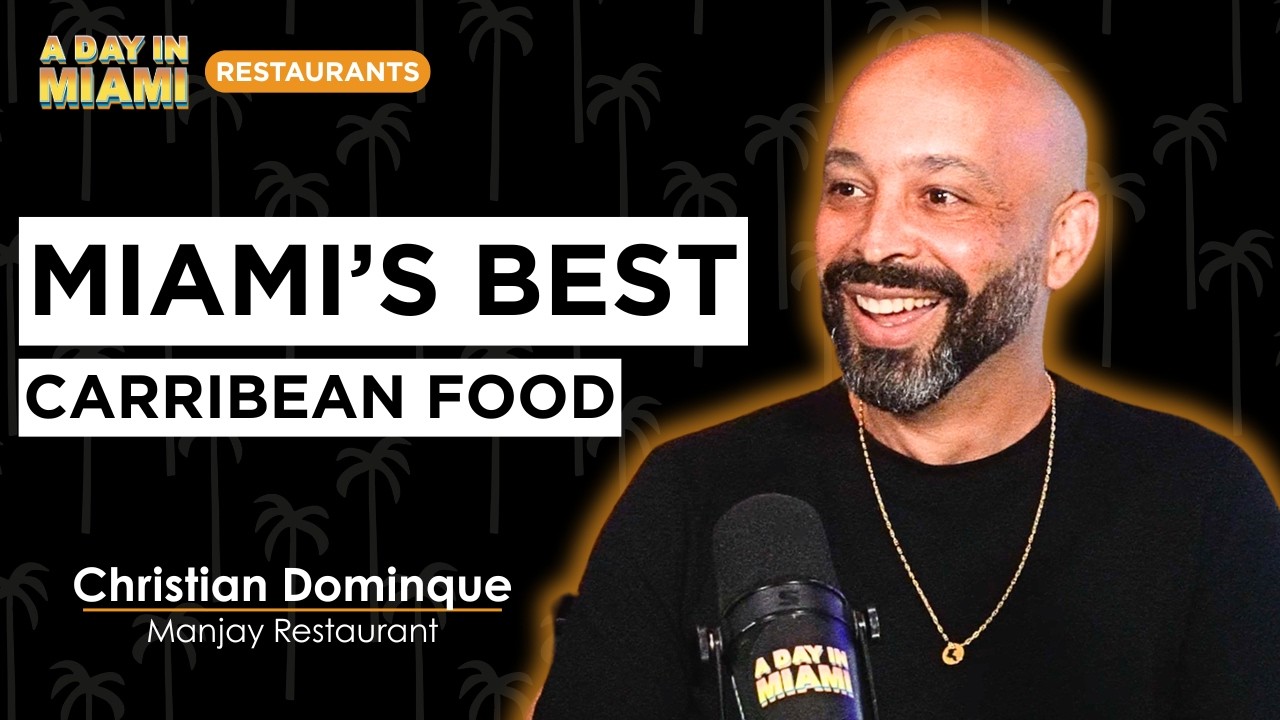
How Manjay Became Miami's Favorite Caribbean Fusion Restaurant | Christian Dominique
Manjay isn't just a restaurant — it's a celebration of Caribbean culture on a plate. Christian Dominique joins us to break down how he built one of Miami's most...
About This Episode
He covers the full menu, bestsellers, delivery apps, the role influencers played in growing the brand, whether food or service matters more, and how Doral has changed since he opened there. He also shares the deeply personal story of evacuating his family from Haiti and what the current political situation means for the country he loves.
If you haven't tried Manjay yet — this episode will make you go tonight.
Manny Alfonso:
Instagram: https://www.instagram.com/mannyalfonso8/
Kiko Suarez:
Instagram: https://www.instagram.com/querikoconkiko/
Eduardo Moya:
Instagram: https://www.instagram.com/mr_moya/
Follow Us! - A Day in Miami:
Instagram: https://www.instagram.com/adayinmiami/
Listen on Spotify:
https://open.spotify.com/show/20WEys6jxiliBCLoo9iSID
________________________
Produced by: Ben Schwede
Instagram: https://www.instagram.com/benthecreatorrr/
0:00 Intro
2:45 About Christian
3:21 Providing Fusion of Carribean Flavors
6:06 Their Jerk Chicken
8:57 Menu
10:31 Mofongo, Mangu and Fufu
10:55 Building Bowls and Sides
11:31 Cooking to Order and Focus on Real Food
13:26 Political Situation
14:13 Getting His Family Out of Haiti
16:05 Is It Safe to Travel to Haiti?
20:14 Surviving COVID and Adapting
24:44 Opening in Doral
28:06 Bestsellers
28:47 How Has Doral Changed
29:30 Balancing Running 4 Locations
31:26 Advice for Opening a Restaurant
31:55 Day in the Life
34:13 What Brings the Most Customers
36:14 Top Influencers
40:28 Is Food or Service More Important?
41:45 Delivery Apps
44:51 Top 3 Restaurants
47:26 Where to Find Manjay
47:55 Little Haiti to Little River
49:32 Outro
Episode Highlights
About Our Guest
Christian Dominique
Manjay isn't just a restaurant — it's a celebration of Caribbean culture on a plate.
All right, all right. Another pod, baby. Again, another pod and you're not wearing a Miami hat. No, no. You know what he says? I always wear a Miami hat. Every time I got a Miami hat, but I got other ball caps. So, I can't be Miami every day, right?
Well, you got to be Miami.
I mean, bro.
But no, but how many Miami hats?
day in Miami and you're not
hats are Miami? You want to wear? You want to wear the same damn hat every day?
No, I'll get I'll get you 10 Miami hats.
Oh, so now I'm your [ __ ] You buy me [ __ ]
Yeah. [laughter] Might as well.
Christian, don't be don't be don't be agreeing, dog.
So, listen, I'm going to stop I'm going to stop buying I'm going to stop buying you stuff and I'm going to start selling you stuff.
Let's be let's let's be honest. We have merch coming out.
Yes, we do.
That's going to say A Day in Miami. I'm going to wait for that.
Yeah.
But don't hate on my hat. It looks good. It's a good party and all that.
We're not hating, bro.
It's just, bro, it's we're Miami.
People comment about it all the time, too, that like, bro, that guy's wearing a Boston hat or that guy's wearing
Oh my god, how dare I wear a hat or a different [laughter] You believe this [ __ ] Jay?
Yeah. I got a Miami Marlins hat there if you want.
Get the swag now from A Day in Miami that's going to be dropping and we'll get that. By the way, before we start, guys, go ahead, please like and follow the page. It helps us out. We work hard for it, but you got to you got to subscribe. We're getting close to 10K, I think, right, primo?
Yeah.
Something like that. So, that helps us out. Comment if you don't like my hat, as well, whatever.
The YouTube is is is doing well. The Instagram is blowing up. And honestly, more than anything, when we go to the streets, people engage and talk to us. I was yesterday at Courtside Basketball. We had an AMG night, you know, uh shoutout to Raheem and them at The Drinking Pig before we get into our our conversation with Chris. Um and we had a a great night and a guy came up to me and we have like a little kids basketball team and he goes, "Brother." And we're playing against him, he goes, "I love what you guys are doing. The way you're spotlighting things." A lot of people mentioned the thing that we did with the firefighters, with the city cops and everything, that we're showing there's there what's going on and that was brought up into the commission and everything. So, we're here for the community, you know?
Bro, we're super hyper local. We take pride in that, bro.
Yeah, we take pride in that.
And we've been going hard cuz uh we had a long ass day yesterday.
Yeah, we're back here. And right now, we're going to the Freedom Tower at 1:00.
But with all that being said, I still see you every day in the gym. Can you show the camera all the muscles there how it is? What? Oh, what do you think about that, Chris?
I got to get to the gym.
Yeah, bro. Yo, I'm I get exhausted just looking at his stories.
Shout out to Complex, bro. That's amazing reason these guys out there.
Where's it located again?
It's South Miami.
South Miami? Maybe I'll Maybe I'll check them out.
The crab de jour whatever that crab is is.
Yeah, that place sucks. But [laughter] it's But Complex we'll check it out as long as I don't have to crawl on the floor like you did this morning. I can't.
Yeah, you can.
How come my arms My arms won't hold?
Bro, honestly, you could do good in there.
Yeah, but will you peel me off the floor?
Yeah, yeah. I get peeled off the floor every day.
Okay. And then we can go get some Manje.
And we get some Manje.
Sir, introduce yourself to the camera who you are.
What's up, man? My name is Christian Dominique. I'm the owner of and founder of Manje restaurant, which is a a modern Caribbean fast casual. And it's uh I'm What I'm trying to do is build a scalable version of that
Yeah.
uh so I can duplicate it and introduce Caribbean food to the world.
Yeah. Is Is it true they call you the Haitian Prince on the street?
Uh I've never heard it, but it would be cool. [laughter]
Self-proclaimed, baby. There's nothing better than that. A little a little backstory, I met Chris when he first opened I think. How many years ago was that, bro?
Oh, dude, that was like six years ago.
Before COVID.
Six years ago.
It was the first first spot where I saw like Caribbean cuisine, you know, Haitian, a little bit of everything.
Yeah.
Tell us about your food cuz the people really want to know what it is.
So, basically, what I do is I take the dishes that I like from the Caribbean, the ones that I like the most. Um cuz I've traveled a lot in the Caribbean from my previous uh life. Um so I take the things that I like the most from them and I try to put my touch on it and try to make it a appealable or or accessible to the general public because Caribbean food basically is the is the the birth of fusion.
100%
Because when the slaves were coming in and the French were coming in and the Spanish were coming in, they were all getting together and exactly. So that's how [snorts] yeah, that's how fusion was created.
portions of it did they fuse together? Was it like where you were from?
So it's from everywhere. So if you go if you go
DR
So if you take for example the DR, you have a mixture of the Native Americans that were there with the the African slaves that came in and the Spanish influence. And then in Haiti you have the French influence and in Cuba you have the Spanish influence. So you get you get the flavors from all of these different areas when you go if you go for example if you I'm going to tell you something that might shake the Cubans a little bit but the congri is from Haiti.
No way.
Yeah.
Yeah, yeah, yeah, they make
For real? Yeah. So congri is a French word that they they Spanish Spanishized
Spanishized
They Spanishized.
Arroz congri?
Yeah, exactly. So congri is is congo with rice. Congo is a bean which comes
And they connect they connected it.
Yeah, I had no idea.
Congri with arroz congri.
Damn man, that's
Yeah man, that's right homie.
Listen, I'm telling you bro. I've tell you this all the time. I'm half black.
You know, like
I can see it.
[laughter]
I have nappy hair.
Say it again. Say it again what you just said.
I'm half black. No, [laughter] I have black hair. He's never seen me waist down.
[laughter]
Oh yeah. Oh lord.
I knew we set each other up there. That's JR producer, by the way. But, Christian, you know, me and Ed, we eat Caribbean food all the time, but it's always Cuban.
Yeah.
You know what I'm saying? And it's a shame that we do that, but we were talking off camera, you guys have like a plethora of different kind of cuisines, even jerk chicken.
Yeah.
Is that a Jamaican recipe, or is that like a Haitian version of it?
So, basically, we use the same ingredients as the Jamaican one, but we put our own twist to it. So, basically, since I'm from Haiti, everything has a Haitian base to it.
it.
So, I I see I see the the the the cuisine more like a an engineer type of way. So, you have the foundation, and then you have the base, and then you have everything else that you add.
it spicy, or you guys dumb it down a little bit?
We We We dumb it down a little
bit, right?
to make it more accessible, but we can
Yeah, original Jamaican patties are spicy, or
Yes. Yes.
Like really spicy? Cuz I like the Jamaican patty.
But, what what a traditional spot or something like that is they just give it to you, right? So, like, here's jerk chicken, and it's at their spice level. There's no warning or nothing like that. So, for him,
it's it is that, but at the same time, you want to appeal to other people. So, you tone it down a little bit. But, you get that OG jerk, bro, and you're you know, yeah.
And and what's like the seasoning ingredients in a jerk chicken?
So, you have clove, you have um So, so I'm thinking in French and speaking in English. Yeah, and you have cumin, you have garlic, you have um cinnamon, yeah, and all of these. So, we use all of that in different levels. So, that way you get some sort of the jerk
like a like a kick on it. But, you marinate it for how long? Is it like, you know, like, you know, you got to do like 24-hour, 48-hour marinades or
So, we start at 5:00 in the morning. So, our chicken marinates from 5:00 in the morning. Everything is fresh. We don't freeze anything. We
cooking on the wood sticks, though. You got to have [laughter] that.
Cuz originally it's on wood sticks.
Yeah.
The grill grade is palitos. And then the chicken's on the palitos so the
Correct.
the wood doesn't burn but it gets smoky made a little char and that's
Exactly.
The real chicken how we do it.
[laughter]
Yeah, they know that man. But that but people I've never seen anybody cook like that here.
Like if you go like if you that's well that's that's the reason why I'm doing Manje right now is an introduction. So it's like a 101 course to Caribbean food. So if somebody has never eaten jerk chicken before, you come into my spot and I give you something that is good to you you can then go oh, let me try to go to a Jamaican spot.
Let me go all the way.
Exactly. And then you start doing your research and then you you you you find different Jamaican spots that actually do that. Um and and I'm like an advocate.
Yeah, yeah, yeah, yeah. I always thought that Jamaican food like mainly like Jamaican patties. I didn't think that they had like I mean I guess this is ignorant of me but like a wider base. And I see a lot of like the conch. Is that that the conch?
That's more Bohemian.
That's more Bohemian.
and stuff. I see I see a lot of those things going viral where they do like these conch
Bro, that's my
bowls and stuff on these food trucks man like in the middle of Miami like
But it's funny cuz you should have called Manje Manje Miami. I'll tell you why cuz your menu is a direct representation of Miami where multicultural Caribbean cultures that live and breathe together.
Correct.
menu is exactly like Can you elaborate on some of the other things on your menu before we get into other stuff?
Yeah, definitely. So the the concept is all about inclusion. Even my my employees, I hire people from the Caribbean and different cultures. Um so basically what I do is I I try to uh take whatever for example we have a vaca frita, right?
You don't know how to do vaca frita.
I don't know but I have a Cuban.
[laughter]
Hey, the charred vaca
Yeah, yeah. You have the charred?
Yes, yes.
Tell me about it. Tell me about it.
So, basically I hired a Cuban
Yeah.
cook and he took stuff from our kitchen and he was making his own dish. I'm like, "Dude, what is this?" He's like, "A vaca frita." I'm like, "Oh, yeah, I like that. Let's like
Love it.
Let's play together and and
Put it on there.
put it on the menu. So, we played together created a recipe and we put it on the menu. Uh I have a Bohemian lady that works for me. We make conch fritters. Um So, I have a Puerto Rican that works for me. We used to do a mofongo which was different from the mofongo in Puerto Rico.
Fufu and the mofongo are got different names?
yeah, exactly.
All right, but listen, that's something that I've always been confused about. What is the difference between mofongo, mangu, and fufu?
The name.
Yeah. That's it.
It's the same thing.
Maybe a couple of the little ingredients, but mashed plantain.
Mashed plantain is the other dish.
Fire.
Got you.
So, it's mashed fried plantains. So, you fry it and then you mash it and
of the healthiest things you can eat, bro.
Yeah. Yeah, I mean, I love like the the tres golpes from like the Dominican dishes, you know, the plátano and mangu and
So, the top
The top seller is the jerk chicken.
Yeah, definitely.
And that comes with what? Rice and all sorts of
It comes So, basically you can build Yeah, you can build your own bowl. So, basically you can
[clears throat]
all the sides as well are vegetarian. So, being from the Caribbean, I eat a lot vegetarian, but it doesn't seem like it's vegetarian because it's just regular stuff like
I got a rasta on the
I GOT A RASTA. I GOT A RASTA. YEAH. I got a rasta.
You know what? food and vegetarian food. I just hate vegan people. I'mma be clear with that.
[laughter]
No, no, I hear you. I have personal reasons. I have personal reasons.
Yeah, yeah.
Um Go ahead. Did you have something to say?
No, no, go ahead.
So, you're at the Cita though, right?
Yeah.
When you first opened, I remember that. I think we did some TV stuff back then.
Yeah.
It kind of took off because one, you were eating healthy, and that was we don't we don't you're not fast food, but you're fast casual that we spoke off air. So, you were actually eating something that was fire because it's fire. I've had it before. It's been a while, but I've had it. And it was good for you, you know? It's a perfect target audience for my man right here who really doesn't like to eat unhealthy, and if he does, it's a little he feels guilty, but he likes to eat quality food. Did you see like the surge of people that really wanted to eat healthy, or it was just everybody wanted some Caribbean food? Like, what was the the customer base when you first opened?
So, I think the fact that we are um cook it as you order it.
Yeah.
Um it shows you a little bit more that we're actually cooking real food.
Mhm.
And um when we opened in 2019, right before COVID, um there was this um um how do you call that? This this whole hype about like real food and vegetarian food and uh
Healthy [ __ ] bro.
natural ingredients
So,
[clears throat]
and my whole life I've eaten like this. Um natural food, vegetarian, but without knowing that it is because you in Haiti, you grow it and you eat it. Uh so, so it that that's how it was. That's how I grew up.
So, you guys grew up in Haiti growing your own food?
So, basically, we we well, we eat uh food from local up until like the embargo, which was in '94. Um everything we were eating was local. Um vegetables, rice, um um meat, everything was was local.
the island?
Came from the island. You grow it, then you you eat it. Um and then we had the embargo, so we started to have to import stuff. Um
Trash. Yeah. You you the embargo they put an embargo on you guys or
Yeah, yeah, they put an embargo on Haiti uh around '94. Uh, that was the time where Aristide, yeah. Um,
You were happy about that? Or you mixed on that? I don't want to talk politics, but
Yeah, well, the thing is that when you think about
When you think about it now, when you see the way Haiti is now, you're like, maybe it was better before. But then, was he the one who started it?
[laughter]
Like,
But he started before Castro. Castro was hated.
Yeah.
all this guy might be the dude, and then it wasn't.
Yeah.
And look where we are.
So, it's all about like the politics of it. And and and I'm not saying that he was a good guy or bad guy. I I was 12 years old, so I don't
directly?
Yeah. Um,
You remember?
I remember.
You go back a still lot or no?
I haven't been to Haiti in 2 years um, just because uh my family moved here and we all moved here because of the situation in Haiti.
Yeah.
Um, my wife and my kids had a traumatizing uh experience leaving the country. Um, we tried to bring the kids back um, and um, they were not too happy about it. Uh,
Who? The government or the kids?
My kids. My kids.
to stay.
My kids left the country in the middle of the night in a in a in a uh uh armored uh car full of guns and sirens and stuff like that.
And they remember that?
And my oldest and my second child remember.
That was a service that you paid for?
Uh, well, luckily I paid for it, but luckily I was able to find somebody to pay for it because at that time it would like they were all booked. Uh, but luckily a cousin of my mother has a company uh a security company, so he he like connections.
But how scary is that, right? Cuz you still take a chance.
Dude, I was here when it happened. I was in Miami and my my family so I like I was on the phone like calling everybody. I spent the whole night uh
So they what they went to the port and they jumped on a plane or
So uh at 4:00 in the morning they came to pick them up um wake them up in the middle of the night and and put them in a car, took them to the airport, and they they stayed at the airport for about 4 hours and then took a plane here. And um that was right in the middle of like everything like uh
Good job, dad. Good job. It's amazing.
man. It was crazy.
similar to stories of Cubans and Haitians.
And um like what would I mean, would you recommend people to travel there? Or is there any like what would what would like is there anything that we can do if we go to Haiti or anything like that or
So there are parts of Haiti that
like nice to go to?
Yeah, man. Haiti's a gorgeous country.
Yeah.
Beautiful country. Beautiful country. I I I've traveled a lot a lot and I haven't seen The thing is that it it hasn't been cultivated. So it's it's like virgin land. So you have Yeah, you have these beautiful mountains, beautiful beaches, beautiful plains like beautiful country.
I would suppose something like DR.
It's better than the DR. Because the DR got the part that is more uh flat and we got the mountain. So I used to joke around we used to ride a Polaris. You know what the Polaris is? It's a side by side. Okay, so we used to ride those a lot when I was living there. And I would go 10 minutes I have my jacket on like my coat. I'm freezing.
Cuz you're up in the mountains.
Cuz I'm in the mountains.
And then how does balls on you get down?
And then 10 minutes down you're like white sand and clear water. You're in the beach.
Damn.
So if you got money you can find a nice spot.
But do you think it's anything that change soon there or anything like that or or like what's the I mean I'm I'm just I don't know what's going on over there.
Nobody Nobody hears about it cuz you don't hear about it.
Yeah, so just curious like what's the status of the country right now.
So, the country is at is at its worst. It's never been the way it is now. So, everybody So, I'm able to say this now because I'm out of that bubble. Uh when I was living in Haiti, I was living in a bubble. And and and I'm trying to explain what the bubble is is when you lie to yourself, but you don't know you're lying to yourself and you feel like you're safe, but you're not. Um when I got out of Haiti and that's when I realized. I was like hey, this [ __ ] is not sustainable. Like
Can't raise a family.
You can't raise a family there. You can't like the country's going backwards instead of like going forward. So, when you when you are there, everything now is confined to one little spot, which is Pétionville, which is in Port-au-Prince. So, the whole Port-au-Prince, which had about 4 or 5 million people, now is concentrated into one little like I want to say 90 square kilometers, which is probably like 30 35 miles 20 30
That's about 30 miles.
Yeah.
It's smaller. I would say like more like uh Fort Lauderdale. A little bit smaller than Fort Lauderdale. Everything is there. Concentrated there. Yeah.
Well, what happened to all those people then? They all migrated or left or
Everybody Well, the gangs are like closing in. So, they're closing and closing and closing. So, people are moving moving moving moving. So, you have like deserted areas like areas where businesses were, hotels and stuff like that that have been completely taken over.
so the gangs are just taking over these cities and the government's doing what? They're part of it?
Well, the thing is that it's been happening for so long that even the the cops that are
Yeah, they're all corrupted.
in the police force, they're they didn't have a choice but to join the gangs because they live in the same area. So let's say I live in an area and you're a gang leader, you might be my neighbor and I'm a cop, right? And you're the leader. So I don't have a choice but to join you because my family is like right next to you.
right.
So some of them is it's like that.
That's why that now I understand why the TPS for Haiti was they're fighting so much against it for them not to go back.
Yeah. I didn't know it was that bad over there.
It's horrible, man. It's horrible.
Wow, dude.
People are getting kidnapped.
on cruises and stuff like that, you know, like years ago, you know. I didn't think it was like that.
inside.
Yeah, yeah, yeah.
So a little Haiti update there. So let's talk when you open up, you opened up, you were chilling.
Yeah.
How long before you stop chilling? When did COVID hit after you opened? How many months we talking?
Uh 10 months.
10 months.
Because when you guys opened, you guys were having everything was going on, it was popping, you had your influencers there, the Citadel was dope.
Yeah.
How did you survive, man, and what was the game plan? I know it was two spots and now it's just one. What was that like for you and and and opening and closing a restaurant?
So now we are we have two spots now.
Two now, okay.
We have two. Um but we had four at one point. Um right now so when we opened in 2019, um we started to make a name for ourselves because it was different from what everybody has been doing and been seeing. Uh very different from from what was in the scene. So we were making some noise and COVID hit. And at the time when when COVID hit, I was still living in Haiti. Uh I had a partner at the time. So, um he was the one here and and managing, but at a certain point he stopped managing because he was doing his own thing. So, I was managing from afar. And COVID hit and I couldn't travel because they closed everything. Of course. Everything. So,
[clears throat]
You were handcuffed.
I was handcuffed. And my fear was that we were going to lose all the traction that we had going in.
All that momentum, yeah.
Yeah, because what happened is all the other vendors that was at Citadel that opened with me, they all closed.
Wow, yeah.
All of them. There's only one
barbecue.
Yeah.
Um Richard Hales, he he had a one of the first barbecues in Miami. Amazing and he moved to Tampa and got out.
Yeah.
The pizza spot too closed, right?
Yeah.
The little bar
Yeah, that place was still one of them in
Yeah. All of them, I'm the only one that is still there.
Yeah, and still to this day now. There's other spots that
There's Yeah, they they opened they opened different like different concepts.
the lone ranger standing there.
I was the only one I I am the only one that that that survived that period. It's just because I don't know if it was because I was arrogant, if I was ignorant, if I like but to me when they said COVID hit and the country is going to shut down, I'm like guys, like
People still got to eat.
Humans have been surviving forever. Yeah. Um I think I don't think like the the world is going to explode. So, there is a chance that we're going to reopen. So, I decided to buy a food truck so that I can keep the name
Be on the street.
Exactly. If ever we we shut down the Citadel, we can be in the street, we could still keep that momentum going even a little bit slower, but so that helped us with the food truck. Um and we ended up closing for about I think 2 months at the Citadel. We closed for 2 months. We were doing In the beginning, the concept was not created for takeout. We weren't doing
going to ask you, why didn't you just jump out into the takeout right away the little bowls with the tops on them?
Yeah, we we weren't we weren't built for that. So we had to reinvent the whole menu and read
Make it simpler.
Make everything simpler uh so that we can cater to that COVID delivery uh clientele. So that's how we we we survived uh COVID. And uh we came out and we were the only ones left at the Citadel that were open. Everybody had closed. So people who were coming to the Citadel, we were the only ones there. Um Ash was still there at the same time.
Ash. I can't remember the name of the pizza place.
Yeah, Ash was still there um and then they started to change the operators. So people wanted to go to places that were familiar with. Uh so that's how we kept on going with our with our traction and and kept going and we decided to open a second location in Wynwood uh cuz Wynwood was starting was outdoor. Everything was outdoor. So uh so we opened Wynwood. Um I think you came to the Wynwood, too. Um We did Wynwood and um so at that time I had Wynwood truck and Citadel. And uh we did that for a couple of years and I opened up in Doral. And when we opened up in Doral
up at Shoma or
No, I was contacted to open in Shoma, but they ended up uh taking somebody else uh I don't remember. I should
doing it? Is Shoma doing good?
Or I've been there once. I just feel like it's really expensive, man.
It's expensive.
expensive.
I know they had Julio and Henry. The big one in downtown, three stories.
Cool.
I remember I went to I went to Shoma one tonight. I had a burger or something. It was like a $22, $23 burger.
Expensive.
Yeah, but whatever, bro. Like, you know, I'll eat it, you know, it's fine, but man, for what it is, to walk around
It's expensive.
at the park and what I was like,
So, Chris, you passed the COVID and you said you're going to keep expanding. Is that the deal?
So, yeah, when COVID
You're like double crazy?
I am a little bit Like, if you ask my wife, she will tell you that I'm bipolar, like
[laughter]
You need to be a little bit crazy.
Yeah. Yeah.
Yeah, to be in this business, you have to be a little bit delusional.
Of course.
So, if if you if you are too sane, uh I I I've thought many times of closing, like I'm a lot of times I get hot the thought passes through my head like at least once a week.
[laughter]
I told you that [ __ ] Make sure he doesn't close. I got to make sure he We're going to push traffic that way. So, did Doral hit cuz Doral's competitive as as hell.
So, the thing with Doral is that when when I when I I want I've always wanted
in Sorry.
Yeah, go ahead.
To give people context, you opened in that like new strip mall they have in Doral. Like, that that's not that's It's not new now, but at the time it was new construction that they have.
So, it when I when I got there, it was already 8 years
Okay, but
But I've been looking at that spot for the past 5 years.
Which is on what? 107, no?
It's on 87 and 20th uh street.
Yeah, where Flanigan's is and on the cross of the street.
So, Flanigan's is is closer to 12, um whereas there's the Chipotle, the um
They had a wing place there.
They had a wing place and they had a burger place. Um and now it's us, and then you have uh you have Paella, you have rice, you have Chipotle. And
I thought they I thought they put their Twin Peaks now.
Twin Peaks is the next The next one. The next one. Yeah.
I haven't been there but you know.
Yeah.
Yeah, there's a lot of competition.
of competition in the route.
So then you opened up and then how did that start off for you then?
It was it was very slow.
Oh yeah?
Very very slow. People didn't Up until today we're still doing like education cuz people don't really understand what the concept is. Um and not a lot of people know what Caribbean food is. I got I got people who come in and and like so you guys funny cuz we we're talking about like restaurants and every you have to control everything. I get Haitians that walk into the restaurant and they see a Cuban person behind the the counter and they're like
Right there all the same [ __ ] is white.
Why Why is that person white? Like
[laughter]
I'm like Cuba is in the Caribbean. Cuba is not Miami. It's a Caribbean country. You know? Um but a lot of people don't really understand our concept so we have to do a lot of education and and explaining the concept and free food and But now it's getting like it's getting some traction.
And do people what's the type of feedback? Like what's your your your number one dish that's sold?
The number one is the honey jerk chicken.
The honey jerk chicken.
The honey jerk chicken. If you go somewhere and you have no idea what the food is you're going to order chicken, right?
Yeah.
[laughter]
Yeah.
And but do you do you see people from other cultures coming in and they see it and they're like wow this is better than I thought? Or
Yeah, definitely and we keep they keep coming back. They keep coming back. The flavors are similar to the Latin flavors cuz it's the same Um they used to call it the I forgot the name but it was like the slave the slave route.
Yeah.
So they would go from one country to the next and so the flavors just kept
circulating there.
Yeah.
There's a lot of similarities. And have you How have you seen Doral change over the years? Cuz you've been there a bit now.
Yeah.
And Doral has, you know, changed dramatically, you know?
Doral used to be warehouses only.
Yeah.
I know.
Now it's residential, it's commercial, um it's it's growing. It's growing super fast. It I think it's growing a little bit too fast.
Yeah.
Uh for the infrastructure infrastructures.
Yeah.
Um
They never thought that the the the the master planning for the city wasn't really thought
of like the amount of people that would come in. Yeah.
Now, they did a great job with the park.
They did.
But now they have the G20 going in there at the end of the year, which you're getting heads of states that are going to come here to Doral.
Like the whole world is there.
That's That's the truth.
It's the Trump effect.
Yeah.
Yeah.
The Trump effect. So, after Doral, what what what was the what happened?
So, when we opened Doral, it was it was so slow that it became so cash demanding. Um I had to make a choice. Yeah, we were bleeding. I had to make a choice is I I didn't want to close Doral like 3 months after opening because I I know the potential that it has. Uh so, um I decided to sell the food truck. So, I sold the food truck so that I could
Maintain
maintain the place and keep it going.
And um I was starting to feel like I wasn't seeing my family cuz at the at when I opened Doral, my manager quit. Uh he went to uh New Orleans uh to open uh his own stuff. And so, I was by myself managing four different locations. So, I was sleeping at 3:00, waking up at 5:00. Uh and it was like
Hell. Too much, yeah.
Yeah, it was a lot. I didn't have any help. Uh I'm I'm by myself. So, it was a little bit heavy. I wasn't seeing my kids. I wasn't seeing my wife. I I didn't have time for anything. Uh it was just
No, that weighs on you, man. You can do it for a couple weeks, bro, but months
Yeah, yeah, it was it was it was insane. It was insane. I did that for for three or four months, like it was it was it was crazy. Like I was starting to uh like lose my memory and and and cuz I wasn't sleeping. Um and I would I felt like I was losing a lot of from my kids and my my my personal family, so I decided to sell the Winwood location. Um that would help me out a little bit personally. Cuz all all three locations were doing okay.
All your time consumed.
But um No, it was it was it was tough. It was tough.
So anybody out there who's thinking of doing a restaurant, what advice would you give them? Oh, if you don't
love it, don't get into it. Like I I I There's a lot of people who who know how to cook and love to cook and there's a lot of chefs who love cooking. When you own a restaurant, you never cook.
[laughter]
Yeah, that's the least part of it.
Yeah, you never cook. You're always shutting down fires.
Yeah.
Um and you're more like a firefighter.
Yeah. What do you What's like your like What does your to-do list look like when you're waking up? Like
Oh, yeah.
Orders in, I got to put this, I got to Give me like a day in your life.
the to-do list changes every 3 seconds.
[laughter]
That's the ADD kicking
Yeah, yeah, it's it's crazy. I wake up every day at 5:50, 6:00. I got to drop my kids at school and from when I'm like this part, like 5:50 to to 6:30, I look at my emails, check what I what last-minute orders and stuff like that. I do that and then drop my kids off to school and then I go to work and then check the list. It already changed like five times.
Yeah.
Uh so the the basic things is is is managing people. Um, and and and that is the toughest part of of of being a a business owner in general is to be able to manage the different personalities and different cultures cuz I I forcibly hire different cultures because I want this to be an inclusive project. I want everybody's input cuz I don't want to do a Cuban food without being from Cuba and knowing nothing about the the like I want to know like
the same.
It won't taste the same and and yeah.
People will tell you.
But do you think that makes it more difficult for you to like scale because you know like you're so particular with who you have to have on your team?
It's it's difficult to scale but we're everywhere, man. Caribbean people are everywhere. You're going to find Caribbean people to to to to to work um, anywhere. And and it's it's good and it has its bad sides because when you have a a Cuban person and a Haitian person uh, the Haitian person speaks a little bit of English like very little and the Cuban speaks a little bit of Spanish and they can't communicate but they have to work with each other. There's a lot of friction because when you hear a Haitian speak speak Creole, you think he's always saying bad things like
[laughter]
And for a Haitian hearing a Cuban speak to another Cuban, you think he's saying bad things. So, there's always friction and and it's always like trying to to bring the communication to let them know like, "Hey, we're a team." like
Yeah, the same.
Listen, I was in I'm curious to know um, what do you think for a restaurant, at least in your case, you know, fast casual has the biggest impact on potential sales? Like is it, you know, influencers? Is it the signage outside? Is it going on the community? Is it um, the delivery platforms? Where do you feel like you see okay, if I put my focus in here, I usually will see a lift?
It's a great question.
That's a very good question because when you're dealing with with food, food is the only thing that tests is all your senses. It's you see it, you smell it, you taste it, you feel it. So, when you're trying to sell a product that you have to taste and you you have to smell and you have to touch, it's a very difficult because everybody eats differently. Like I eat with my nose. Uh you might eat with your eyes, you might eat with your touch, you might not like certain textures. So, you have to be able to to touch everybody, right? So, for me, my experience, the influencers do a very good job at explaining the food, explaining the texture, explaining the flavor, explaining the the smell. So, if you can smell it, at least somebody else smells it and lets you know. So, that brings a lot of people.
Yeah, it's like an amplified view with visuals. So, you would say you would say that that's probably like the thing that you've seen the biggest lift with?
Yes. Yes. Um you can you can post a million pictures.
Won't do nothing. Yeah, organic guy.
You'll get probably one person who who eats with their eyes and say, "Oh, this looks good. Let me go try it."
Yeah, or usually people what what they do is they save it and then they just forget to go.
Yeah, they're great and then oh my god, here you go. Like he says, a lot of influencers do the dirty work for you.
Exactly.
A little preview of that's what it looks like. I use my eyes though.
Yeah, there you go.
I see it and if it's appealing, okay, but if it's not, I'm like
And [snorts] uh who would you say are like from your experience are influencers have gone and you're like, "Wow, that really worked." Like do you have like a top three that you'd say, "Man, these guys went, they just blew it up."
Dude, there this is there's this guy that came the day. Uh I don't even think he's an influencer. He just has a lot of followers cuz he doesn't do like influential things.
Um he came the other day and what's his name? Randomly his name is Rob. I can check his Instagram. Um His name is Rob. And he came and tasted the food and then he was like um He called he called me on the phone. He asked for my phone number and he called me on the phone and he's like uh I'm at your restaurant. I really like the food. Um Do you mind if I come tomorrow and film it? Like
Yeah, sure. Pay for it.
I know.
Yeah, you can come.
So he comes and he films them preparing the food and and blows up. Like right in the middle of February which is the slow it was the worst month this year.
Wow, man.
And then people just start showing up like crazy for like a month and a half we've had people coming and and
We got to find this guy Rob, man.
Yeah, I got I have his Instagram.
And and so then so then where would the people come from? Was it like outside of Doral or from
From everywhere. From everywhere. Like people coming from Weston, people coming from Fort Lauderdale. Like We had we had one person like that came to Doral um from Minnesota. They came like
Traveling and they said I saw this online.
No, they they were going to on a cruise. So
It's the best stories.
They they were they're from Minnesota. They were going on a cruise the cruise on a Fort Lauderdale. They drove to Doral
Wow.
to get the food went on their cruise. On their way back they came back again
and went to Minnesota.
Amazing, That's amazing.
So and was from from this guy, random guy just like that and I I have his name here. Um It was crazy, man. I I I've never seen anything like that. And then you have uh
Who else is Who else like any of the local people that are going there?
Yeah, we've had um um
I seen Alexander Martin go.
Yes.
Alexander Martin, she did a good video.
Yeah, she did a good video. She got some people, too. Yeah.
I think I said May
Um May I take a bite? Yeah, she she she gave us 1.3 million
She did a good job, you know.
Uh a lot of people came for her as well.
Yeah, she did.
Um I would say those those those three.
Has Evi the foodie gone? No?
Evi came, yeah. Evi She did good, too.
good. You know Evi used to work here?
No way.
Yeah, she used to work here.
Yeah, she she turned into a foodie influencer here. No way.
I met her when she used to sell ice cream.
Yeah. Wow.
She was a child back then.
Yeah, she's good. She's done a great job though building her business.
So, in your opinion, Chris
Let me see his name.
Is it the one that says Poppy?
Gary. My bad.
Gary.
[laughter]
I told you I had bad memory for names, like
Gary Wilson, bro. That's amazing, bro.
Shout out to Gary.
Gator Gary, man.
I have very bad memory for names, man.
Chris, so you So, in your opinion, influencers do help because we've had other people on where they don't really think it's so much effective, but in your experience, they've helped you?
I I I I wouldn't even call them influencers. I would probably call them uh promoters um because I've the the the the influencers that have I've I've worked with one influencer who didn't really like the food. Um
Would you care to share his name or hers?
No, but I mean, that's okay.
Yeah, I mean, it's fine. It's It's like
to places that are great and I'm like, "Whatever." Actually, I eat everything. I don't Yeah. I don't I don't discriminate, doc. I eat everything. The only thing I don't eat is olives.
[laughter]
I look, to me personally, and we've had this discussion before, and you know, yeah, would you prefer okay food and great service or great food and not good service?
I'm a foodie, so I don't really um I wouldn't go back if the service is bad.
Boom. That's the thing.
If the service is okay and the food is amazing
Yeah.
I'll go back. But
if the food is okay and the service is amazing, you're probably going to go back, you know, because it's the way they treat you. You're going to give them another shot. You're going to say, "Hey, you know what? Maybe in a moment I'll get another dish or I'll come back, but I just felt great here, you know?" So, I think
Service for me is is number one.
to be. It has to be. And not only in the food industry, in every industry. The way you make people feel
Yeah.
right, goes much further than the actual service or product that you're giving them, you know?
Definitely.
100%. What's the status of Manjay presently right now?
So, right now we are at two locations. We have one in Citadel in Little River and the one in Doral, the OG. Yeah. And we have the Doral location. Uh right
thriving? We're good?
Thriving, we're we're
Not like last time, we're good?
No, we're good now. We're good now. Well, we could be better. We always always want to be better.
We'll be better after this part.
How how how how how how how's uh the delivery on that on that side over there?
It's pretty good. It's very good, yeah. Uh we we do a lot of um I mean, Uber Eats, I don't want to [ __ ] on them, but like they took they take too much money from us, man.
But you know what? You can negotiate with them.
Well, they don't want to.
[laughter]
Uh they take about 60%. They advertise 30%. They advertise 30%, but if you're on the 30% and you're not doing marketing, you're not doing two for ones, you're not doing advertisement, you're not doing all that, you're not going to sell anything.
working for
What about DoorDash?
Yeah.
DoorDash is a little better. Um they don't they they don't force you to do the marketings or the um I don't do marketing on DoorDash and I do get a lot of customers from DoorDash. But the majority of people from Miami are on Uber Eats.
Oh, yeah?
Yeah. The majority. Um
Damn, bro, but that sucks that they're taking
it eats
so much of that and then you end up usually, honestly, you usually have to pass that on to the to the consumer because you end up being having to adjust your pricing on that.
You're working for free you don't want to
You know? Yeah.
You're working for probably for free, but you're working for marketing, people know your your your food and then hopefully they show up. Also, you have movement of inventory, you know, you have cash flow that you're getting, you know, so you're not maybe the most profitable tickets, you know, but you know, you're getting movement, you know, how you have people just standing there looking around doing nothing, you're burning cash, you know.
Can we have Uber Eats reach out to us and maybe take care of this?
Listen, I I've heard situations where they do negotiate and maybe have to be with the do a volume or stores and things like that. Um it's a great platform and I I I mean, it's not only you. Even the Uber drivers complain about like the cuts that they get, you know, so and you know what's the I haven't read up on it lately, but I've heard that they're not even like profitable themselves or something like that.
Everybody says
Yeah.
that it's not worth it.
Like the company itself is not like profitable. I don't know how that's possible.
How does that work?
how that works. The same thing with like Netflix. Netflix has come out I don't maybe recently it's changed, but I know there was a time that they weren't even profitable, you know. Um but that probably happens when you're, you know, CEO's getting paid $55 million a year.
Yeah.
Something like that.
Well, that's why it's not profitable.
That's that's that's not, you know, [laughter] I I don't know if that's true or not, but you know, that's that's the idea behind that. Um but yeah, it's like a love-hate relationship. You have a lot of people and clients that they just don't want to be on the delivery platforms, but I think here in this market, the way everything's so aggressive, you don't have a choice.
You have to.
Yeah.
But I will tell you something. I don't know if the margins are there or not, but the two for ones on the Uber platform is phenomenal because it pops up, you get the the orders, and a great guy that does a great job with his Tiago's Tacos. He has the two for one taco trio. Always. Always. And when I'm like, you know, you're kind of like looking at the value and you're like, well, you know, you got friends here, family, and you don't want to go and spend, you know, $200. You just get those couple of little two for ones, and he always has them pop at the top, man. You know, he's done that and and for I mean, it's tacos, so I'm sure Yeah. you know, flour. But he's done a good job with that, so Yeah. I think that's something you could incorporate somehow on your end, you know.
I think it's time for the toughest question of Chris's life.
Oh, man. No, go for it. You go for it.
All right. All right. Chris from Manje, give me your top three restaurants that you like to dine in Miami. Starting with number three and why.
And obviously it cannot be yours.
Oh, it cannot be mine. Oh, man. It would be one, two, three.
[laughter]
But starting with number three.
Give us why. Give us some shout-outs there.
All right. Number three. Number three. Number three would be Lungyia. Lungyia Thai.
You already mentioned that. You already the monster loves going there, too.
Yeah. Been there a while, too. What do you like there?
been there, man. What is it? What's good there?
Dude, it's it's It's a whole experience.
I heard they're very intense about their
It's a super get out. It's the soup Nazi. Yeah, one time order. Yeah. Yeah. It's like one time order.
I love that.
What do you like to eat there? Uh the soup, the coconut soup.
Oh my god.
I don't know the names. I just when I go have the coconut soup, which is crazy good. The pad thai is good. Uh the the crab fried rice.
Damn, really hungry now.
Everything. Everything hits on that. The red curry, the green curry.
They've been there for a while or
Yeah, they've been there for a while. No, I don't know the owner. It's just like some obscure Okay, cool.
I haven't seen him. All right, number two, Chris. And why?
Number two would be Macchialina.
Oh, Mike Pirolo, shout out.
Yeah, yeah, that's uh It's in South Beach. Uh it's very good. Italian. Yeah. Yeah, Italian. But like like you feel like his grandmother's in the kitchen. And then she's the one cooking and he's like small spot there and like I can touch the walls with my hands, but crazy good.
Shout out to Mike.
Crazy good.
All right, and number one
Number one would be my OG Nobu.
Oh.
You know.
I haven't been there in a while.
Classic, bro.
Yeah, classic.
Classic. Miami's first uh like widely [snorts] seen restaurant.
Yeah, yeah.
What do you like there? I already know.
The the hamachi jalapeno.
The tuna the tuna crispy tuna, too.
Crispy tuna.
Everybody copied that.
Dude,
Everybody copied that.
OG.
Everybody copied all those recipes. Everybody copied everybody from his
If if you go to any sushi place
cod
That's that's
to the crispy tuna
miso cod. Oh, man.
Yeah, dog.
They're a franchise owner now, no?
Nobu's Nobu, dog.
King of the world, they kidding me?
Yeah.
How many locations do they have?
I think 30.
They have hotels, they have yeah.
Yeah.
After Saudi list, bro, we had some new entries when you said.
Yeah, man.
Brother, how come they locate you? What are your addresses?
Lekoke.
We'll know real quick.
So, we have two locations. The first one is in the OG, which is at the Citadel in Miami Little River. And the second location is in Doral, 2000 Northwest 87th. Uh
Instagram?
Instagram is at Manje Restaurant. Uh
I have a question for you when we first started. Um wasn't Little River Little Haiti before?
Yes, it was.
So, where did that change come from? I I know people are confused about it.
up. They're changing it making it making it appealing, bro. You say Little Haiti back then, nobody was going in there.
Yeah.
Yeah. Yeah, so they changed it.
feel like it's growing a lot right now.
So, there there is So, Little Haiti in itself um is changing by like it's been bought by different corporations. Um and
Same thing happened to what was happening in Little Little Haiti.
Yeah.
Buildings, new structures.
Yeah, that's what I was saying. But I feel I feel like a lot of restaurants are popping up in the Little Haiti area.
Yeah.
And then now they call it Little River.
Well, it started with Sunny's and Ogawa. Mike Pirolo's got his place there called Bo's Kitchen.
Mhm.
So, it's like now it's So, Mike said, "Bro, when when Sunny hit number one restaurant in the country, where is it? Little Haiti. Where? Little River." Bro, when you go there, like you got to run to your car.
Yeah, marketing. Marketing.
[laughter]
Marketing.
But I went to Ogawa.
Yeah.
You You were in Little River?
Yeah.
[laughter]
And then I'm parking, I swear I thought there was no sign.
and told me, "Hey, yo."
Yeah, I was like, "Am I in the right place?
Yeah.
[laughter]
Can I leave my car here?"
Yeah.
I should I get out my gun? I'm like, "No, just hurry up and get inside."
[laughter]
Listen, I I mean my whole life, you know, I've always hung out in those areas even before like five years.
I've never had like issues there, you know? I know people talk about the bad side of Miami. I've Thank God never witnessed that.
Yeah. Yeah. Yeah.
But yeah, it did look really sketchy, especially if you're hanging out with your wife or your family, your kids, or anything like that. You're kind of like, "What's going on here?"
Even Sunny's in that warehouse. You know, they put "Where is it?" There's like a little sign that says "Sunny's." Oh, that's it. Yo, brother, thank you for being here.
Thank you guys. Thank you so much. Thank you. Thank you so much.
know when you're going to book a trip to Haiti. We're ready to go.
Of course. Thank you.
Never miss an episode
Subscribe to our podcast and get the latest episodes straight to your favorite platform.
Subscribe on SpotifyMore Episodes
View all 46:22
This Israeli Entrepreneur Saves Miami Developers Millions on Insurance
Nov 18, 2026
 1:07:52
The Attorney Saving Miami Businesses From Expensive Mistakes
Nov 17, 2026
 56:27
What Miami Could Learn From Denmark | Jesper Møller Sørensen
Nov 16, 2026
 1:04:23
How Bizzy Is Changing the Way Miami Students Save Money & Go Out | Evangelos Milionis
Nov 16, 2026