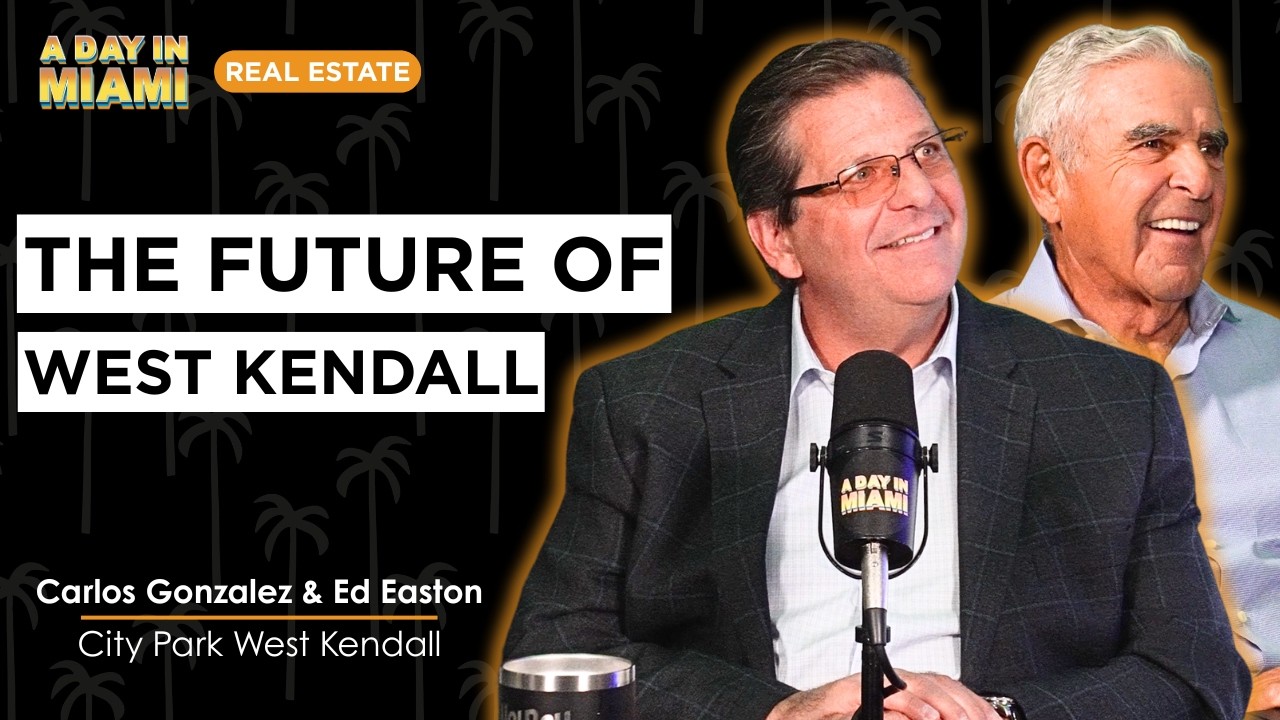
How City Park Will Solve West Kendall's Biggest Problems | Carlos Gonzalez & Ed Easton
Miami is growing faster than almost any city in America — and the land to accommodate that growth is running out. In this episode, Carlos Gonzalez of Lennar and...
About This Episode
They walk us through the full City Park vision, what the development will offer residents, the process of working with the county, the Urban Development Boundary, traffic and connectivity solutions, Krome Avenue, and why building alternatives to driving is no longer optional for Miami's future. Ed also shares what he's witnessed since arriving in Miami in the 70s and why this moment feels different from anything before.
This is the conversation about Miami's future that everyone needs to hear.
Manny Alfonso:
Instagram: https://www.instagram.com/mannyalfonso8/
Kiko Suarez:
Instagram: https://www.instagram.com/querikoconkiko/
Eduardo Moya:
Instagram: https://www.instagram.com/mr_moya/
Follow Us! - A Day in Miami:
Instagram: https://www.instagram.com/adayinmiami/
Listen on Spotify:
https://open.spotify.com/show/20WEys6jxiliBCLoo9iSID
________________________
Produced by: Ben Schwede
Instagram: https://www.instagram.com/benthecreatorrr/
0:00 Intro
2:10 About Ed Easton and The Easton Group
4:34 How Miami Has Changed Since the 70s?
5:45 About Lennar's Carlos Gonzalez and What He's Seen
8:52 Miami is Running Out of Land
12:35 Why Miami Needs Smart Growth
15:56 Planning City Park West Kendall
20:50 What Will City Park Offer?
21:46 How Has it Been Working with the County?
24:29 Requirements for Moving the UDB
25:59 UDB: What's the Solution?
31:42 Community Outreach
32:19 Connectivity and Alleviating Traffic
34:49 Krome Avenue's Growth
35:32 We Need Alternatives to Driving
37:49 Building to Improve the Community
42:10 Living in a Condo vs Home
44:28 When Will City Park Break Ground?
45:53 Keeping ADIM in the Loop
49:04 Outro
About Our Guest
Carlos Gonzalez & Ed Easton
Miami is growing faster than almost any city in America — and the land to accommodate that growth is running out.
You know, this is a this is a normality for me. Always like how I am. I'm very hyper. You know, everybody laughs here because everybody says, "Does Manny need coffee?" Everybody, do not give coffee. No coffee. [laughter]
I'm always on the run with these things.
You got that personality.
This is it. Thank Thank you. Listen, welcome back to a day in Miami podcast. So, you know, in continuation, I think I I don't know. I think that I don't know if it's been on purpose or it's just been, you know, a stroke of luck, but we've been like with uh different Miami royalty, I call it, from behind the scenes for many years. You know, last week we did a spectacular podcast with a good friend of ours, and I know you guys know him, which is Russell Galbert, and and we did a great podcast with him and in in the courthouse tower in the courthouse, you know, beautiful courthouse and the history and and everything behind the the whole thing. So I say that to everybody because I think we're continuing with those things with a lot of uh good uh uh very important people that are coming to the podcast to explain great I think great projects and things that are happening today. We are joined I'm going to start with Ed Eastston and then I'm going to go with Carlos Gonzalez. But I want to say that you know for the people I can't give you the whole history of Ed Eastston but all I know is Ed is royalty in Miami. That's all I can tell you. You know what I'm saying? I think uh uh when they told me today that Ed was going to be here, I've dealt with with Ed in my past when I was with Maurice as everybody knows when I tell my stories and these are people that have legacies and really have done a lot and you know really uh embraced and have really done a lot for Miami. I really credit the East Group and and Carlos that represents the LAR group have done a lot for Miami. So with that, you know, people are gonna say, "All right, Manny, get to the get get to the get to the point." But the thing is, I think it's important to everybody know who you gentlemen are and what you guys represent. And before we get into that whole, you know, why are we here and the fact of I believe such stuff that is is needed in Miami because we got to it's a tough subject, but it's it's it's one that you have to face. Before we get into that, I want to start with Ed. And Ed, a part that I already introduced you, give us a little bit of of of the background of how you've seen Miami from when you started to the Miami today if if you can.
Yeah, I'm glad to. You know, I I came from Pittsburgh, Pennsylvania.
Yeah.
August 1962, I came down to go to school at the University of Miami.
Great.
And I graduated there with
It's all about the U.
I like the U. and started our business in October 2nd, 1974. I worked with a fellow named Stanley Dodd before that. And when I started in this business, Kendall Drive wasn't here. I mean, it was just amazing. And my my first job with Stanley Dodd was to acquire property on Bickl Avenue for $7 a foot. He he he syndicated real estate and he was like, they called him a bull brickl. And my job was to find anything for $7 or less and he would syndicate it.
Could you imagine?
No, at the time. At the time it was uh out of money.
Yeah. Well well not really. It was on the high side of the market, but it was it was we accumulated 230 some thousand square ft and many many stories around that. He ended up selling it to a a group from South and Central America a lot later for a huge profit. It was a great experience for me. So my job was to assemble land in Bickl Avenue and down in the Kendall area where we are today where we're talking about today.
And our business we have we own a number of warehouses in Day County. We're basically we went to the industrial market because that was the only thing back then. Everybody hated industrial. And so it was easy for me who didn't have any wherewithal to do anything
to get started in industrial because everything else was kind of taken up by other people. So anyway, industrial was not the real baby it is today. Everybody loves industrial today. And we started as I said October 2nd, 1974. I raised my family here. I have five five wonderful children. The best asset God has given me are my children.
Absolutely. God bless that.
And 13 grandchildren and six great grandchildren.
Oh wow. Ed, we got to continue working [laughter] for sure.
It's a big family.
So, we any we we've accumulated a number of warehouses around Date County and built some projects around warehouses to create jobs for Miami. Miami has changed dramatically. You know, it in ' 62 it was the beginning of uh this is a terrible thing to say, but the Del Castro basically moved people to Miami. Yep. and Miami got some legs and then it went from there to different countries in South and Central America and it was it's built into a then you had the white plight and you had a whole bunch of things going on you know old greenos that were here like like myself although I love it here and I grew up with the Latin community coming to Miami yeah it's the best thing that ever happened to this community and today it's a major international city and now we're attracting people from other states like California Europe's here everybody's here California, uh, Illinois, and New York are probably the number one contributor to the growth right now with the big players coming to this city. I mean, major players, and it's it's just transitioning. I think the best is yet to come.
You know, it's funny.
Three to five of the richest people in the world that live.
That's what I was going to say right now. That's what I was going to say. You know, and and I love to call this I I don't call Miami, Florida. I call it Miami, USA. I feel like we're our own country, you know. I think Miami is just our our own thing. Carlos, tell me a little bit about you and your position and and Lenard.
Um, so I um started at Lonard 1990. Okay.
So I've been around 36 years with the company. Um, born here in Miami, raised my kids here, my parents. Um, as you were saying, Fidel, one of the greatest things that happened to Miami, well, one of the worst things that ever happened to my family was Fidel.
Yeah. But one of the greatest blessings I've had is the fact that they immigrated.
Yeah.
And so I was born here, been blessed to be here. Um, and just I love Miami.
So, um, my kids are here. I know you've got 13 grandkids. I'm on my first that's coming any day now. So, my oldest daughter is expecting in June.
That's beautiful.
Um, and so just really excited about that. I I think as Ed has started to describe it's like Miami has changed so much. You know, I was raised in Westchester. I remember driving. It was so I went I would drive to Sunset and like 117th Avenue.
That was far
and that was the end
of the world.
Yeah.
Right. Yeah.
And this was, you know, when I was a teenager. Um and so to see all the evolution of what's happened and you know um how we've evolved as as a as a county and the attention we've gotten across across the world albeit is exciting and great and you've got you know all this um wealth and attention in the end we're still a nice community right of people and what I fear and I'm just throwing this out here.
No, please. This is this is what we love. This is what we love to talk about on the podcast. What is that you feel?
What I experienced?
Yeah.
Okay. Was young guy growing up, my brother, my sister, mom, whatever, playing in the streets. Um, you know, continuing my life, growing my career, now raising my kids. It's gotten so expensive for our kids to live here, right, that they're starting to leave. That's a big common denominator by the way with a lot of people have come to the podcast talking about the expensive and trying
and what's happening is that the native Miamiian right the fabric of Miami date county people that have been raised here and or immigrated here right are are starting to say I got to move out of here it's just too expensive right because the options for housing are are dramatically changing yes and they have been it's been very visible and we'll talk more about that later but um you know I I just Um, I love being here in Miami. I wouldn't dream of moving anywhere else. And um, anyway,
well, but but I think that's important and let's continue with that because I think it's important. You you you set it up perfectly because at the end of the day, that's what Lenar has been doing, right? Lar has been building here across South Florida for so many years. I mean, I I know of a lot of people that live in LAR projects. I mean, they love it. I think it's it's, you know, you're talking about high great quality construction. what what do you guys see as you know what can we do because a lot of people like I told you common denominator we've had here folks have come and say well you know it's getting too expensive you got to move to an apartment I'm not an apartment guy with all due respect of people I like apartments you know I like my yard I want there's some people I love the the the apartment living I'm for it what can we do what do we have to do in order for that affordability well is do we have do we have, you know, options for affordability still in Miami with
so so I think there's options. The the the reality is are running out fast.
Okay.
And and this has been a long time coming if you think about you know the UDB for example and
Okay. So that's are we running out because there's really no more land around
land is running out for for development. There's just no question. Yeah.
And and if you study
um those facts Yeah.
the county puts out a report and all that good stuff. So it's all their numbers. They're running out of single family housing. Single family defined in the county as single family and town homes. Correct.
Town homes are in that grouping.
Condos separate. So I think the last time I looked at it, there was maybe a couple years left of supply of single family housing.
And by couple I mean two. Yeah.
Right. And about 30 years of condo.
How does that happen? One of the important constraint factors has been the UDB, right? Control, growth, all of this. and it became that political hot potato for a lot of people.
That's a huge one. Everybody Everybody always has a problem with the UDB. UDB. It's like a bad word. UDB.
Yeah.
You know, you know,
right? And and so, you know, I think that's that's something that needs to be talked about. Um and it's it's really important that um you know, the supply of land is just not there. The most expensive real estate you can build and live in is a condominium,
right?
It's more expensive to build. the land, the maintenance, you name it.
Do we feel then and you know this is now and now I'm going to get into these technical questions. Do you feel that because we have not move that line it's made it even more expensive for people to buy because you know you have to be within certain parameters and then you know people I don't want to say the word take advantage but you know oh people can't move anywhere they have to buy a house. So if either you don't listen I I say this always my my nephew bought a home and you know the whole family like where are you buying all the way I don't know where and it still cost him like $900 and some thousand dollar because he could not find a home around the area that he wanted. So I feel that we've talked about this so many times but we got to get some answers. I know a lot of people out there will come out and say, "Oh, well, but you know, uh, more construction." Guys, we have to face it. Ed was just saying something very important. Miami has become the place that everybody wants to live in. Everybody. I was having this conversation today before I came here in school with other people from my daughter's school. Everybody wants to be in Miami. I mean, is it not insane that this weekend we have F1 and the PGA at the same time? It's like I say, don't people get together on what's going on here? I mean, you're talking about the PGA Cadillac Championship and F1 in Miami. Two huge events that everybody around the world, not not, you know, from Minneapolis or from California. Everybody around the world is coming over here. And then when you come over here, there's people that love it and want to stay. It's just I don't know. It's it's the flavor. It's the people used to say it's like, you know, because of the heat, you know, you have the sun, the water, you have everything. I think it's just everything. You have every every culture you have in Miami. So, anything that you're into, you have it right here. We have to face the fact of the housing situation. People do want to move down here. To Ed's point, and to your point, we have high netw worth companies. I mean, we don't want I mean, I'm going to tell you something that's going on right now in the news. You've seen the argument that, you know, Citadel has been having with with New York and Ken Griffith back and forth with Mandami and all a bunch of stuff. And what did he do? He moved everything down over here. I mean, he did the correct thing. Thank you, Ken. But at the end of the day, now you're having, you know, workers coming down here. You're you're looking at other things that they want to bring down to Miami. Where do we house these people? You know, I mean, I'm one of those that I think that you do have to build. You you you have to go somewhere.
Listen, I of I often say this peop people look at us as developers as people create traffic.
No, we move it around.
Yeah.
The fact is people want to live here and stay here, right? So, you've got birth rates, you've got, you know, people that just migrate here from other countries and other states. We are growing.
All we are is a reactionary business in fact, right? Right. And so we we try and
cause and effect. Cause and effect.
Exactly. Right. So we start thinking about well with all this population growth and the need to help entrylevel buyers and or maybe move up buyers and young families, you know, where can we afford to buy the land, develop and still sell a home at a price that is affordable. Well, what happens inside the line? There's so little land left that price has gone up four-fold or fivefold just since co. But that's what I just told you a while people taking advantage of that.
I don't blame them. It's it's a free market. Market capitalism. It's where we live. We love it. But I'm saying
it is okay. Housing prices have gone up in concert with that. Yeah.
To the point that we have an affordability issue. You have to release the pressure on supply and expedite that. But it has to be smart growth
and and I think and I think you know the audience you know here needs to understand that we as a company we as partners want smart growth and if you look at you know community we'll talk about it in a minute you know is exactly
you know the kind of growth that I think this county needs and all counties really need. We need to be thinking about things like this. Um, and you see it examples of it like in New York, you've got Soho and you've got all these different neighborhoods. Well, they all can offer
and God knows there's traffic in New York.
Massive traffic. However, it's walkable. Yes. You've got you have the ability to bike. You can do that, right? But you've got places to work, you got places to dine, and it's where you live.
And and and I'm going to get into this now, but that's something that we we have no control over because you just said something a little while ago. Listen, we'll get it all the time. And when this pot comes out, we're going TO GET EVERYBODY. OH, more traffic. Guys, if you have people of parents that have their children that don't want to move out, they want them to stay here. So, if they're going to tell them, hey, you're going to have a little traffic, but I'm happy you're here. You're you're I don't need to get a, you know, a plane to go see you four hours away, you know. If I have to be in traffic for an hour, that's okay, you know, but it's going to happen anyway. So, if it's going to happen, why not keep it here with with us, you know? So then when you're telling me about smart, talk to me about what you guys are are envisioning to do with City Park.
What is that? What is it that you guys are envisioning about City Park? Because I think it's Listen, I've been reading about it. I think it's uh I think it's it's I think it's great. I would love for our our viewers and our listeners of Day in Miami to get right from you. I don't want to say the horses now, but you know what I'm saying. Right. Right. Straight from you of what City Park is all about. Um, how much time do we have?
Oh god, don't worry about it. We listen really excited about this.
Listen, I I mean, I'm excited with what I learned and and all the brief that I I heard and and and it's just that's what I feel is going to be the future. But explain it so then I I can continue, you know, rambling on when I
and feel free to chime in when whenever you'd like. But let me start by saying this. um Ed, myself, um the team um behind City Park, um we've owned it for a couple decades. Um and it's morphed over time. The important thing, and I'll fast forward to maybe three, four years ago, um as we've seen these things evolve in Miami Day County, some of the things we talked about just just a minute ago.
Yes. We said, you know, if we're going to proceed with getting, you know, this community to be a reality, we have to shed old thinking and what is our new thinking? What does the county need today? So, what we did in in so doing, and we did it, you know, in concert here, Ed, Ed, myself, and the team, we we hired a company called SWA.
Okay.
And Ed, I don't know if you want to talk a little bit about them. Yeah, I'd like,
but they're our planners.
Okay. Yeah, SWA is out of Salelo, California. And I I think they're probably the one of the best land planners in the country. They did uh Disney World in Orlando. They did University of Miami retrofit from 1980 on. They did a Kibiscane retrofit of organizing the city. They've done they've done projects all there was a guy named Calvin Platt that started it. He was the chairman. and they're the way they go about planning land is probably superior to anything I've ever seen. So, we hired SWA to be our land planner here and they came up with City Park and I think they came up with a brilliant idea with the mixture of Carlos and and everybody at Lonar and our team and I I think the secret to any development is to have a good piece of land is well located and then plant it properly with the proper planning people. I think we've done that. S SWA I have the highest regard for they've done many projects all over the place and I I think that's really one of the things that's going to make a difference between our project because it's a full live, work and play facility. You know, you
three great words, by the way. Three great words.
Well, and there's going to be over two and a half million square feet of commercial space for jobs, over 13,000 permanent jobs, probably 36 37,000 temporary jobs. But it's basically located in the heart of of Kendall, West Kendall. And I think City Park, Main Street is going to be a destination before long of people where they want to go like other destinations in Miami.
Well, you know, and it's funny you say that because we always have so many people always comment that remember everybody from West Kendall to come maybe, let's say, to the Bickl area or come to the Gables area or come to the South Miami area,
Coconut Grove
or Coconut Grove. You know, it's it's you know, it's a ways to get to all these places. I mean, I've always said that having areas over there is is the answer. That's the that's the answer.
Well, one of the restaurants I like to go to in West Kendall is Fina.
Oh,
right. I want to advertise.
But you see, that's now you're cheating me. That's what that's one of our last questions.
Oh, sorry. [laughter] But but but anyway, so I I frequently where I live, I I go to different restaurants and either the Gables or whatever. So, it's always a drive.
Correct. So when we employed SWA to help us lay this out, you know, they really also did 200 and some odd acres, I think it's 230 acres, 250, something like that of of parks, um, interconnected bike paths, right? Walkable areas that together with schools and really significant presence in being able to work there. 400 almost 500,000 square foot of office, 2 and a.5 million in total. as he's saying this is real business coming to West Kendall.
So for the first time it is real. It's not phantom. This will happen. It would be part of an overall approval. And by the way, it's a really beautiful site plan when you think about these roads, how they navigate the width. Very cool. And the amenities within City Park. Very important for your audience to understand. There's going to be plenty of amenities here. And there'll be a lagoon of some sort. It'll be open to the public. It's not just for the people in city park.
Take take us through City Park. It to Ed's point, you're going to have retail.
We're going to have retail.
You're going to have houses.
We will have
single you're going to have single single family town homes.
Town homes. You know what I'm saying? And do have you guys already looked into the sense of you I mean everybody always says you know of a lot of people already like companies that would love to be in already start their companies over there and start hiring people to Ed's point. Correct. you know, people that already are thinking this is an area that I could go have my single family home, live there, shop around the area, and have entertainment around the whole area that you don't just have to say, I have to get the car and go all the way to Bickl and go and shop or I have to go get the car and go all the way to Coral Gables.
You follow me? It's a sense that something that you have the whole area catered to your the people are living there.
Sure.
That's the important part, you know, to your to your point. My biggest thing is now is how has the county embraced this? Where are we with that?
I mean, we've just begun the approval process, right? Um, you know, we went through we've been going through a DRRI process, which is important. Then now we've applied with the county, right?
So, we're engaging back and forth. It it's been a wonderful engagement thus far with the county.
Um, again, I think these are this is more of a political thing when we go in front of the commission and we're unfortunate. But they're driven by constituents and and I respect and understand that. Um I I will tell you if if this is what you're asking me, the county staff has been great to work with,
right?
Okay. Um we're just starting our outreach now. Um and what's really important to us is to get out to the community,
right? And talk to the residents of West Kendall and all of Date County alike, but really the the the the folks that we call the stakeholders, right? um and engage with them and listen to them and and look for as thoughtful as we we feel we really have been in developing a site plan and a way of life right
that is positively transformative for West Kendall um you know we're open to hear from from the residents of West Kendall
um but I I expect that there's going to be some controversy around this because it's right that's what I'm saying the bad word the UBD but I keep on saying what is then the solution you know what I'm saying because everybody says you all housing and this, but I I just I don't know. I've never seen what the solution can be. I think they're going to have to eventually when when's the last time the UBD was moved? Does Can any I don't I don't know that question. I mean, I know that answer yet said or more or less.
Do do you mean in large scale?
Yeah, more or less. I like
large large scale residential project was probably in the late 90s.
Yeah.
Large large scale. Yeah.
Certainly. Look, something like city park has not been done. Maybe the hammocks was as big. I I don't know.
Well, how big is this?
It's a It's about a thousand acres.
That's That's
And remember, a couple hundred to parks. We've got commercial, retail, entertainment, all that good stuff.
Um bike paths, all this stuff. So, um as well as residential, um
so something of this magnitude just hasn't been done.
Well, but my my point of all this is that I think that it's time. Yeah,
it's time that, you know, our our commission has to really look into this. If it's, you know, like I told you before, I don't know, I've been hearing all this chatter. It could be the commission, it could be the state legislation or whatever, but they have to really take a good look at this already. And and you got to look at the sense of how do you move this? Because at the end of the day, where else are all these people going to live? Going back to the same thing of affordability. So, can I tell you something? as as we thought through the idea of bringing on SWA
and how do we feel the market has changed here in Miami date county and what does it need that's why we went in this direction um for a long time and we've done it we've just built residential housing
right
and we hear you that for particularly a UDB expansion um that's not appropriate I will tell you that a few years ago um the code change ordinances is whatever the right terminology is changed. So there's requirements that need to be met to move to UDB. And I'll give you a couple example. One of them is a is a jobs to housing ratio, right?
So you can no longer
just move the line and not offer mixed juice.
That's what I was telling you
which I think is brilliant. Some people may think from coming from a LAR guy, you know, we wouldn't agree because we build homes. Um but I can tell you I think it's brilliant, right? And I think it's a onetoone jobs to housing ratio. um you have to offer affordable housing. I think it's a minimum of 12 and a half percent. Something like that. Um and we'll do that in this community and happy to do that, right? Um to serve the community, you have to have minimum densities. You have to have all these great planning concepts that the county was very thoughtful in putting together that if the UDB is going to be moved, these requirements must we must be met. And we are first in line saying, we're happy to meet those requirements.
What city park wearing those requirements? 100%
100% 100%. You know what I'm saying? But so Ed to, you know, to that point, um, you know, is there a solution if we don't move that line? I mean, how where else do we where else can we go ahead and fit all the people that are coming down to Miami or about take away the people are living coming to Miami? What about our your your grandkids and and and other people's grandkids that do want to stay in Miami near their families? What what else do we have to offer them that's not this? You know, a place like City Park, you know,
this is by far the best solution. There are I'm sure somebody can come up with something else if you believe everybody wants to live in a 38 story condo, but I don't. I think
I like I think they like the single family. If you look at Dade County over, you've got about 88% of Dade County is built out and it's going to all you're not going to create any more land. You've got the Everglades and you've got the ocean, which are both blessings. Correct.
And the blessings of Miami is we have the beaches and the sunshine. I mean, that's what's bringing people here ultimately. And you have almost 400 million people in south in South and Central America and let's say 5% of them want to be in the United States of America. And they think Miami is the United States of America is they want to be here. There's no question. And on top of that, you've got Illinois, California, and New York basically feeding us people that would like to be here for tax reasons. I don't think anybody moves just for tax reasons. They have to have a way to educate their child children. they they have to feel good about their community and so on. So I I think Miami has that all to offer, but we are 88% built out and about I think 4% of that land is outside the boundary. My opinion is east of Chrome Avenue should be developed unless there's an environmentally sensitivity to the particular piece of property. In our case, it's not environmentally sensitive. And I also believe that they should do
which that's great to know by the way. Yeah. I also believe they should do it with a major project that has a live, work, and play component to it so that you're not adding more traffic to the roads, but you're actually containing maybe even taking some traffic off the roads because 13,000 people be working there instead of working on the other side of Day County, which is a big problem. They're it's an hour and a half each way for these poor people to move to go to work every day. and if they could work and do the same kind of job back in the neighborhood where they live, I think there's a there's a need for that. So, I think I think with reasonable understanding, it's easy to pass the buck and I think the state is putting pressure on D County and other counties. Look, cut the cut the crop basically and get something done. We need housing. They camouflage, you know, there's a ratio of housing needs that they have to show the feds in order to get federal money and so on,
right? They camouflage it all by putting them in condominiums. I don't don't think that's the way everybody wants to live.
That's for the housing supply numbers.
Yeah.
I mean, you know,
that's the only reason you have the supply numbers met is because of the high-rise. They're saying you're going to put a high-rise all the way up and down Coral Gables and US fund and so on. And everybody knows that's not going to happen.
There's a profound supply imbalance between single family and condo.
And then you have other like, you know, you have, let's say, local mayors from their cities. I know you know this the mayor here he's he doesn't want to go that high in other places over here. So the people are saying you know where else do you go again it's such a such a topic and and again people think about you know the whole thing UBD UBD guys we have to address it now I always say if you're going to address it come with a solution I think what you guys are proposing you guys have stepped up to the plate to say if we do move the UBD line this should be the the the solution you know because everybody wants to move the UBD line but nobody has a solution. I think that is I mean the whole live, work, play concept. I used to live in horse country before I moved down to South Miami and I loved it over there. I loved horse country. I moved because schools and the kids and everything else but I really did all of my life talking about Fina. I would go there in a constant basis as well. My life was revolved around that area. I really I mean I worked over here but I played and lived over there. And I I got to tell you, I really I didn't get that much traffic because I was just in my area between there between 122nd here or there to. And I calculated my time frames of when I left and and when I could leave and you know pick up and stuff like that. [snorts] I keep on saying that when you have a company like Lenor that it's you know you're not talking about XYZ company people the company you just brought for the planning. These are people that really have put time and thought and money behind this to show people of what a beautiful thing you can do in an area that does need that whole expansion. To your point, when you go to New York and you have the Soho area and you have the other area, why has that relieved a little bit from Manhattan? Because nobody doesn't have to be in Manhattan anymore. And you know what happened with Brooklyn? You know, Brooklyn all of a sudden exploding.
Brooklyn is a great place. Now, Brooklyn is a great place. The restaurant world is a is a whole is a whole it's a whole different era now. People don't even want to go to the Manhattan restaurants. They want to go to the restaurants in Brooklyn. So, if if you see all these great cities and cosmopolitan cities doing, we have no choice that we have to face it, you know, because again, everybody's like saying, "Oh, you don't want to do this. You don't want to do this." But we can't stop the growth here. We can't stop the people coming to Miami or coming to Florida. We just can't stop it. So, if we can't stop that, how do we enhance it? How do we improve it? I think this whole thing with City Park is is is is great. I mean, the fact of what you guys are doing does it I it be, you know, spectacular. My biggest thing is, are you guys, to your point a little while ago, you want to hear from like the people in the area?
Sure. Will you guys be holding some type of um you know like either groups or something that people to do and all extensive community outreach. We're doing a lot on social media but but we want to get out there and we'll
you're going to get a lot of social media here now. This is your focus group by the way for everybody. We welcome it. We'd love to have your feedback.
No, no, we always ask our viewers to give their honest opinion because that's that's that's the truth what you're gonna get. Something you said is just so so impactful, so true. Listen, we get it. Traffic is a nightmare in Miami Day County. It doesn't get fixed or destroyed by any one project, right? But but we we need to start by saying if you're going to make a move to expand beyond the UDV.
Yeah.
It better be the right project.
That Yeah, correct.
It better be. and a better offer. If I'm if I'm living in West Kendall and I have friends that live there, you know, if I'm living in West Kendall, I'm gonna say, "Oh, okay. I'm listening. Okay, I'm listening." Now, I've got the 836 that now terminates. By the way,
I was going to tell you, we were going to talk about
in front of our city park project. It it terminates there. And so, but you now have the 836. You have Chrome. The game changer here even for the people that live in West Kendall today is that when that 836 gets built, but that's where there are they are. It's already fully approved. It's done. It will be built. That's going to reverse traffic trends. Then you get a city park project, you know, that creates 13,000 permanent jobs, 36 jobs, thousand jobs in total. You create recreation and and you can go to our website and you can see some of the things that we're doing. But as you think about that town center, if I live in the hammocks, I can enjoy City Park.
I can go to those restaurants. I can shop there. I can go to the lagoon and all of the amenities that they have. We'll have cafes looking over lakes and lagoons.
It's a really cool place to spend the weekend if you want to do that because a lot of this is pre-ordained to be commercial if we're successful with the approval. And I'll just about one other thing. um the 836 I mean sorry the CSX line runs through our property
and and I'll just put this out there for for for political consumption. It would be nice if one day that CSX line were in fact okay either controlled or acquired by the county so that now you have a western commuter line right for traffic we talked about that many times
to go from the west over to the the bus way and get people out as well.
Correct. So it that's right there.
Extend that. Extend that.
And I'll say this on the record for us, Ed, if you don't mind, is that if that ever gets done, okay, certainly in the tenure that we are we are, you know, endeavoring to do this project, we'll put a station right on our right in our community.
Well, we'd love to do that. You know, how beautiful would that be?
That that'd be amazing.
That'd be amazing. That'd be
And it's not difficult to do. It's it's I'm sure expensive. And
you know, I just want to add to something and I wanted you to continue, but you just said something to me. Chrome. Could we talk about how crazy Chrome Chrome is like another world now? You know, you know, you know, Chrome Avenue to to think about it all those areas that to your point when you talked about a little while ago, you know, you would end up at 117th. It was the end of the world. You know, Chrome was the other day the end of the world. Now you go to Chrome, you got all these amusement places, you have all the the farms, the people go out. It's like it's become a whole entertainment area,
you know. So again, to your point, living in that area,
you don't need to leave. You're not going to have people those people used to go from here from over there wanting to come over here. Now you're going to have people wanting to go over here going over there because of all everything you have to do over there because chromisel has just you know blown up and it's so perfect to your other point if we can get that extension that would be you know you know remember Miami people are a little bit spoiled Miami people love you know to drive you know every their mentality was never you know get the public transportation if you have it and you see it little by little increasing I see it now with the people taking you know the the train all the way to Orlando, you know, everybody was like, "I'll drive. I'll drive. I'll now everybody's like, "Oh, you know what?
I'll take the bright line.
I'm taking the bright line." You know, I'll sit back and relax and and they're loving it. I think that once people start getting and the new generation start seeing that, it it it would work out. I mean, again, listen,
well, we have to have more legs to the mass transit.
100%. Yes. Now, they can't commute the way they need to commute. And getting, you know, at Miami people love being in their car. So to get them out of the car, you're going to have to have it a perfect system that really works. Like New York has a subway. You can go everywhere. You can't do that in Miami yet. You've got to get that. And the reason for the traffic, a big reason is, you know, these roads were all built predicated on one car per house. We end up now with two and a half cars per house. So therefore, we have too many cars on less roads. You have a couple choices. You can either double deck, get the mass transit thing working or, you know, build the new extension to 836 is going to help a lot, but it's going to be a problem. But I think if you can create a project where they can live, work, and play, it won't create traffic going out of there and their jobs will be here instead of going back and forth for three hours to work. I think it's good for the community. If you don't mind, I want to add something to the traffic thing to make sure that that the audience and everybody's um clear with this project together with any other project, right? You know, Ed and I we we all developers have to do this. We have to do a traffic study.
Yes.
And we are required and want to be clear here. We are required to mitigate the traffic impact. So if we overburden a road, we have to pay to fix it. It's not complicated.
And so and we have done that for years and years and years. how those dollars get allocated, I think is a great subject to ensure that they do and and all of those discussions can ensue far beyond, you know, today's podcast. But we pay to mitigate all of our all of our traffic impacts or we build it ourselves.
And you guys you guys have the proven track record. I mean, how could we, you know, I'm going to put you on the spot.
How many houses built?
More or less. You know, a ton.
Yeah. It's it's
You know what I'm saying? So, you guys know what you're doing with that. You guys have and you guys have a listen, I've never had heard complaints. You guys a very good track record with the fact of building and doing the studies that you have to do.
Oh, and I think you know Leonard Miller started LAR and he was one of my best friends and Stuart now runs it along with his brother and sister are very very communityoriented people and they've been here. This is their community Miami and probably done more for this community than any family down here or at least close to that. and our family to a lesser degree. Also, we've been here for over 50 years in business. They've been here for almost 70 years in business. And this is where we live. This is where we work. And I think it's helpful if I were looking at it from an outsider looking in to get homegrown people that are committed to the neighborhood and committed to all the civic things that we've all been committed to. I think that would go a long way. And we're going to do the right thing to make this a better community. That's I mean I've never developed anything that I didn't think if it if it didn't improve the neighborhood I didn't want to do it and I will never do that and I think Lonard is kind of the same way. So you have a a family tradition.
But that's what you know Ed by the way I just want to say this just just by listening to your voice. I mean people out there it's just it's just so truthful. You know what I'm saying? Just soothing. Ed's voice is so soothing. You know what I'm saying? So you listen to Ed you go I love the guy. You know what I'm saying? He's right.
You know what I'm saying? because you're I mean you hit such a great point in the sense if you're going to if I this is way I view things. If you're going to have somebody do something you want it to be people that have already you know have really really been in Miami and know Miami to your point the Lar family
and care about Miami
and care about Miami totally
you know 100%. you don't want, you know, X Y and Z. But it's somebody like that, you know, like the the family and and you guys have been here for 50, you know, you know, you say 50 years, that's that's those those are numbers. Those are numbers and you've seen things and then you're not only worried of what's going to happen to Miami, but you're concerned and you know, you want to, you know, attack those concerns because you know what people are thinking about.
So, it's better than saying, "Okay, you have another company that's just, you know, doing something." But having you guys behind the project, I think it mean mean means means a lot.
I appreciate you saying that.
Well, because I've dealt with you guys. I've seen you guys for many years and I've seen what it works. I know people say, "Oh, these are your friends." I don't care.
I've I've worked in government. I've been inside government for many years. And if there any other company has been so reputable, has always been I don't need to say about Ed because he's a staple, but also with Lenar have always been, you know, top-notch people always in in building.
Well, you know what's important in development is that,
you know, often times you'll go and you'll get an approval, but depending on who's behind it. Yeah.
Will it ever be built that way?
Correct.
Will it come to fruition at all? Um and if it does, does it morph? And and I think I think having you know Ed's track record certainly ours we have the financial wherewithal but more importantly the absolute integrity um to execute um on on whatever we do get in fact approved and I can tell you speaking from the heart I think this will be a transformational project for the for the county and I think it should serve as a vision for other expansions albeit in here in Miami date county in a year or and other places. This is the way forward is a city within a city,
right?
And and that's what this is. It reverses it. It completely transforms.
Continue the Miami thing. City within a city.
It's city within a city.
Yes.
Hence why we call the city park.
But I'm saying because Miami is a city within a city. I always tell people here, you know, people come from anywhere. They're like, "Where should I go?" I go, "Listen, you have so many places to go here. What do you want to do? You want to Gable's area? You can spend, you know, a week there. Right.
Uh you want the Kendall area, you can spend, you know, two weeks here. You want South Miami, you want Pinerest, you want uh Aventura. I mean, you have everything here. So, why not have that other city within a city? But again, to the point that if you live there, you can work there and you can hang out there.
That's right.
You know what I'm saying? I think that that is so so crucial.
And you're starting to add supply
and you're starting to add supply. And if that pattern continues with a requirement for, you know, smart housing, right, good good good planning outside that UDB and in other places where you might even be able to redevelop and bring projects like this. Yeah, it'd be tough to do it with this kind of size and scale. Um, but it starts to transform the supply equation in Miami Date County cuz right now we're over supplied on condo and we're almost out of single family and town home. and ask any one of us. Certainly, I pre I do not prefer condo living. Not that I have a problem.
No, I don't have anything.
I actually enjoy I have a condo in in Hollywood. I enjoy going there with the family and we have a great time. Correct. But but it's
No, no. Listen, I have a problem with being a balcony and I have to be dressed all the time because somebody across the street is looking at me.
Okay. Okay. Where we going with that, Benny?
Well, [laughter] I'm just saying, you know, unless you're in the only fans building, but anyway, that's another conversation. But still, I just don't I have a problem with that. I just I I I like my home. I like the fact of stepping out to your backyard, however it is, however minimal it is, go to your grill, you want to grill something, you want to do burgers that day, you want to do hot dogs, you Fourth of July, there's just something about having your piece of property with your wi-i with with with your grass there, you know, and and again, I know everybody gets so tormented with this, guys.
The traffic in Miami is the traffic in Miami. It is what it is, you know. I I can't tell you anything else. It is what it is at the end. But now, if you have companies like you guys that are doing the study plans and to that point, if you're going to build, if you're going to build, build something that people can stay in that area.
Correct.
You know what I'm saying? Do it right
and do it right because at the end of the day, what people sometimes don't understand is it's going to happen.
It's going to happen. If it's not you, it's in two years, three years, it's somebody it's they're going to they have to expand it. So then then maybe someday they expand it and they do it the wrong way. You follow me? The right way is that the right way is you have jobs there, you have facilities there. You want to stay there, you know, leaving on a weekend is an outing. You know, if you want to leave now, you know, and explore, you know, come to Gables on Saturday and Sunday, it's an outing, but you have everything else that you want there, you can have it right there without issue. When are we thinking of breaking ground with this, more or less? Well, I think um provided um we get our approvals and we're we're hopeful that we will. It would happen sometime,
say end of next year, full approvals, but then you've got to get civil permits and all that good stuff. I I would say it'd probably be couple years
28. Yeah.
Yeah.
Infrastructure.
Couple of years have to get the approvals first.
Correct. But, you know, the state of Florida is doing a lot of things to try and help everybody. I think I think the way they run this state and keeping the taxes low, if they can get this homestead exemption tax increase, it'll really help the affordability index tremendously. I think I hope it happens.
Yeah. I don't know where we're at with that right now.
It's going to go from what I've heard.
Yeah.
What I've heard, they're going to start it. I mean, it's all Nobody knows. They're going to do a special session, I think, later on here. They have to do it to get on the ballot by November. They have to be finished, I think, by July. And so I think what they're talking about is starting with a $100,000 exemption and building it up to a million over a 10-year period. And that'll help the working people more than anything in my opinion. Because you know, if you if you get it up to a million dollars, you're talking $22,000 in tax savings. Yes.
On a three.
That's meaningful.
That's very $100,000 house in three years. You're talking $78,000 in tax savings, which is meaningful for everybody.
Correct. Carlos, I would like to propose something.
Okay, go. You can go ahead. Go. Go. Don't worry about it. You go. I'll continue with Carlos here and then you just come back into the shot.
Carlos, I want to propose something. I would love the fact of you guys keeping us in the loop and a day in Miami, you know, fans family to like come on and give us a little bit of what's happening, where we at. You know what I'm saying? I I think it's important what we try to do here in a day in Miami and that's why we started this was you know we want to shed that light we want to you know put you know uh what's going on throughout all of South Florida Miami sometimes people don't know some people don't know the story you know you'll have anybody come out from another side and say oh this is bad this is bad you know oppositions we see it all the time with everything that's going on in the world
sure
I think it's important for you guys to come to our microphones and give us updates and even with you know concerns that we get from our viewers that say hey what about this this and that and we can ask you those guys those questions when you guys come back anyway you know what I'm saying I mean to get all that you know
I'd love that
you know because apart from just that people can go in and comment I like to take up the comments sometimes and answer them because sometimes people have a question and and we have a lot of great questions that people post on our on page that we can't answer. You know what I'm saying? And you're the one that can come out and say, "Hey, this is what we're doing with this, this, and this." If that makes sense to you.
Yeah. Listen, Manny, we we want to be out there.
Yeah.
Um
and you know, be very straightforward with people,
right?
And and we want the same, right? Pay me the complement of your directness and and vice versa. Yeah.
And and partner up on a way to find the best path forward. Correct. Right. Um
so, first of all, thank you for the idea of having us back. I'd love to do it.
Yeah. I mean, listen, if if one thing that we like to do is we we like to follow up on these things. We we'll do the podcast, but our thing is that we want to follow up and we want to know, you know, we've done it with other things. We've done it with the airport. We've done it with everything. We've gone out there. What improvements have been done? People say, "Oh, they didn't do this yet. We'll go back out there and take a look." So, I think it's important for the viewers and, you know, so they see how we are. We like to try and be transparent as well. What are you guys Where are you right now? We're here. This is the new phase. This is where we're at. And again, come back and answer those questions where which I think is just important. So listen,
a day in Miami is great for Miami. This is terrific these podcast.
Thank you. That means a lot coming from you. I really appreciate that.
I think it's good for the community to hear from everybody that's working and playing in this community.
Well, at the end of the day, remember I always say that you really can't get the full information just out of a newscast. you know, you got to come here and and you got to ask the questions and you have a regular conversation,
you know, and we try to talk about things that make sense and you know, again, we're gonna have people that say this is bad the come back. I you can't get scared of the questions. You know what I'm saying? I mean, we love them. We love people. You know, sometimes we get the craziest stuff and the we we love it. We we'll answer it. We'll we'll and we try and make the best of it. But all I want to say is I really really enjoyed you guys coming here today. I really enjoy the fact that you've you know used the platform of a day in Miami to talk about City Park. You know what I'm saying? So I am I'm we're we're very very honored having both of you on. And again once we start already, you know, moving forward and moving forward, I want you guys to come back and tell us here we are. This is the next step. And again, even if we have, by the way, let us know when you have any type of uh, you know, meetings or stuff like that, we can post it in the in the site so people can go and attend. Thank you. Thank you for having us. Been a pleasure. Nice to see you. Thank you guys for coming. So, Ed and Carlos, good luck and keep us posted. You guys know it. So, I know you're going to get the comments. So, but let us know. City Park, what do we think? Beautiful place coming to South Florida. And we'll be back.
Never miss an episode
Subscribe to our podcast and get the latest episodes straight to your favorite platform.
Subscribe on SpotifyMore Episodes
View all 46:22
This Israeli Entrepreneur Saves Miami Developers Millions on Insurance
Nov 18, 2026
 1:07:52
The Attorney Saving Miami Businesses From Expensive Mistakes
Nov 17, 2026
 56:27
What Miami Could Learn From Denmark | Jesper Møller Sørensen
Nov 16, 2026
 1:04:23
How Bizzy Is Changing the Way Miami Students Save Money & Go Out | Evangelos Milionis
Nov 16, 2026