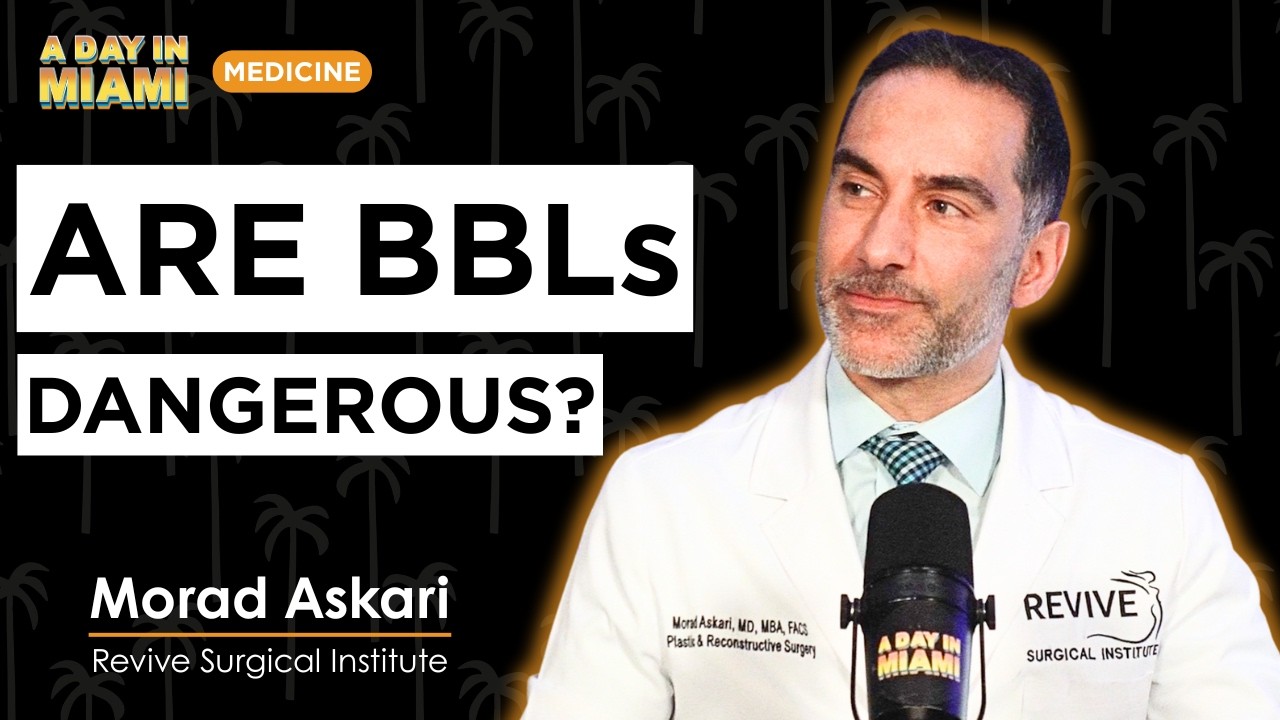
Top Plastic Surgeon Exposes the Dangers of BBLs and Ozempic | Dr. Morad Askari
Board-certified plastic surgeon Dr. Morad Askari of Revive Surgical Institute joins us for one of the most eye-opening conversations we've had on the show. He b...
Sobre este episodio
We also get into fillers, tummy tucks, plastic surgery for men, the "Miami Look," AI in surgery, peptides, burn patient reconstruction, and the wild story of replacing a thumb with a toe. Plus — what men really ask for, OF girls getting procedures, and red flags to watch for when choosing a surgeon.
Before you book any procedure in Miami — watch this episode first.
Manny Alfonso:
Instagram: https://www.instagram.com/mannyalfonso8/
Kiko Suarez:
Instagram: https://www.instagram.com/querikoconkiko/
Eduardo Moya:
Instagram: https://www.instagram.com/mr_moya/
Follow Us! - A Day in Miami:
Instagram: https://www.instagram.com/adayinmiami/
Listen on Spotify:
https://open.spotify.com/show/20WEys6jxiliBCLoo9iSID
________________________
Produced by: Ben Schwede
Instagram: https://www.instagram.com/benthecreatorrr/
0:00 Intro
0:21 What is Board Certification?
1:29 People Doing Surgeries Without Certification
3:42 Teaching at University of Miami
5:08 Decision to Become a Surgeon
7:14 Why People Get Plastic Surgery
8:18 Tummy Tuck
10:12 Should You Use Ozempic or Surgeries for Weight Loss?
13:03 The Issues with Ozempic and Semaglutides
15:24 Ozempic Face
17:46 More Males Taking Care of Themselves
19:49 BBLs vs Going to the Gym
21:35 Fatal Cases of BBLs
23:46 Plastic Surgeries for Men
25:53 Refusing to Perform Surgeries
27:30 Men Decided on Plastic Surgeries for Their Partners
28:09 Board Member of Florida Society of Plastic Surgeons
31:30 What is Miami Look?
33:06 Celebrities at Revive Institute
34:29 Khloe Kardashian's Surgeries
36:08 AI in Plastic Surgeries
37:05 Peptides
38:12 Day in the Life of Plastic Surgeon
41:31 Surgery Process for Burn Patients
42:58 Replacing a Thumb with a Toe
45:02 Red Flags When Picking a Surgeon
48:58 How Has Marketing Changed for Plastic Surgery
50:49 Liquid BBL
54:09 Top 3 Restaurants
56:22 Outro
Sobre el invitado
Dr. Morad Askari
Board-certified plastic surgeon Dr.
Go ahead, Anna. Introduce our guest.
All right. Welcome to a day in Miami. We are here with our host, Eddie, and our very special guest, Dr. Murad Ascari. And he is the founder of
Revive Surgical Institute.
Amazing. And he's not just single board certified, he's double board certified. So, congratulations.
Thank you. For those people who are not smart enough, what does that mean?
Yeah, it's double board certified.
Well, I wouldn't I wouldn't say it has nothing to do with being smart. is just being familiar with essentially medical specialties. I think more and more of the public is becoming aware that if you're seeking a doctor for a certain service, you got to make sure that they're actually uh certified in their own specialty. So all medical specialties essentially have board certification. And board certification essentially means that you have basically a validated seal of approval that you're qualified to do what you claim you can do. In fact, you can probably do it better than, you know, what you're claiming you can do because to go through um basically board certification, especially in plastic surgery, it's a rigorous process that you go through usually after you finish your training. It takes several years. You have to uh essentially collect cases. You have to present yourself in front of a board. You have to basically defend your cases. You have to answer questions. Uh some people fail actually that do not receive this uh board certification. But eventually when you do receive these board certification it means that your uh colleagues people who are in the same specialty who are more experienced and sort of the have gray hair have decided that you are in fact good to go to treat you know average to follow that question you're telling me that there's people who are not board certified doing surgeon surgery.
Unfortunately that's correct. How is that possible though? So actually in Miami that's actually very common in uh so technically when you get a medical license in the state of Florida um realistically you could do anything that any doctor in any specialty does. Now in practice that really doesn't hold. I mean a person who's for example a general practitioner probably doesn't want to do brain surgery but interesting a lot of people want to do plastic surgery for some reason and uh there you know there are people who do weekend courses there even like one-year uh courses that some people do from some medical specialties and then they start doing um you know basically aesthetic surgery for example or some aspects of cosmetic surgery it does happen with some other specialties as well um and this is why I think uh board certification has become much more important in fact the American society of plastic surgery is really trying to you know push this forward and they're really trying to educate the public that if you are getting uh plastic surgery, uh one way that you can make sure that your outcome are going to be probably better uh is to go by board certified plastic surgeon. That is not to say that some of the other guys who are not board certified don't do good work. But ultimately, you know, similar to when you take your car to a shop, you want to make sure if you're getting, for example, oil change that these people are people who change oil and are qualified in doing it, not like for example, people who do body work, for example. Um this is sort of similar to that as well. Yeah, it's really intense. I mean, I if I'm going to go get my face touched, I mean, I've never had plastic surgery. I'm not saying I wouldn't get it in the future, you know, but
uh I would want to make sure my guys like, you know, quadruple board certified as much as possible because touching my face, my body, you know.
Yeah. No, for this is something I think it's a really good point to raise, but um um obviously Miami is the hub of uh plastic surgery in United States, if not in North America. you know, we we definitely have patients from all around the world coming to us. Um, and I think that education doesn't always exist. In fact, some of the uh some of our own population, people who travel from across the board from the US, if you have a nice Instagram account, if you're presenting your stuff a certain way, most of the time, you know, we stop right there. Sim similar to how we hearing more and more that people get their political news from Instagram, for example. It seems like we really relying a lot on social media in trusting our lives as well.
Absolutely. And now you've been practicing for 15 years. And you also taught at M. Tell us a little bit about that.
So actually what brought me to Miami? I I trained in Los Angeles and after that I was in U Mayu Clinic. Um I came to Miami because uh an opportunity came about at University Miami. I'm I'm uh as you mentioned I'm um uh dual uh certified both in plastic surgery and microvascular and upper extremity surgery. So that was the the one place that I was able to actually get the ideal job where I was part of two departments and I was basically dealing with um medical students, residents and at the same time I was doing uh cases that you know as you know universities usually get more challenging cases. So it was great place to get started um and uh basically to learn the the ropes of what the field of plastic surgery and the greater uh Miami essentially is like.
Amazing. And now did you grow up in Pennsylvania as well?
I did. Yes. in the Philadelphia area. Yeah.
And what brought you to Miami besides being the hub of plastic surgery?
So, primarily the job, but then when I came here to interview, I was just stunned. You know, I I'd come uh once or twice when I was a kid to go to Orlando, to go to, you know, Disney World. And then one time, I think we came to Fort Lauderdale and then I came over here, especially coming from California where you had to be uh, for example, an A-list uh Hollywood star to live on the water. And I could see that, you know, you could just, you know, have a condo, whatever you want, and you know, wake up to the ocean. That was the selling point, but it was really University of Miami as well. [laughter]
Nice.
But all right. So, so walk me back. When you were growing up, did you fall in love with medicine or you said, "I'm going to be a plastic surgeon when I grow up." Did you know that at at a young age? Cuz I feel like it's um So, if you know, I I have had exposure to medicine in my family, but no surgeons. And it's very interesting. I sort of always thought to myself that if I did uh go into a trade where I wanted to sort of make my living, I really like it to be such that I can uh make that living from helping other people. That was really the ideal and um also my background of you know people who I grew up around I definitely could see that the doctors were the valuable members of society where when you're at a loss everybody's looking up to this doctor in white coat and hoping that um you know he would have an answer when nobody else has any answer. So that was really the impetus to go to medical school in the you know medical school generally what happens with students is that you sort of identify whether you're more somebody who wants to just get in there and like treat the disease and make a change right there right away in the operating room or are you somebody who's more you know of the type that wants to go to clinic give somebody a medication and just wait and wait and wait and see okay now like the blood pressure comes down now let's give them a little bit less maybe now the sugar gets better let's do this and I was uh for better worse among the group that wanted to just go in there and make a change and come out and see results a little bit sooner And so I identified with surgery. Reason I went to plastic surgery was because most of surgical uh medicine today is about taking out disease. You have lung cancer, we take out the lung. You got gallbladder disease, we take out the gallbladder. You got appendicitis, we take the appendix out. You got some sort of ulcer in your intestine, we take the intestine out. But when everything is taken out, ultimately they need a guy to come in and put everything back together. And that's what a reconstructive plastic surgeon uh does. And the big part of plastic surgery is actually reconstruction and basically putting things back into function again. when something's not working. Now, aesthetic plastic surgery, which is where um essentially there's a lot of focus in media, is part of plastic surgery where essentially um already you you know you're dealing with something normal, but you're trying to make it a little bit better. Well, the reconstructive plastic surgery is when technically you're not at normal and you're trying to come back to normal. So, you're trying to basically reconstruct somebody's face after a gunshot wound or a car accident um or after, you know, cancer extension for example.
Wow. Listen, what is the majority of cases you see people come to you? Because you got into it to help. Obviously, you're doing the aesthetic side. Um, is it weight loss? Is it how they feel? Cuz I know confidence is key, especially now with this day, this day and age in social media where everyone's on the camera all the time. Uh, I wanted to get your insight on what people usually are, what do you see a lot of people coming to you for?
Sure. So, obviously 15 years uh later now that I'm in a in an office in Coral Gables, my practice is different than how it was before. In fact, three times already my practice has changed from being, you know, very strong in reconstructive and burn to now uh primarily an aesthetic with a big focus on massive weight loss patients. So, you know, for better or worse, most of what um my patient population is looking for, they're usually people who are living a normal life. They don't have necessarily any deformities or abnormalities, but they want to live the the better self of their own, you know, their own uh being. They want to be they want to be themselves, but they want to just somehow feel a little bit more uh healthier. They want to look the better version of themselves essentially. That's sort of like one thing that I actually hear verbena from my patients.
Right. And now congratulations. You just got named right number one plastic surgeon here in South Florida by Newsweek and specifically on your tummy tucks. So talking about surgeries that must be something that you see a lot. Now I am a little bit against tummy tuck but cuz I'm not a mother and I believe in you know fitness doing it the right way no shortcuts. However, if I was a mother, I would totally go in for a tummy tuck. Tell tell us a little bit about your procedure and what makes your procedure more special than other doctors in the area.
Sure. Um I think there are a lot of good doctors in the area. Uh obviously all of us have our own little you know changes to the procedure that you know we think you know something that we've learned to do uh to make u our patients happier and basically get better results. So reality is that not all Tommy talks are the same and it's very much I always say to people that many aspects of plastic surgery including Tommy talk is sort of like the same way one goes shopping for shoes or jeans. There's one size that is going to fit you but you know just because you like certain gene of certain type or certain shoe of a certain size it may not be the best fit for you. So um basically the idea of number one is to find which type of tummy tuck fits that person uh best and there's different types. There's for example traditional uh sort of classic abdominal plasty or tummy talk. There's extended version. There's what we call fuller release abdominal plasty. There's circumferential. They're all really types. And then literally every day a new modification comes up. But those are probably the four biggest categories. And um basically become a little bit more um I guess detailed when it comes to someone who has more extra skin or has specific needs elsewhere in their body. Sometimes tummy talk even though you're everybody sort of thinks of it as a surgery that is done for the front of the body in the lower abdomen it actually can be impacted by what's going on in the back for example or in the chest
right now this is a very interesting question okay and you're going to probably have some other angry doctors out there do you think somebody that is severely overweight could be genetics it could be an issue they've tried everything diet exercise and they can't lose the weight do you think that they should do the tummy tuck or do you think that they to do those like shots lipo what are they called
yeah that a zmpic
what do you think should they first try a zmpic and then do a tummy tuck what
sure so that's a great question and obviously as a doctor like same way you see all the fine print on everything that you buy I have to say that this is a generalization uh but you know altogether we know that if somebody's overweight and their body mass index is above a certain level if they undergo surgery that involves body contouring body contouring is anything that involves essentially removing fat and skin like where the incisions that are being made to essentially improve the shape of the body those people will can have more complications. So essentially if body mass index is a little bit lower body mass index is a value that we assign to a patient based on their height and weight. So this way I can compare somebody who's for example 6' tall to somebody who's 411. If their body mass index is for example let's just use the you know what we use in our practice which is 32. If it's below 32, um, that person potentially can have whatever surgery they'd like to have pending that they're cleared by their doctors and there's no other health issues going on. But if they're above that, obviously becomes a little bit more of a customized um, decision. You know, we sort of look at that patient. Some people may have higher BMIs, but they may still be good candidates for surgery. But we know that the more essentially fat that exists, the more difficult time one may have with um, basically healing. So many many times for those types of patients um if they're willing and capable we usually like to counsel them on how they can achieve weight loss. Weight loss is done many different ways as you mentioned. One of the ways that is becoming more and more popular these days are basically what we call GLP-1 receptor agonist of which ompovi or for example the generic name is semiglutides um you know may have heard the names tepatitize mjara these are all part of the same uh family of drugs and in fact every day new one comes in as you may have heard recently um oral version is has come out too so these do exist and they're good but even those I have patients who come to me and say doc this is not working for me I've been taking this medication for three months now put on weight you Wow.
So there's there's a little bit of coaching that goes into it, but they are uh much better. We have they have a lot more promise than some of the prior medications that we've had. They've completely pushed things out of the um basically the the mainstream when it comes to for weight loss. We had for example fentamine. We had medications similar to that and they're essentially falling sideways as more and more people are you know finding luck with these medications. In fact, I'm hearing more and more from my friends who are beriatric surgeons who do weight loss surgery that their business is being affected by these medications because people are actually managing to lose, you know, really really impressive um numbers of um you know, basically pounds of weight with these something comparable to, for example, gastric sleeve or even gastric bypass surgery.
I see a lot now in the news the after the OMIC, which I actually tried it once for like two weeks before I was getting married just to lose a little bit of weight. Mhm.
Um, but it gets you, you can't really, you don't get any hunger, you know. I would drink coffee and you couldn't really go to the bathroom. So, it was a very awkward feeling. I didn't feel good. You know, I didn't feel like myself.
So, I I weaned off of it, you know. I I didn't want to follow through.
But I see now people who who've taken it. Obviously, it's done a lot of health benefits for the majority of the population. Um, but I see them now with like Osmpic face
and then I recently saw the apparently the bone density is also an issue too, long-term issue. So there are you know good medications as I mentioned to you under supervision of a healthcare provider. The problem is that more and more people can buy them anywhere. I mean you can now buy them online. You know you can and there are definitely clinics all all around our own city and definitely southeast Florida where with a very little um contact with a health professional you can be basically given a prescription can start these medications. Uh sometimes you could even I mean you know I don't know if you've even seen them but on Facebook or Instagram you can get actually connected with the doctor and they can basically just ask you a few questions without you ever seen that doctor and you get send a prescription and you can get it. Um this is fine. I think it generally has this model seems to have worked because it does exist and seems to be continuing. But I could tell you that um there's going to be I have heard a lot of patients sim say similar things to you. Now obviously uh it's arguable whether you actually need to be on semiglutes you know but I understand your point. Um many patients start them and they don't have um they don't have good reactions. You know, many of them have gastrointestinal issues. They get nauseated. They just don't feel good. And that's actually just telling that somebody needs to just modify that dose to something that works for you as opposed to just, you know, completely giving up on it and saying that this doesn't work. And then the other thing that we know that um really really is important with the these medications the GLP1 receptor agonist is that you have to supplement yourself with protein because when you don't then you start getting to the whole cascade of first of all losing muscle mass which believe it or not people love initially because when they go on that scale they see that scale changing and you see that results. You see like 5 lbs gone but but you don't realize that a big part of that five pounds was like your biceps and your triceps and now things are a little bit different. You heal differently. You recover from um illness differently. You may get sick more. uh uh faster. But if you do it right with the right everything else in place, it's really can be rewarding.
You can manage it. But have you had a case where someone goes takes uh semiglutide, lose drastic amount of weight, they have those epic face, and then they're like, "Hey, you need to get a facelift now."
Yeah, that does happen. I mean, it happens in the face. It happens elsewhere in the body. But yes, what is traditionally, I guess, you know, what has come to be um known as the ompic face is essentially a face that one gets after having having had accelerated weight loss. So, you know, we see that anytime your body goes through changes, whether you have accelerated weight gain or weight loss, you your body does not keep up with it as quickly. Like, you know, if you lose weight, for example, if you lose 50 lbs over 5 years, your body's going to respond differently than if you lose 50 lbs over 2 months, for example. So, we don't have the same elasticity. Your skin just doesn't um keep up with it. Now, one thing that is interesting about ompic face is that we know a lot about natural aging. We know that when you naturally age, you lose fat in your face. Now, everywhere else we may gain weight, but there are places that we love to have fat and we actually lose fat in those places with aging, including our face, our butt, and our feet. Those are some of the areas that are everybody wants to have fat, but unfortunately with aging, we lose fat in those areas. And one thing that happens in the face is that as we lose these like really full you know sort of beautiful cheeks that you know we you know that one sort of admires in a younger person everything else sort of loosens up and falls. It's not an actual mechanical fall that you see in the face especially with the ompic um and similar medications but it's more deflation of the face. So everything just falls you know sometimes simply just putting more fat in the face can actually you know undo that. Some of those people may not even need a facelift, but depending on how much the their face has changed and what age they are and how long they've been on these medication and how much weight they've lost, sometimes um they need more than just fat transfer. So ultimately that is becoming more and more reason. We have more and more patients coming to us. Face used to be sort of like the forgotten part of the body when somebody would actually have weight loss. But more and more it is becoming a focus for everybody. And we are living in a world especially since uh the days of COVID epidemic that we're becoming a lot more focused. we all have to be on, you know, um on on on the monitor looking at ourselves or be on social media looking at our own photos. We're becoming a lot more conscious about our face uh and our look. So, those are some of the things I have patients now that come actually want to, you know, do something about their face before they want to do something about their abdomen after having lost, for example, 150 pounds, which is unheard of, but 10 years ago, you would definitely be doing something about the body before the face.
Do you see males going more into into this world now and wanting to take care of themselves more? Because I feel like I do. I feel like I see a lot of my friends back then we used to call them like metrosexuals you know [laughter] I always felt like I was one maybe maybe not you know but um I have a lot of my friends that they just like taking care of themselves you know
yeah I think I think uh men taking care of themselves is becoming less taboo than it was as plastic surgery is really becoming part of this whole spectrum of wellness this is becoming also more acceptable um so you know so yes I do I would say that over the last 5 to 10 years we've seen more males seeking plastic surgery we we have seen that you you know almost 10% of our population at times maybe more are males and this is sort of I think statistics that you see uh across the board we're really actually trying to expand that aspect of our practice because I think it's very um it's actually really helpful to patients I think many men um I I meet them mostly in the context of um their wives or their girlfriends or their daughters coming to us and then they just come around and at some point they ask me doc can you do something about this like I've you know I have like my chest looks like this I'm really self-conscious about going to the gym um is there something that could be done and it's more like okay I know there's nothing can be done but just let me tell me like you know
is it like can you give me some abs and chest it's kind of
it could be any of those yeah it could be any of those but yeah
that's true
but the the probably one among the more common um uh procedures we do for men in some regards is not that different but like liposuction still among men is a is a very popular procedure gynecomastia surgery basically um you know trying to make a the chest more masculine looking when somebody has be extra skin or some people have some extra fat. Uh that's a very popular one and then just you know adonoplasty or tummy tuck uh even BBL putting fat in the glutal area. These are not uncommon. They're done differently for men. They're you know this is why I think it's good to um you know for for someone who's familiar with these procedures doing the procedures but the way you for example do a BBL in a man and a woman is night and day different and uh same way with the tummy tuck. So those are some of the things that obviously goes into consideration as and the technique.
All right. So, I'm a bodybuilder competitor and I know what it takes to get amazing glutes, right? Lots of deadlifts, lots of hip thrusts. I mean, name it, right? However, there are some women that just can't seem to get glutes.
Yes.
And they go and get a BBL. What are your thoughts on that?
Or men.
Or men.
Yeah. [laughter]
Yes. I I never consider men with this, but there's a lot of controversy, you know, and stigma around BBL. But I mean you've done everything you could and you still don't have amazing like lifted glutes,
right?
What do you have to say about that?
So very good question. I think this is something that comes about a lot from our patients as well. Um so I have to distinguish because while um I think the best way of if one is athletic and you know is a bodybuilder they should definitely start supporting their their glutial um the glutial muscles you know there's several glutial muscles that you have glutius maximus you know obviously the one that is mostly targeted when uh somebody's doing specific workouts for example that definitely creates a lift um but ultimately you know one of the main things that is considered aesthetic is the volume in that area and that volume is not necessarily the muscle it's actually the fat pad that is over the muscle. A lot of women who, for example, have more square shaped hips or they're feeling like they they look a little bit boyish around their hips is because they're just basically have what they refer to as hip dips. You know, areas where you have posity of muscle. You don't have this posity of fat over the muscle. So, the muscle may be quite strong, may be very lifted, they may be very strong. In fact, they may be going and doing squats in the gym all the time, but they don't have as much volume there. Um so what is done usually when we do fat transfer which is more popularly done uh known as BBL or Brazilian butt lift which is a very inaccurate name because it's really not a lift it's an enhancement in medical in medical term we call it uh glutial enhancement with fat transfer
why are some women just dying maybe they went to a doctor that wasn't double board certified
so that certainly has been the case if you look at unfortunately um some of the cases that have happened they have some of them have been uh ones that have gone to uh doctors that were not board certified some of them have gone to doctors that were board certified but you know maybe some of these high volume places where you don't necessarily get the you know the close attention that you should get. Many times it was a basically a misjudgment in who's a good candidate for this surgery. Somebody who probably with better and thorough investigation before the surgery they could have been ruled out as somebody. And then sometimes it was just a terrible technique usually because that person either the doctor who claims did the case didn't do the case or they weren't as familiar with the with the glutial anatomy. technically a plastic surgeon besides putting fat in people's glutial area should be very familiar because we have all types of flaps or reconstructive procedures. You know, we're the doctors who take care of bed sores and things that sort. So, we are very familiar with every layer of the glutial area and they should very well know, you know, where to put the fat. Um, in the state of Florida and something that I think everybody across the country, you know, is coming to do more and more, we actually use ultrasound when it comes to transferring that fat, whether it's in the glutal area somewhere in the body. Even if I do fat transfer in the chest or in the face, many times I use ultrasound because um we want to know exactly where is that fat going, you know, where is it sitting. So in the glutial area, we want that fat to not at all uh be going into the muscle. We want it to be above the muscle. So that's why like, you know, when you know, when I know that somebody likes to have very enhanced glute, you know, glutius muscle, they have to know that when you do BBL, you're not looking the same way that somebody does when they go over to the gym. It's really the fat over the the buttock that looks more enhanced. And that that there's many layers of fat that one has over their glutial area and this needs to go into the right compartment for it to look natural, you know, incredible.
And and and when it's done in the right way, in the right place, um it really can be very rewarding. It can really um produce very good results. It can almost look like the muscle is actually larger because the layer of fat in which you're putting um the tissue is usually right above the muscle but not in the muscle. and you're putting it bas basically in that area and you're enhancing um that shape that naturally the the botock had.
And you did have a dedicated section sorry just for men in your website. Yes.
So like you mentioned earlier more and more men are like going away from the stereotype that it's just for women and going into your practice wanting just different procedures.
Yes. Um I think well part of it is because we're overall we're becoming a little bit more educated. I think my patients are just it's amazing how over the last you know 15 years that I've practiced how much my my patients are more educated about what they want before it used to be that somebody would come to my office and ask me so like what can you do with this what should we do um and then we would have to start from you know basically ground one and try to build up to ground 10 now my patients come they already have some ideas they've been on social media they've done their own research they actually ask me about specific treatments and now simply I just have to guide them through the treatments that are out there and they already know of the five things that are out there like you know I didn't know about each and they just want to basically pick the right one for themselves. I think in answer to your question is why you know I I sort of you know as a man myself and having been exposed um and being the guy who back in the day didn't think that you know men should really care about how they look and what they wear. I do think that you know we we could benefit from a little bit more uh outreach and education when it comes to these topics and that there's no shame in wanting to you know look your better self. I also do think like we talked about it earlier overall the role of plastic surgery has changed before it was something that was going to define nature you had aged or something had happened and we were trying to change it that is not what plastic surgery is about and we should not really think of it that way it's really a spectrum of wellness we become a lot more health conscious through the years we all do things differently than we did um you know 20 years ago we all were sunblocked it's becoming about being healthy and doing everything you can to sort of live whatever life we're all going to live but live it as best as we can live and you know be our the better version of ourselves. So plastic surgery has a role in that sort of you know armamentarium of things that one can um use to achieve that goal which is to look not necessarily don't defy age gracefully but do the best version of be the worst version of yourself essentially. Yeah I love that. Do you ever get a case or do you ever have a situation where someone comes in and you're just like I'm not doing that, [laughter]
you know? Yes. Yes. It's actually happens more than you think. Part of it because some people just have um you know um maybe unrealistic expectations and more importantly some you know the thing is we obviously part of my job is to guide my patients or counsel them on what is considered aesthetics. when somebody you know I'm going to use an example like you know I have women who come to get a breast lift for example and they want an implant and um you know they're they have they have long chest their breast belongs lower in their chest and when we talk about where the breast will need to be it's going to be higher than where you know where it is then but it's not going to be as high as they want it to be which is like by their neck essentially um you know sometimes shirt yes well part of it yeah because they want it to be seen through you know cleavage of shirt but if you're you know have a long chest and your breast or you know there's if your breast have been attached to your chest at a lower h section of your body, then there's no way they're going to come up there. And if you do it that way, even though it may look good for the for the weekend and maybe for the next few months, longterm, it's not going to be a good idea. Or they want a really big implant, an implant that doesn't fit their body, and we know that that is going to basically cause problems. And then occasionally you have some people who just want things that are just not, you know, like um they may want u something that is just not considered um proper like you know they want something done to their face that just is not considered um you know um probably uh acceptable when it comes to some of our norms. So with those things it's you know we do we have no shame in sometimes telling our patients no you know maybe somebody else can serve you better than we can. Yeah.
So safety
absolutely. Do you ever have a situation where you see like a guy come in and just like hey brings his girlfriend do her up you know like get her ready. Unfortunately, yeah. Unfortunately, uh sometimes we have had couples come in where one speaks for the other and the other one's very very quiet and those are always very um um you know that almost is a sort of a red flag, you know, and um you know and obviously you know some some there's many things that we sort of have in our uh questionnaires asking uh our patients and we do like to have the family member be involved but not to the point where one is not talking at all and the other one is sort of like treating them like it's a good that belongs to them. So it's
wild.
Yeah. But that unfortunately does happen sometime.
Is she a lot or no?
Not a lot. But yeah, it does happen.
Dr. Wow. You are a board member of the Florida Society of Plastic Surgeons. Tell us a little bit about your role and some of the things that you discuss on a monthly basis, maybe safety measures for any of the surgeries that you perform.
Sure. So, our group is committed to basically improving the quality and basically the practice of plastic surgery in Florida. We're actually um sort of a subgroup of the American Society of Plastic Surgery. So you know American Society of Plastic Surgery which oversees the whole country has also you know uh branches across and uh we're basically affiliated with them. Um but as as a group we basically have membership all across uh Florida. Many of the board certified plastic surgeons in Florida are actually our members and we have actually an annual meeting every year in actually West Palm Beach uh in December. Um and as the board we meet every month and we have specific um basically priorities and one of our priorities is how to make plastic surgery become safer and how to make uh basically plastic surgery better for both our patients and for our doctors. Um, one of the things that um is very notable about Florida Society of Plastic Surgery is that when originally um the whole scare came about about BBLs and there were several deaths reported in various um um basically centers with high production where they were doing you know 16 to 20 BBLs a day per surgeons. um this obviously raised the flag and one of the things that we decided you know as as they were talking in Tallahassee about banning BBLs or doing things and basically coming up with um sometimes this one you know one-sizefits-all type of answer that we see um in in in in politics. We decided to investigate this more. Actually a few of the board members actually were involved in performing autopsies on those uh patients and it was actually the cause of what was what had gone wrong was actually uh identified and we realized that actually those patients um the reason why they had the complications they had was because the fat was mistakenly injected into the muscle and that had basically gone into the um blood vessels and had caused the stroke essentially. Uh that was you know the typical um you know things that was seen in common and because of that new policies came about. one was that you know to require uh at least anybody who does this type of procedure in Florida whether they're board certified or not board certified to uh use ultrasound when they do this and to have some you know training in ultrasound uh to have some basic training since then we've also again worked with our politicians in this state to come up with some rules and some regulations um one of the things we deal with every time is that um you know every literally every you know couple months a new group that is not um a plastic surgery group I don't want to necessarily name them they come and they want to sort of basically uh poking into doing some procedure that usually should be done by plastic surgeons. They're med spas that want to do plastic surgeries. They're you know um you name it like small little shops here and there that want to do Botox and fillers and there are people who are not doctors who want to basically uh perform procedures unsupervised. These are some of the things that we work with uh politicians. We actually have a lobbyist who works with us and through that we've been actually really been effective in trying to make plastic surgery safer in the state of Florida.
Yeah, it's a good job. We got to continue doing that, doctor, because
that is I didn't know it was that serious. Like, you know, you had people doing these random things in these little offices.
You know, you usually see these news articles of something happening to someone and you think it's just like a mistake, but from what you're telling me, it's bad practice now. What's leading to this?
Um, would you consider there is like a Miami look?
Like if you if they say, "Hey, do you get girls I want to look like a Miami girl or?" So um I don't I don't remember having anybody who in fact I have people who come because most of you know 75% of our patients actually come from out of state and then I occasionally have somebody who tells me that doc I don't want to look like the Miami girl you know and I think and then you know which then begs the question of what is the Miami look and I think the Miami look is obviously probably not very accurate some I think some women in Miami would definitely take offense to this and some men would as well too but it basically usually means that everything is exaggerated so you have mo you know most commonly obviously the breast or the the buttock. So those are the you know things that people I think people who at least come from out of state associate with the Miami look with somebody basically you know has really really large breast and really large buttock you know
I would think like a couple years ago you know 10 15 20 years ago I would probably say I feel like the Miami look now is I don't know I feel healthy you know I think a little bit more I think that's how we as residents of Florida and Miami perceive this because we truly know what a Miami look is and we look you know we're all um because we live in an environment where we tend to wear you know t-shirts most of the year. We tend to show our body. We can't really hide uh if you had, you know, extra fat. We tend to be healthier. We tend to exercise more. And those are some of the things. I mean, I came I come from Pennsylvania, so trust me, I know firsthand um when I first came to Florida that everybody looks different. They look like they have a little bit more life in them. Everybody has a little tan because they see sun more, you know? And I really do think that the sun really impacts our life and makes us want to, you know, do better and live healthier. Do you ever get like celebrities and like hey I don't really know about this you know.
Yeah just we unfortunately we do and I as much as I would love for those people to give us a shout out at one most of them are very incognito. They definitely don't want anybody to know. Uh but we've been very fortunate to be um doctors to some celebrities.
I don't see why they wouldn't want to give you a shout out. Like I'm so open about that. Like whatever I do I only get Botox
you know and I'm I'm a huge believer in Botox like public figures you know they probably like I don't want nobody to know that you like you No, I'm a public figure.
Yeah. Yeah. I think you're more
I'm a local celebrity.
You're local.
I I agree.
You're our celebrity. I think after everything you told me, I'm definitely going to be a fan now. Um but no, I think part, you know, some people are more confident. I mean, you also know celebrities that have no problem talking. Um nobody talks about their plastic surgeon, but they will talk about uh what plastic surgery they had. Um but no I think more and more they you know I think we we all have this tendency to say that I'm naturally beautiful and I want to keep it that way and I want to you know advertise myself as having been all you know people who have especially many actors who've been uh in public eye for like say 34 years from when they were young like if you're somebody like Tom Cruz who everybody's known since he was in his 20s and now you know in his 60s and people are like going to be like oh man like look at him now you know obviously he may not want to anybody know that he's had plastic surgery because he knows people have known him that way and he wants to say that I still have that in me.
Yeah, but come on. Like it's obvious like the Kardashians like when they say they don't get plastic surgery like really.
I saw the Netflix documentary of Lamar O.
I did too. I just finished it
and I saw the way that Chloe looked and now it's a different
definitely definitely at least two rhinoplasties since then. So I I'll say now that I have you here what do you think she did? How'd she get like that? Cuz it's a she looks way better now than she did 15 years.
I don't know. That's argu that's a I mean I think she looks good now and she looked good back then you know just in a different way. Um first of all you know kudos to her. I actually you know I had I was on a flight so I you know the only thing I could watch was that and I really actually enjoyed that show and I became and I actually had never was never really knew much about the Kardashians but kudos to Chloe for sticking u by by by
I want someone you know
who loves me like Chloe love.
Exactly. I can't let I can't believe he, you know, he let her go. But,
but anyways, but one of the things that was catchy, you're right, though, you couldn't miss it during that interview because they had all these close-ups of Chloe was that she definitely had had a rhinoplasty nose job, except maybe maybe even two, I would say, because that nose looked like it had been basically worked with at least once, maybe more.
Um, so,
you know, I think she looked good there. There's, you know, there's there was definitely, you know, certain technical issues which made me think that this was probably maybe a revision had been done at some point or the other, but um, you know, kudos to her. I'm I'm a big fan of her now.
She look phenomenal.
No, her nose. Can you make my nose like hers?
If I think your nose looks pretty good, you know, broken.
We're going to get Anna an appointment there. [laughter]
A couple other questions that I have. AI celebrity patient that I [laughter]
a AI and plastic surgery. Has it gotten to that point yet? uh are you seeing anything new considering you're in the board? You talk about these
things. It's hard to find any field in in in in this today's world that is not affected by AI and uh we definitely we're excited to see how AI is actually going to shape plastic surgery. We definitely use AI in our practice to help us with simple tasks like scheduling like you know sometimes um even you know some basic stuff as far as just our everyday uh matters but um as far as you know as far as assessments um you know there there's some softwares that are being developed where for example AI can do a consultation or tell you like you know um okay like you know you you have this you know your face looks like this age as opposed to like your age or you know or some of the things where they can look at your weight and height and basically make recommendations regarding health measures you can they haven't become common practice but I think that they're going to be you know hopefully tools that can assist plastic surgeons um to further get confirmation regarding some of the decisions they make you know
that and then uh peptides
I've seen a huge rise now in people incorporating
so very controversial as you know um most of these peptides are not uh FDA approved in fact technically you know some of the some some of the semiglutides are essentially you know peptides so they're are FDA approved but there are many other peptides um that you sort of hear about that are good for healing for u tendons. There's definitely very promising data regarding some of them but I could tell you that there are a lot more than the few for which we have a lot of good data for. I do suspect that by 2027 a lot more of these peptides are going to be FDA approved. Um, but I would really want our listeners to basically uh approach this with caution because there's definitely a lot of uh also bad stories you hear when people have had allergic reactions to peptides or things haven't gone and you know I think I think it's always good before you put something you know we get excited when somebody tells me like I took this and it did this for me. Um maybe your body is not exactly like theirs. So, you know, wait for some more data to come out. But it is definitely something that I actually very excitedly wait for and I think it's going to really uh be um something that at least going to help uh our patient population in our practice.
Obviously, I've never had a chance. This is the first time I'm meeting you, right? And you're an extremely interesting person. What I'm I'm curious to know what is a day in your life because being a surgeon for me it would you know just gives me like an immense amount of fear you know going into a room you know set up cutting people up. I would never be able to see myself doing that. How do you prepare for something like that? You know,
kind of bring me into your into your is are you going is it like game mode for you? Like, hey, it's game time. Let's go.
I want to come. We should do an exchange program. You come live my life one day. I would love that.
I'm so fascinated by your life. I want to come and like do what you guys are doing cuz this is so awesome.
This is this is fun. But yours is like,
you know, serious business. So number one is that I mean by the time you walk into that O it is I got to tell you it's an it's an amazing feeling to you know especially since we trained for so many years you know you're you know I I went to college for four or you know four years then I went to medical school I did a you know I did u basically a research project for another year so it was five years and then I went to training and even though I was in an accelerated program was seven years so you do all of that u to basically prepare you for that first day when you walk into the operating room as a young attending uh surgeon and it is just exhilarating to to know that you know you are the commander of ship. It's like I I think the same feeling that probably a pilot or a ship captain has when they finally walk into that cab. But ultimately it's very nerve-wracking at times. But the good thing is that by the time you're there you have prepared for it. I got to tell you I've been doing this for I graduated medical school in 2004. 21 years later or 22 years later I had a rhinoplasty today and all yesterday I was preparing for that case. Um and uh and I will continue to do this till the day that I probably stop working because sometimes you need to again everybody's different. There was you know a specific thing that I wanted to review. I knew I knew it. It was also going to make me feel better knowing that I was going to read about and review it. So key is preparation before you walk in that room. And this is something what we do. So if you want to know what my day today was last night, yesterday I told you what I did when I came home late at night. I was preparing for that one. Um today I I got up first thing in the morning went to went on Pelaton. Then you know then my wife reminded me that I'm running late so I basically got myself ready went to the office and then um basically we did um three cases today and then between cases we see patients. Um um and then after you know after that we we do some more procedures in the office. Um then end of the day usually if we're not doing this we're basically sitting out and basically doing huddles regarding our patients talking about you know people we've seen instituting care with our office staff. Um and then usually we end up uh leaving um and then when I leave I go take care of my parents who are who live also in Coral Gables but they have ad dementia so I go and basically they're my children essentially. So yeah you're a great person
both parents unfortunately. Yeah.
And do you find time to relax any way shape or form?
Well be being with them in some regards is very for me it's it's gratifying. It's not like all work I'll be you know you know what sounds selfless but part of it is also fun for me to be with them. you know it's it you go through I think with dementia you go through you know five phases of um you know with everything else the final phase is acceptance and then when you finally at that phase uh it's actually very gratifying because you value the time you have uh even though you know that person may not be um everything they used to be you know still you know pretty valuable yeah
do you have kids or
I don't that's why they're mine
okay [laughter]
I'm I'm available for a
when someone has a burn um and you need to reconstruct Are you taking skin from other parts of the body? Because I s I feel like sometimes they look like patched up or stretched out. How does that work?
So, I mean, it's obviously a little bit more complicated than that. Um, but uh but yes, but gist of it is that you know they're missing skin. Um there depending on how much skin they've lost, whether it's full thickness or partial thickness. You usually have to either replace this skin with their own skin or sometimes you actually have to, you know, you take samples of their own skin. They grow it in a lab or they do things to it to essentially expand it so you can get more skin out of it. Um and then sometimes you can actually use cataric skin or there is also synthetic uh skin. All of these come to play to essentially make someone who's lost greater amount of skin of their body to survive and to go on living. Um but as you could imagine the more skin one has lost the more likely that everything will not be perfectly normal. But most of the time I mean we've learned a lot this field has also advanced a lot every day and new technology is coming where allows us to you know better serve this patient population. Also, we're learning a lot more about rehabilitation and things that comes um after to essentially be able to integrate um these patients back into the society. And
do you ever miss that like part of the field? Like
yes and no. Um uh yes, it is gratifying in some ways when everything goes well. It's you know, but at times it's also very um you know, you come home and you're just you know, you're just not yourself. You know, it takes a we we learn as doctors unfortunately to be able to disconnect um but it becomes really hard sometimes. So, I heard a rumor that you one time transplanted someone's toe as their thumb.
Um, yes. So, we do this. There's a there's a procedure that we do for someone who, for example, has lost their thumb. Um now not everybody's a candidate for this but if you have specifically lost your thumb at a certain um level like this person had lost their thumb at the level of metacarpal knuckle and it was a it was actually a a young boy 16-year-old and um and uh basically he was you know he'd been referred to me by someone from u West Palm Beach and we evaluated the the child and we thought that he was actually a good candidate and he was amidable to giving up one of his toes. So we took off we took basically the second toe of the of one of the feet and we put it in place of his uh thumb and it actually ended up working really well for him. Your thumb it job is to be able to you know oppose your hand and be able to grab something in there. So and the second toe the big toe is actually even better but big toe unfortunately causes some functional deficits if you take that one. So the second toe
Yeah. So but you know it's a it was a long surgery you know surgery. So you don't need
I didn't know that like our anatomy would be even able to allow that. So you put the second toe into the thumb and it worked function perfectly.
What I would you know perfectly is something that comes with time like that requires a lot of therapy but it does so basically it can become sensitive meaning they can actually have sensation and it can move because you're using the same tendons that were previously moving that thumb that now still exist in your forearm and you're connecting it. So it can bend it can it can extend and more importantly it can allow you to have the function. You know, interestingly, people don't think of the thumb as being a very important thing, but the thumb when it comes to the disability world almost has the same value as an eye does. So, that's how much our thumb um plays a role in our hand. So, that's why we're willing to, for example, use a toe to reconstruct it, you know, if one's a candidate.
The thumb is important, but the second toe is not.
The second toe plays a lot less function. I mean, if you think of it how much, in fact, even if you look at the guy, like, you know, if you look at the, you know, someone who's basically given up their second toe, whether for a trauma or for something like this, it takes a second look to know that they don't have a that they're missing a toe. Yeah. Four toes.
Yeah.
All right. Uh, this is probably a question for people out there that they're in the research phase right now,
but what's the biggest mistake people can make when they're looking for a plastic surgeon? So uh the biggest mistake is number one to like try to go you know with the cheapest one that you can find because you know it's funny like you know we talked about board certification you know I feel like everybody's very um picky about you know where they want to go you know they want to know like what is this guy's qualification um but ultimately when the price comes to to a certain level like it's so low enough they're like okay you know what never mind like this must be good enough you know so you know and that's how like a lot of unfortunately you know high volume facilities have business I mean some of these you know I've I I so indirectly know about some of these places and some of them don't even have a surgeon right now available but they have 200 cases booked. Now you tell me how do you book 200 cases without even having a surgeon ever talk to these patients or even having a name of a surgeon given to those patients. These patients are booking to have these surgeries without even knowing who their surgeon is going to be just because the price is right. They say well you you know you must have some qualification. If you told me that you're going to do BBL on me then like and you're taking my money then must BBL will be done at the end of it you know. And this is to me sometimes um you know we're more picky with which restaurant we go to than uh with the surgery we get.
Um and then the second thing is that um I think number the second thing is that basically to be open to the advice of the plastic surgeon. I think we come from a culture where we're all becoming very educated. We have Dr. Google, we have all types of, you know, social media out like there's multiple, you know, we're getting information from everywhere.
And um and ultimately, uh when you go to a doctor, the doctor's job is not to be your technician where you just tell them to, you know, you it's as though you go to a tailor and say, "Okay, make me a suit, but like I want you to cut here, I want you to sew here." That's um that's is unfortunately a formula for disaster. I think the key is to be open to the consultation. It's good to be educated, but ultimately that, you know, sets a ground for asking right questions and basically come up to a decision. you know be open to suggestions that your surgeon has because ultimately they have more experience.
So don't go by Google reviews.
No, Google reviews can be important but also as you know their their ways of um you know their ways of making them.
Oh interesting. I didn't think of that.
But Google reviews actually you know over it seems over time it has also proven to be a good tool for at least you know having a general idea about somebody's practice. But again, keep in mind, I mean, I know I don't know how you write reviews when you go to a restaurant, for example, but the restaurants for which I write reviews are the ones that really incredibly impress me or the ones that really really piss me off.
Yeah, it's always like never in the
It's always like an extreme, you know. It's true. You got to take it with a grain of salt.
I think the fe I think for me it would be like meeting the doctor in person, seeing how they speak to me, seeing before and afters, cases,
you know. I I for me it had to be like a gut feeling, you know?
I would not recommend going with the cheapest price.
No, never. And I would say, and I think your point is a good one. Um, assuming that one is going to pick their doctor, like they're going to pick a board-certified doctor for whatever specialty they're looking for. I think ultimately there are a lot of good surgeons out there, there are a lot of good doctors out there. Um, and the idea is to find somebody who you think is in tune to you. You know, I've had, you know, it's funny. When I was a um when I was living in California as a resident, I would have u family members or friends call me and they would have gone to Beverly Hills and they would have had plastic surgery done by some, you know, famous people. They would have paid $25,000 for like some small little procedure somewhere, but they couldn't reach the doctor after the surgery. And more importantly, they were scared to call the doctor because they knew they were going to get, you know, somehow like they were going to get some, you know, rude nurse on the other line or they were just going to be pissed off. Why are you calling me? and they were calling me who was a resident because saying that after all that like what do you think does this look right to you like do I need to call them do I need to be worried and to me I would ask myself like you know you need to make sure that whoever you go have a consultation is somebody who you're comfortable with god forbid you had a question after the surgery or you had a complication is that somebody who you think will be there for you to hold your hand if you need to you know
I'm curious to know what are your thoughts in the way that marketing has evolved especially within plastic surgery you know with social media
it's fascinating but at the same Um, you know, I think it's something that I think will benefit from some um oversight and regulations. You know, the truth is, as we all know, I mean, we know about all these influencers that are um influenced every day through social media. You could be whoever you want to be. You know, I was just I was stunned when I was, you know, I don't know if you watched that Netflix special about the influencers where about how they hire like a studio. They there's studios where they have like private planes where you go in there and like you showed like you're in present. So, you
look like you're in a private jet, but you're not.
Yeah. So, it's all pretend.
Yeah. All right. So, so basically you could be who you want to be. And I feel like that's what marketing's become. We we're really basing a lot of stuff on what we see on social media presented to us. And whoever is willing to spend more money on this stuff is going to be the one who's going to get the most patients. Back when I was uh in training, they used to say, I remember my attendants used to tell me that if you do good work and you're, you know, and you put your head down, do good work, take care of your patients, people will come to you. And realist realistically, what maybe there's still some room for that. I think things have changed. If you sit back and just do your own thing and do good work, nobody's going to come to you. Nobody's going to even know anything about you.
So, unfortunately, both ends have to be basically heated in some regards. And um I don't know what the right answer is, but we all, you know, essentially have to follow what the what the mainstream marketing really requires us to do.
Credibility and exposure, not like
experience, too, or like double border, things like that.
Yeah, credibility 100%. because you hear all those radio oh my god the what's the jingle on on the radio and
I don't want to mention any plastic surgery patient just in case but [laughter] yes I know exactly what you're talking about
the jingle jingle
and I will never call them [laughter]
like every time I hear it I cringe
listen a lot of people call them a lot of people call them [laughter] you know
okay doctor we talked a lot about BBLs on this episode but there's a new thing and it consists of liquid BBLs
do you do that So I think the the term liquid BBL has been used by some people again on social media to refer to um use of alligraphed fat. So alligraphed fat is a fat that doesn't come from you. You know technically any fat that comes from our own body is considered an autograph. So like when we do BBL the typical BBL we're using one's own fat and putting it in their own body. So that's an autographed.
But there's this whole new thing that is coming to the market um by a company called Tiger Aesthetics. It's called Alo Clay. Now, there's different versions of it, and I bet in the next few years, there's going to be even more um similar products that are going to come to the market. But this is a fat that essentially comes from, for a lack of better word, a cadaavver, but has been processed in the lab. It's very safe. Um in fact, you know, some components that could be immunogenic and can, you know, result in one rejecting it has been removed. Now, we have this fat and we can basically inject it into one's own fat. The benefit is that you don't have to go through a whole liposuction. Obviously, a big part of what a BBL is when it comes to recovery is the fact that that person has to have pretty extensive lipo suction. Now, some people, frankly, need the lipo suction or want the lipo suction, so they should still get the traditional BBL. But if you really are a skinny person and you don't really have that much fat and you or you have somebody who really just needs a little bit of volume, not too much, and you don't, you know, you really like you, you got to go to work on Monday, you know, you really don't have that much time to take off and um, you know, you want something that has low recovery, you could basically do what's called uh, liquid BBL where now essentially a fat, you know, a product, a fat product comes from a shelf outside of your body and is placed in your body and it can essentially serve like your own fat. Um we know that probably some of it will go away maybe more than one's own fat but it still has a pretty good take. So you know when you put some you know when you you can actually create enhancement of the glutial area without having to put somebody through the burden of liposuction.
Okay. When I say liquid when I hear liquid I think of jiggle.
Yeah.
Does it jiggle more than the traditional?
No. you know, actually very much. I mean, I don't know if you've necessarily seen like a, you know, a fist of fat, but uh it's it looks like I guess maybe for lack of a better word, it looks like a little bit like butter, you know. So, that's what our own fat sort of feels and looks like. Um, this is sort of similar. It actually does have good integrity to it. So, when you put it into an area, it actually creates enhancement of volume. And one some argue that you may not even need as much of this fat, you know, like for example, if you know when you take your own fat, if you need like I don't know this much, you may need half as much with this to create the same effect. And what's even more exciting that they're going to hopefully come up with a version of this that could be used in the face alo clay or the one that I just mentioned is approved to be used in the body. You know, the new version which hopefully will be coming out in the next several months to year will be used for the face. There's also another product similar to that called Renuva which is you know not necessarily like meant for BBLs but is also something that is similar. It doesn't have the exact fat cells but it's similar to you know alligraph fat and it can be used. So they're you know there there are these products that are out in the market and I think they they pose a you know very they provide a good alternative for someone who for example is really really skinny and has been told that you're not a candidate for BBL.
Perfect. or somebody who's got like, you know, who's had, for example, liposuction before or has some deformities that has a little dent somewhere in their body, maybe from trauma or from some other surgery. This would be a good choice for that.
Excellent.
All right. This is uh your hardest question. Okay. You got to give me your top three restaurants.
Okay.
Okay. Starting with number three in Coral Gables. Okay. You give me Coral Gables. I love Corable.
Just so float.
Yeah. Where where you go, where you like to go.
I So we're we're simple people. You're going to start with number three and then tell me the reason why and then go up. Ready? Number three.
All right. So, uh, Zuka in um, again, everything that I know is in Coral Gables. I love all the Coral Gables places. So, I'm going to just I'm going to stick to Coral Gibas and shout out to our little city.
Um, so Zuka. Um, I like um I like Motech uh on
but Zuka Zuka
Zuka that that is on uh Pon that they're actually opening Zukali now in
we've been waiting for that one but somehow it seems like
opening this year. It's I'm sorry. It's opening uh this month. They just finished it up. He also owns Herford Grill.
He also took over that. I think his name is Erasmo if I'm not mistaken.
We'll have to try it.
So, number two.
Number two, Motech. Motech is a is a very good It's a It's a Mediterranean restaurant on Miracle Mos. They have many branches across the um the city, but I like, you know, the one that is here.
Yeah. It's very consistent, too. What do you usually eat there?
Um I we eat the the you know, they have this chicken kebab, which is to die for. Their hummus is great. You know, their drinks are great, you know, so everything you can't go wrong.
Yeah. Yeah. And they do the marketing, too. They do a good job.
Yeah.
I'm excited to know your number one.
Tulio.
Tulio. Tulio. That's Italian restaurant, right?
Yeah. Run by a father and son, I believe. Right. And, uh, they do a great job. Their food is amazing. Uh, the best part of it is when you've ordered everything, they usually bring you this gelato, which is just, you know, incredible.
That's to the left of Flemings. No.
Yes. It's just right by Flemings.
Yeah. Yeah. Yeah. Yeah. I haven't been there. I want to go check it out.
But they're not open for lunch. No,
I don't know. Oh, you know, I've always gone there for dinner. Maybe, maybe you're, you know, you may be right.
Yeah, I got to go check it out.
We should suggest him to maybe open for lunch there.
Been to two Leos.
It's amazing. Yes. Yes. Yes. Yes.
Yeah. Yeah.
Yeah.
And it's it's a very it has a little bit of a also like a familyun feel to it, too.
Um so, which I which I love.
But you usually eat out or
h a lot of Uber Eats, you know. [laughter]
It's okay. It works either way.
Yeah. You see, you're a busy man, doctor. You're a busy man. You're studying. You know, you're doing things the right way. Doctor, honestly, it was a real pleasure.
Thank you so much. Thank you. Thank you both. Such a pleasure. Thank you.
Great having you.
No te pierdas un episodio
Suscríbete y recibe cada episodio en tu plataforma favorita.
Suscribirte en SpotifyMás Episodios
Ver todos 46:22
This Israeli Entrepreneur Saves Miami Developers Millions on Insurance
nov. 18, 2026
 1:07:52
The Attorney Saving Miami Businesses From Expensive Mistakes
nov. 17, 2026
 56:27
What Miami Could Learn From Denmark | Jesper Møller Sørensen
nov. 16, 2026
 1:04:23
How Bizzy Is Changing the Way Miami Students Save Money & Go Out | Evangelos Milionis
nov. 16, 2026