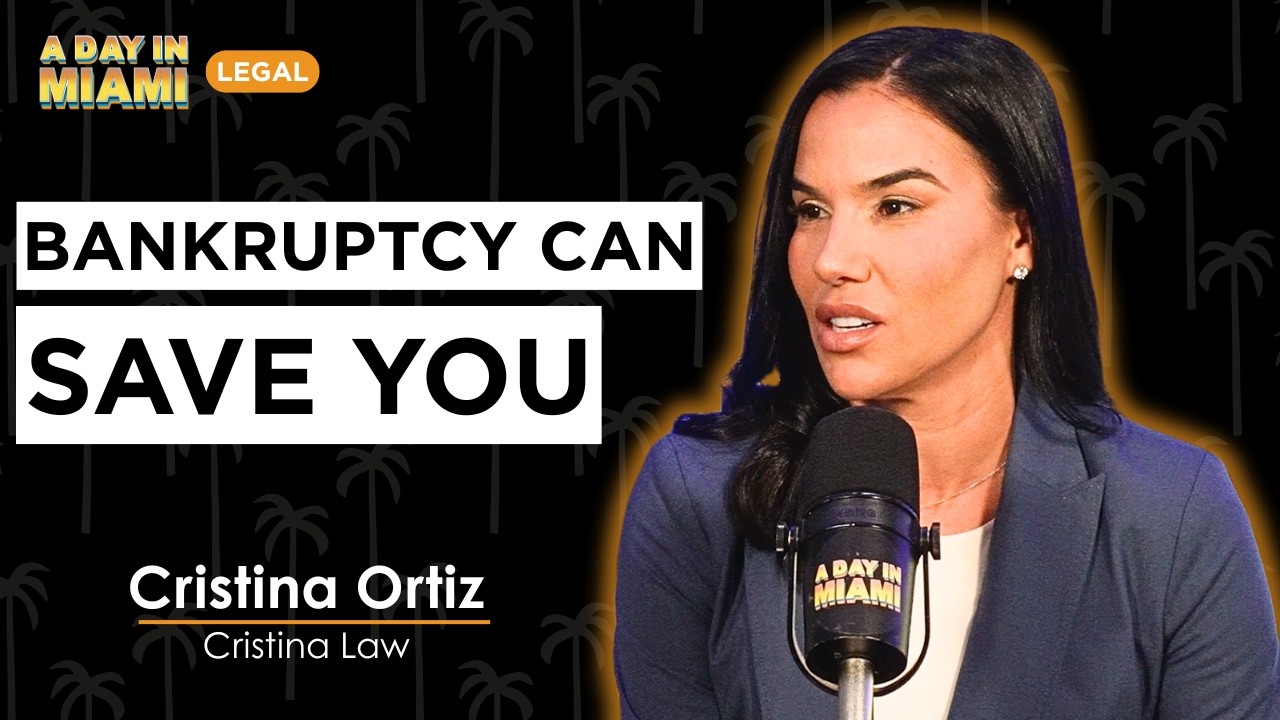
Bankruptcy Attorney Explaining What Nobody Talks About | Cristina Ortiz
Bankruptcy attorney Cristina Ortiz joins us to break down everything Miami residents need to know about debt, bankruptcy, and financial recovery. She walks us t...
About This Episode
We also get into credit repair scams, garnishments, exemptions, the 7-year period, filing before a divorce, the biggest mistakes people make, and what demographics are filing the most right now. Plus her craziest case from the 2008 crisis and whether her business is booming in today's economy.
If you're struggling with debt in Miami — this episode could change your situation.
Manny Alfonso:
Instagram: https://www.instagram.com/mannyalfonso8/
Kiko Suarez:
Instagram: https://www.instagram.com/querikoconkiko/
Eduardo Moya:
Instagram: https://www.instagram.com/mr_moya/
Follow Us! - A Day in Miami:
Instagram: https://www.instagram.com/adayinmiami/
Listen on Spotify:
https://open.spotify.com/show/20WEys6jxiliBCLoo9iSID
________________________
Produced by: Ben Schwede
Instagram: https://www.instagram.com/benthecreatorrr/
0:00 Intro
1:37 How She Became a Bankruptcy Attorney
3:20 2008 Crisis
4:24 Craziest Case from the 2008 Crisis
7:19 The Relief of Bankruptcy
8:10 How to Know If You're Close to Bankruptcy
9:57 Types of Bankruptcies
11:42 How Does Payment for a Bankruptcy Attorney Work
13:38 How Does the Process Work
15:58 What's Worse - Bad Credit or No Credit?
18:24 Credit Consolidation
19:18 When You Should Consider Bankruptcy
20:11 Garnishments
21:03 Posting Lifestyle Content While Filing for Bankruptcy
22:42 Which Debt You Cannot Avoid?
24:24 How Long Does the Process Take
26:06 What Demographics File for Bankruptcy the Most
26:44 Embarrassment
27:46 Exemptions During Bankruptcy
30:12 Biggest Mistakes
31:50 Average Credit Score
32:17 Can You File More than Once?
33:14 7-Year Period
34:27 Who Would be Affected Most by a Crisis Like in 2008?
35:52 Is Her Business Booming Now?
37:13 Filing for Bankruptcy Before a Divorce
39:29 Top 3 Restaurants
41:17 Outro
About Our Guest
Cristina Ortiz
Bankruptcy attorney Cristina Ortiz joins us to break down everything Miami residents need to know about debt, bankruptcy, and financial recovery.
All right. All right. Busy week, huh, Primo? Yesterday was fun.
So, I just realized something this morning. What?
I looked at why I'm so busy because I usually I'm someone who slams my schedule. Totally. I don't like telling people next week. If I can do it right now, I do it right now.
My blocks in my schedule when people are booking are 15minute blocks with no buffers. So, I'm like, okay, I need to increase this to like 30 minute. I got 15-minute buffer. So, I'm not alo because then I don't get to do my administrative work.
We'll schedule the buffer in between. busy busy as a uh lawyer that handles bankruptcy. Is that safe to say?
That's uh at this at this day and age, she's probably very busy.
We're here with Christina Ortiz. Introduce yourself to everybody.
Hi, good morning. I'm Christina Ortiz, bankruptcy attorney here in Miami.
Private school grew like me. I'm excited.
Yeah, I'm a public school guy.
Huh?
I'm a public school.
That's okay. Why do we say that? Public schools are great. We just we have, you know, a lot of friends in common.
I mean, private schools are awesome. My daughter I put my daughter was a government finest schools in the world. You guys
My daughter did. I did. I I grew up behind I grew up behind.
Hey, you were a quarterback. You did all right.
Yeah, I did all right.
Welcome to the show, Miss Ortiz. How are you?
Fantastic. And you?
Good. Good. I'm excited. I'm excited. We uh Eddie, we always talk about how bankruptcy is so popular in this city. Is that safe to say, Primo?
Listen, um I'm surprised that it's been two and a half years and we had had a bankruptcy attorney. So, first I want to tell her that
uh thank you for trusting us and coming on because I know that people about this topic. It's a, you know, it's a hot topic, especially the way things are right now.
It's a little touchy. Nobody likes talking about it,
but you know, it's there. You know, it's like one of those things that are there. So,
um, fortunately, I mean, I know people who've gone through it and survived it. I mean, fortunately, you know,
that hasn't happened to people in my circle or anything lately.
Um, but I know that it could be very devastating. Like, I can even imagine going through that through that process, you know. Um so tell us a little bit about you know how the market is and and um a little about yourself and how you started.
Sure. So talking about bankruptcy and how the devastation I got into it by accident because in 2008 which everybody remembers 2008 [snorts]
that's when I graduated law school. So I was thrown into that world into the foreclosures and bankruptcy. So that's the first type of law that I started practicing. So that's my background. And then we're talking I had clients that were you know doctors, lawyers, dentists that you know bought overleveraged and bought a ton of properties that they could not afford and maintain. And then I had the lady working the ventanita laareta who had five properties also. So I saw all the sides of of bankruptcy. And you know what actually you said something interesting when you're done with the bankruptcy it's not as devastating. I find this devastating when the person actually realizes that they have to start thinking about bankruptcy. That's when they feel that
the panic.
Exactly. The panic, feeling like you have no other choice. It's sad.
It's not the end. And you you focus a lot on the Hispanic community, right? So, helping people out is something that I'm sure brings you.
Yeah. Because back then, most of my clients were Hispanic. And what would they all say that? I didn't understand what I was signing. I didn't know what I got into. Also, United States is very credit friendly. They They're like, "You got credit. You like Oprah." They start selling you cards. Absolutely. With no evidence that you could pay for it. So, you know, you get to this country from Cuba, from wherever, and you're getting all these credit cards in your mailbox. You're like, "Okay, this is amazing. Let me buy a chain, a motorcycle, whatever." And that's what happened.
But listen, the 2008, we got to go a little bit back and talk about that because that was a crazy time here. Yes.
I mean, I was really young at that time. I was still like in high school. I had Yeah, I was I had just graduated high school. And I see, you know, these guys are like 25 26 with like uh 750s of convertible Mercedes
flying private
private. And I'm like, where the [ __ ] is all this money coming from? And then as I started learning about life and real estate, all stuff, I realized that they were giving anybody with a pulse like
a [ __ ] deal, right?
That was the era of straw buyers, you know, like mortgage brokers would go say, "Okay, let's use your credit for this house. You don't have to pay the mortgage. We'll pay it." It was it was all it was that world. But they were giving people I what I was told too at that time is that you could have had like multiple processes of loans going on and buying multiple homes at the same time.
They didn't verify your credit history. They didn't verify your income. Um nothing. You just applied and if you had a decent credit score, they would give you a loan to buy a house
and then people were taking the money and purposely defaulting on it.
Yes. Mhm. And then getting that money to then buy another property and collect rent in the meantime, rent them out. There was
like the most obscene case you saw from that time. Oh, from that time I mean people
like does one particular stand out to you? [snorts]
I
give us something juicy.
I mean it's well the Did you guys ever see the movie The Big Short?
Of course.
That is so accurate. And if you realize that movie uh wasn't filmed here, but it took place in South Florida cuz we were ground zero for bankruptcy. I mean, in the courtroom, Dineine was there 2020 to watch what we were doing. The judges didn't even know how to rule the cases. So, I would go to court as a one year out. I think I was just a few months out of law school and I would win these cases. Like I'd get my case dismissed, but no one knew why. You know, the bank was saying, you know, you owe me money. Then I was saying, well, where's the the note? Where's the mortgage? None of these lenders, like Deutsche Bank, remember all those lenders that are out of business now? They were suing for foreclosure, but didn't even have the document proving it themselves. So, that's how I was winning a lot. But that doesn't mean that it was that they couldn't come back later. And the most obscene thing was that there was like some random warehouse in like Alabama that had all of these documents, all of these mortgages, and it was robo signed like by a stamp. I don't know if you ever heard of of those cases. So, not to get to the boring nitty-gritty, but we all buy a house, you know, nowadays you're sitting there signing a 100page doc uh loan package, right? And there's a notary and there's witnesses and and things like that, right? Or people like that. Well, back then, you know, those documents were being notorized or authenticated by like a stamp. You know, some some random person in some tiny little office was stamping these documents to authenticate them. So, and then there was this warehouse and how that happens.
Yeah. Watch the big short documentaries are all there.
Apparently, the the realtor was in bed with the mortgage broker. the mortgage booker with the guy who's the title with the guy who's doing the uh evaluation of the property appraisal the appraisal guy with the inspector with like all the way
that's why kickbacks are illegal you used to be able to um you know bribe your appraiser to overeal evaluate your your house
your property get more equity
let's say you have a house that's 200,000 you tell your appraiser hey 400,000 now you're getting a $400,000 loan
on a $200,000 property that right now when you get I got to get a note almost like if they're doing like a physical is what's next, you know, like how healthy are you, you know, like that's how serious they get now. What she was saying, all the documents and papers, where this wire come from here and what is this money over here and who's this person over here? It's really crazy now, which I think is the right way to do it.
Yes.
You know,
well, back then, you know, I said the Ventanita lady and I that's not a joke. Um, that was something that was alarming to me because she literally worked at Ventanita of Sergios or Keta or whatever and she made like $7 an hour yet she had five different properties. And I remember thinking here I am I just graduated law school. I can't buy a house and you know but that's that is how it was back then.
Honestly, if they did that now it wouldn't be that bad because it'd be like a free-for-all. So we'd be able to take advantage of it. But
yeah, right. you know,
but you know, and then the what I saw about bankruptcy is that once the bankruptcy case was done, people were so thankful and they were able to breathe again. They were able to, you know, the idea of bankruptcy is that it is a legal tool and we all as citizens have a right to bankruptcy and it's actually a fresh start. It's a way to start over and it's a trick to stimulate the economy again. Imagine if we were all broke and just were drowning in debt all the time and we couldn't go on vacation and we couldn't buy things. We couldn't move on and buy another house. So, I know I sound biased because I'm a bankruptcy attorney, so it sounds like I'm
promoting bankruptcy. But one of the things that I always tell my clients is what you're facing now is really difficult. It's really stressful, but I bet you you can't even sleep at night. And they all they all tell me the same thing. I can't sleep at night. I can't, you know, it's so stressful if you have kids,
their their wives, you know, their their houses, their households. They feel like a failure. But after they really do get to have a fresh start, and that's very rewarding for me.
Being broke, how do you know you're six months away from financial disaster? H that's a good question. So basic you already know, dude. Like you know like a year before because you know when already you're
even if you live paycheck to paycheck and you're making minimum payments on your credit cards, believe it or not,
you're still not that broke. If you're living paycheck to paycheck and and minimum payment on your credit card, it's when you're not paying credit cards to pay like one creditor and then like the next month you're not paying one for the other. When you're starting to juggle things like that, that's when you know it's within a year.
It's it's going to drop out. And what do you what are some of the the mistakes that people are doing right now?
Waiting until the last minute.
Yeah,
that is my biggest thing. You know, people think that they could ignore things or like ignore the the the letters, ignore the foreclosure notices cuz not only bankruptcy, yes, is to discharge unsecured debt, you know, um there's to liberate yourself. Yes. From credit cards, personal loans, things like that. But you can also use um bankruptcy to discharge I've been discharging some SBA loans which were huge about six years ago that yeah because it's a government loan. So technically they're not but some of them below a certain amount are being discharged and that's getting tricky now because a lot of people took out SBA loans in 2020 2021 that that were not supposed to didn't use those funds for what it what they were supposed to. So, you know, I have to put those people into oath sometimes and make sure that they're telling the truth cuz you are under oath when you go to a bankruptcy hearing. So, um, but that's how I think when you start juggling all of those loans and finances, that's when you know it's imminent. The good thing is that with bankruptcy, certain types of bankruptcies, usually the most common that I do is a chapter 7 for individuals, you can protect the property that you live in.
I was going to ask you,
you're not going to automatically lose your house. It's a big misconception.
So, what I mean, this is something personal for me. What's the difference between like a chapter 7 and I think it's like a chapter 13 is what's the difference? And is that those are the only two options?
No, no, there's there's several types of bankruptcies. The most common are seven and 13s. That's the one that a lot of people did in um back in08. Those are the ones that I help clients with. Now, there's also a chapter 11 which is for businesses, you know, and I would say a chapter 11 for a business is a reorganization of your debt. Okay? Those are the type of bankruptcies that American Airlines did, the Trump organization did, like even Ford Motors have done it. Those are where you have to restructure your debt. Um, sevens and 13s are more for individuals. A seven is a complete what they call a liquidation. But still in a seven, if you're current on your home where you live, you could still keep your property. So, you're not going to lose it. But you're going to discharge.
Yeah. You're discharge even like your medical debt. I mean, think about somebody who has gone through some sort of like trauma, traumatic injury. They've been in the hospital for months. Imagine a hospital bill. So even though now recently um they passed a law that you know uh it can't go on your credit uh credit report any medical bills things like that it's still something that gets to your house you know that stresses you out. Absolutely. So you can even discharge that but seven is a complete discharge. You are walking out from a bankruptcy completely debtree. Okay. A 13 is usually for people who actually are making a lot of money. They have a lot of cash flow but they overlever. So now we have to do a reorganization of their personal debt. And you're usually put on a payment plan for three or five years depending on your case. What I don't like about 13s, to be honest, I I always love putting people in sevens because that's where I get that rewarding feeling of liberating somebody. The 13 is, you know, you're going to have a trustee breathing down your neck for the next three to five years. Yeah. You can't win the lottery. You can't get a really good job because if you do, you're going to be expected to pay back all of your debt.
But question, um, after I do, let's say I do a chapter 7, right? Hey, I'm, you know, $150,000 in debt, credit card debt, whatever the case is. Uh, what, like, how do you bill your client? Like, is it based on how long? Like, does it make sense? Like, hey, it's going to be 20 grand to take care of me, but overpay.
Exactly. Right. So, you um interesting question because the answer is that do you know that federal law does not allow us to take on a CA to present a case without us getting paid in full? So, the client has to pay us first, believe it or not. If not, I cannot file their case. So, I have a lot of clients on a payment plan.
Okay?
You know, and at least I've opened their case. I'm working on their case. I'm helping them out. They get a letter. They're getting calls from creditors.
You start working on it.
I do. I just cannot
file the case because then I become a creditor myself. Imagine I'm defending someone that owes me money. So, we get paid first.
Sounds familiar to us.
And what's more or less like is it depending on how many accounts they have? Like what's
No, it's a flat fee. It's a flat fee. The the only um caveat there is what I always tell married couples is if you're a married couple, you can file together and it's one cost, one case. If you are boyfriend, girlfriend or domestic partners and you're not married, you have to do two separate cases. Got you.
So, you know, if you're a married couple, it's a bang for your buck.
Business model is a flat fee. Doesn't matter who it is.
That's right.
Wow.
It includes court and it includes court costs. Usually around $2,000 a seven way. The others are more. The others are more. I know chapter 11s could go up to like 20,000. That's what I was thinking.
Um chapter 13s could be around five. Yeah,
I thought it was like 15 20 grand from the
but the market and of course the money on the attorney is around $2,000. The the benefit of working with my office is that I include everything because that's something else that scares off clients when they like
they don't trust attorneys. I mean, they're already in such a bad financial situation. They don't want to feel like they're, you know, signing up for more problems, more creditor problems with an attorney. So, I do a flat fee includes everything from start to finish, final hearing. So, like now let's say I'm interested in using your services. I call you. What's the next step? I go to your office and then I assume you're doing a full analysis on me.
You come to my office or we do a telephone uh consultation. I do consultations for free. I know a lot of attorneys don't do that. Like immigration attorneys charge and and whatnot, but I do my consultations for free. I always have a handholding element to the call. Make sure that the person feels relaxed. it's anonymous because a lot of uh hesitation or anxiety about bankruptcy is oh my gosh like I'm going to be outed like someone's going to know I did a bankruptcy but everything is confidential even the docket system for bankruptcy cases you need a specific login and password you have to be an attorney or the actual client not anyone can look it up like in regular clerk of courts so this is something that is very private and we try to keep make everyone feel comfortable and confidential
what do you like now what's like the legal steps I come into your office now. What are you like identifying everything? Reaching out to creditors.
But so we were talking about loans earlier. It's actually like applying for a loan. What are we what are we going to need from you? We're going to need your your bank statements, your tax returns. I'm going to need I'm going to pull your credit report because I want to see all of the debt that's associated with you and your social security number.
Um they're going to look at transfers. Something that Hispanics love to do, and I could say this because my background is Cuban. We love these Maranas with zel and Venmos and you I Venmo you and you're going to pay my bill cuz the bills LA and it's like why do we do that? But we we do that. Cubans do that. I don't know. Don't you agree?
Yes, people do that.
We do that.
So, they're going to be scrutinizing all of that and we have to explain it. I mean, imagine somebody in bankruptcy who just bought a a crusero cruise which has happened. You know, someone in bankruptcy shouldn't be going to the casino, shouldn't be going to Nean Marcus.
So, they're looking statements saying, "Hey, wait. So, not only you, the courts will look through the statement and say, "Hey, you're not paying this, but you're doing this."
Correct. I didn't think that they could tell you that
they can't because then it's preferential treatment. So, you're telling me that you um committed to a loan or credit card, you solicited this credit, you went and spent it and you're declaring bankruptcy, which by the way, it's not automatic. We have to qualify for bankruptcy, by the way. You have to qualify.
And um we're asking the government to basically give us like a freebie like uh you know, a hall pass. We have to come correct. We have to show good faith. So, why why are we going on a ski trip or buying jewelry and not paying American Express? So that's that's the idea of credit.
I think I think everybody's scared of creditors and one of the questions I have is what is better credit or no credit?
Bad credit.
Bad credit.
Yes. Bad credit.
Is it better that you have no credit?
Yes. So I
better you have bad credit then no credit.
So yes. So let's talk about school, right? In school um is it better to have a C or an F?
C.
Exactly. So when you get out of bankruptcy, I like to compare it to you having a C. You're in the middle. You don't have bad uh bad grades. you have so so grades and then it's your job to kind of build from there. But you're building it from a C, which is more possible than building it up back from an F, right?
So no credit is better. You're going to within
months after your final discharge, your final hearing, you're getting credit cards again in your true in your mailbox because creditors are like, "Oo, like look, she has
So no credit is better than bad credit
in this situation." Yes, absolutely.
Backwards.
No, no. Bad credit is better than no credit because it
after bankruptcy having no credit.
No credit is better
is better. Yes.
Yeah. But after bankruptcy, she's saying,
"Yes, that's correct." That's what we're talking.
Yeah. Of course, you're not going to get break and then have bad credit again.
And remember, bad credit, you're it's going to take you years to get your credit back up. It It takes years. It takes at least seven, eight years, okay? At least after bankruptcy, you are going to be offered credit at a lower um
within the year,
within months. Believe it or not, my clients are getting credit cards, low credit cards, you know, they're getting like those um what are you like those limited 300 500 bucks, but all of my clients, all of my clients within seven, eight, nine months can are buying a car within two or three years are buying a house. Now, there's going to be certain loans that you don't qualify for if you did bankruptcy recently. You're not probably going to get some government loans probably. Um Exactly. But you do, you know, I love saying this, bankruptcy is not a death sentence. Okay. I have a a book. book. I did like a bankruptcy for dummies book during the co eraing and I'm I send it to people who are on the fence and they feel like there's a
New York bestseller.
Exactly. It's an Amazon bestseller. But anyways, and I have a chapter just listing all of the famous people that have filed for bankruptcy like MC Hammer.
Oh, totally. Obviously, Donald, how many times has he done it? I mean, come on. That's what I'm saying.
You know, some of the best companies have have filed for bankruptcy. So, it's really not a death sentence. It really allows us to move forward and start again.
Do credit repair companies actually help? like a legit one can it really help?
There are some out there. There's I have a friend Ometo that actually coaches even you could build business credit too which is something that I learned in the last couple of years with him. Um but I would say credit consolidation is the big scam that these company well they're they're national. They're advertising all over all over the place. Yeah. And they just change their LLC names also like when they get enough bad reviews cuz how does credit consolidation work? You are you you think you're getting all of your debt and consolidating into one monthly payment, right? but you have already stopped paying those credit cards or you're about to stop paying those credit cards. So, you're already behind. You're already defaulted. Your credit is already dropping. Okay? So, consolidating them isn't going to all of a sudden uh increase your your credit score. Okay? And these credit card consolidation companies are earning their fee and they're going to get paid first. So, they're not even paying the creditors that you hire them to. They're for the first couple of months they're paying themselves.
Yes.
I thought that you get the loot, they pay them all off, and then you stay with them.
Oh, that sounds beautiful. Of course, that's how it should be. But no, they they pay themselves first.
So at what point at what point should you just say, "Forget it. I ain't paying [ __ ] no more."
Yeah, it happens.
At what point like is there a number or is there
Well, you don't have the money for it, bro.
No, but like to give up the fight. That's it. [ __ ] it.
Okay. What I tell people is I just said that for a chapter 7 bankruptcy and you're going to eliminate all of your debt. It costs $2,000.
People are paying that in minimum payments on their credit cards.
I'm surprised. So cheap. And drowning people. I mean, I pay like that. I I pay like two three racks a month but all to keep the card like pay what I use.
But that's fine. But I was saying I'm surprised filing for bankruptcy is so cheap. I thought I feel like it would be much more expensive. Yeah. But it makes sense because people who are filing for people who have no money. So you can't make it expensive unless it's like a corporation.
Take all that weight off your shoulder must be legal, bro. 100%.
And to have a chance to come back.
Look, I'm not promoting bankruptcy, but again, it's something that when you're facing it Yeah. You know.
Yeah. I mean, if you have a free consultation anyway, so if someone's like worried, it helps. All right. Well, before you move on to your next question, can a debt collector take your car and thing back like whatever you owe? Of course. Paycheck.
A debt colle Oh, yes. Absolutely. So, going wages is what it's called.
You asked me earlier um what what are the things that people or mistakes when you ignore those credit uh collectors that they're calling you sending you uh speaking in Spanish lawsuits.
That's a garnishment at the end of the day that they're getting a garnishment. you're going to wake up one day and this happens all the time and it's too late. I can't do much at this point.
They go into your bank account and freeze your your funds or you wake up think you have, you know, 2,000 bucks in your account and you have negative 100.
And imagine that happens. ATM, you're going to go it's the garnishments are the worst. I hate dealing with those.
Wow.
But to get to garnishments is serious, you know.
Yeah. They're blowing up my phone and and I have to work.
You probably left you let it go for too long already. Um, have you ever seen cases where the person's coming to you, they're filing for bankruptcy, they get approved, but then online on the gram, they're just still like living life and like showing off that like it happens a lot. That's really sweet of you people to to Yeah. No, but that happens a lot. And I do tell people that they need to watch out. Um, it has been in in the legal community in general, it has come out that judges and opposing councils are looking at your social media to see what you're doing. And if you're getting ready for bankruptcy or in bankruptcy with me, I always say make your profile private or please do not post that you're on vacation or you're buying something or you're even at a restaurant cuz that just looks like bad faith, you know, especially we whether we like it or not. I was born in Halia, you know, we have a bad reputation of of of taking advantage of the system. So, we're being overly scrutinized in federal court, South Florida. I have a hard time I have a hard time sometimes with some of my clients.
Have you had cases though where some where it does get to the opposing council and the judge and they say, "Hey, look at this person here's hanging on the yacht. They're eating at ma. They're doing this. They're doing that, but they're filing bankruptcy. They're hanging out with Eddie and Gigo."
So, the trustees, which is the trustee represents the bankruptcy court, which is the federal government. Okay. And yeah, they're going to see, you know, that's nice. They have a Range Rover, a Maserati, a Lamborghini. How'd you get that? Um, they've also looked at some of my clients who have done transfers like right before they file for bankruptcy, they'll remove themselves off of an asset. That's what's called a fraudulent transfer. So, they've gotten in trouble and I've warned them about that because I never put my clients in a position where they're not going to qualify. But, I've had clients that I could can't take their case or I say, "Hey, we're going to have to wait a few years,
you know, because they did something stupid like that." Gotcha.
What are the debts that don't go away? Anything that sticks no matter what?
Uh, child support alimony and IRS. The IRS is like have like you know there's two things that you can't avoid death and and taxes and the IRS
I talked to you can't discharge IRS you could do
IRS you could do like what's called um like a cons like there's a partial um
you have to deal with them
yes you could get into some sort of deal with them but the the taxes uh federal taxes you can't destroy the IRS will get you
to your bank account so child support you know any debt that you incurred as a result of a crime name. I have um represented a felon before filing for bankruptcy and the debt he had um was restitution and I could not discharge that because it came from a fraudulent you know crime that he committed several years ago. So I couldn't discharge that.
So those things stay intact no matter what.
So if you're a debate debt you can't file for bank.
But does that wait question does
I mean you can't for your other debt just not that.
Does a child support affect your credit? No. Child those things don't affect your credit either though. No, but it'll be it could be criminal and you know there could be criminal consequences to you not paying child support.
So it's not a a credit issue, it's a criminal issue. Yeah. In those cases.
Wow, that's incredible. I didn't know that.
Yes. But I can't discharge that. I can't discharge certain student loans, government uh student loans are are not dischargeable.
Um some of those though like when you go to like um Kaiser University and you got like a private loan or something, those are dischargeable. And I've done a lot of those like massage schools and things like that, you know, that are very popular here like schools. Yes. I discharge those loans.
So again, bankruptcy does help a lot of people. Even when you're stuck with child support and you're stuck with IRS and you discharge everything else, now it becomes easier to pay off the other stuff.
Okay. So for people out there that, you know, may not find themselves in the best position right now. What's realistically a time frame that let's say someone has, you know, moderate debt, they want to file a chapter 7, they go, they speak to you, they pay the loot. What are they looking at between between being like, "Okay, I can get my life back in order."
Timeline like between what you're the situation you're talking about and filing bankruptcy.
No. Timeline like for it to be now like you know getting discharged and you know being free.
Okay. Well, with my office I mean between hiring me and getting your discharge is about three or four months and that's you know from zero to hiring me to after the hearing and you get your final discharge. So, it's relatively quick and with our office, we like to make it quick because usually there's a garnishment on the horizon. They're already getting lawsuits served on them by creditors and we want to avoid all of that. So, we try to file it as quickly as possible. Now, I do know people and I actually think this is smart when they're already feeling that financial stress. I do get calls where they're saying, "Hey, if I'm in this situation and I have own a business and I own this car and my kid is in private school and how should I be titling things to protect myself from creditors?" I get those questions which I think is smart.
Um, so I do have clients that wait until the last minute and then my my biggest advice that I give is
there you don't you're not going to lose anything by calling my office. We give free consultations and I and I do guide you. I can't give you legal advice obviously because I'm not your attorney yet, but I can definitely give you some tips and guidance depending on your situation.
But like let's say from the start all the way to the end where you know everything's done. You said four months.
A couple months. Yeah.
Wow. I thought it would take like two years.
Well, the 13 there's a chapter 13 bankruptcy that could take a few years but you know an individual bankruptcy for a married couple or an individual. A couple months.
Wow.
Um can you tell me a little about the demographic you're seeing? Is it men, young men, women, older people? Like what are you really seeing that's like you know find themselves
who are the brokies? Okay. Well, finding themselves in financial,
you know, recently, when I say recently, probably in the last two years, people of my age, you know, um late 30s, early 40s, they have young families. They they usually do own their home. They actually pretty they have pretty decent jobs. The workforce, the workforce here is struggling in South Florida. It's it costs a lot to live here
and it costs a lot to maintain your children. Even if they go to for the school, you're doing their dancing and their cheerleading and the it's it's a lot. I I see what people are spending money on and they really don't have disposable income at the end of the month.
What do you tell somebody who's like embarrassed about bankruptcy? Like their whole like ah I feel like I like I I like I quit
I'm a loser or whatever. Like how do you explain that and make them feel better about it?
Well, I I I try to be comp as compassionate. It's true. Absolutely.
No, I the bankruptcy and you get it. That's like you failed at everything. It's like
I don't So, bro, I think you just got to reset, bro. Everybody does everything. I'm going to bring you to my office to do a little pep talk for my clients. They they're coming with their head down, you know. Absolutely.
Proud moment.
Yes. Absolutely. So, I always coach them, you know, my demographic also is usually like the Hispanic, you know, churchgoers. They're like, "This is immoral. The this against the Bible." I'm like, "For real?" I'm like, "Relax." Miami, bro.
Yes. Absolutely. So, what I tell everyone is I know it's a hard time, but I promise that when we're done with this, you're going to feel amazing. You get to start over. You get to, now that you know that you already failed, now you're going to do better. It's
because they're gonna take their loans their home.
And again, I look at it's look at the companies and celebrities that we all look up to. They've done bankruptcy.
The president.
Yes.
Exactly.
Um but from a bankruptcy, you can save your home. You don't lose your home in a bankruptcy.
No, you do not lose your home. That's a myth. That's a big myth. And actually, that's what that's what prevents people from doing the bankruptcy or even calling my office. They think they're going to lose their car. They think they're going to lose their house. You are not going to lose your house in bankruptcy. You could protect it if it's your homestead exempt like your primary residence where you live. And if you're current on your payments, you have to be current on your mortgage payments. That's a caveat there because if you're behind on your on your mortgage payment and you're filing for bankruptcy, you're kind of proving that you can't afford your house. So, you can protect your home. In fact, the the bankruptcy courts uh tell people your most important uh debt and your most important asset is your home. Keep paying your home. Um the it's the unseen thing that you can kind of stress. Yes.
To the community, especially the Hispanic community. That's the most important part.
Absolutely. Yes.
And you can also keep your car too though.
Yeah, you can keep a card. keep your car. So, you got to make money.
You have certain exemptions, you know. Um, you don't lose every you could keep up to a certain value of assets. Okay. So, you would have to you could keep your car if it's under a certain value. Okay. Um, most people are leasing their cars also, so it's not really an asset that they own. So, you're you're basically keeping a liability. Other people are financing their cars too, so that's a liability. So, it depends on the value of the car, but there's certain exemptions that where you can keep certain assets.
Yeah, bro. I cannot imagine being someone I mean just the trouble of like let's say you do file bankruptcy and let's say you're renting and now what you're going to go lease an apartment or rent and they're going to see this on you life it just made it more difficult or can can you not discriminate on someone that filed bankruptcy or you can tell someone I can't give you a property right
there are standards that certain communities have just like loans do and if you're credit if you're not worthy of the credit you're not wor worth worthy of of the credit and and moving into a certain community so the problem's not you got to borrow someone's credit or live with somebody else. Like, it really is like a fast downhill.
That's something that Hispanics do a lot. They love to cosign. We love to cosign for our kids, cosign for our parents. Um then you have bad debt because your parent or your cousin from that just got here from Cuba didn't, you know, pay something. That happens all the time. Another one that I get is um talking about assets. People don't want to lose the silliest assets. I had had a client the other day uh you're allowed to keep what's necessary like your home or a house that you are required to go to to work.
Got a jet ski. got a jet ski, an RV, a mobile home. Um, I've had I've had questions like that. Well, what if I give up a car? Can I keep my jet ski? I'm like, come on, we can't, you know, how how am I going to present that to the judge that you want to keep keep these things? Yes.
What's the What's the one mistake you you continue to see like buyers making? Like when they haven't learned, they still making the same mistakes.
Co-signing is one of them. That's a big um one. And I know we do it out of love. like if we're lending our credit to a family a member or a cousin or your kid, I know why we do it, but I say that I think that's like one of the biggest um errors that we that we commit and waiting until the last minute.
Like being we are there's a saying it's like
we are so afraid of debt that we'd rather live in debt than face it. So we'd rather live making the the minimum payments and being stressed out about it than just facing it head on and doing a bankruptcy.
Well, you know that technically the algorithm and the formula for minimum payment means you will never end up paying that. will never I tell everyone that I tell all my clients I'm like you know that you're never going to get out of this one you know again unless you are inheriting some you know massive fortune you win the lottery they give you a huge bonus out
yo the credit card company that's the client that they want the guy who's going to pay minimum payment forever correct you pay off they don't want you to pay off the credit cards every month they don't make money off of you
yeah that's right
money having your credit cards at zero being a good person that's not beneficial as well
of course it is
of course it is of course
but you have to have something in there right cuz they always say you build your credit. They they coach you. I've from what I've heard, they they coach you on having a certain amount, paying it.
Look, the best thing to do is use your card at the end of the month, pay it off. Use your card at the end of the month, pay off like that.
Sometimes they say pay when it's due and then sneak another payment in before. So, it shows two in one month every two weeks.
There's tricks to the trade. No.
Yes. Those are tricks. Sure. The mono just pay your bills.
Yeah. Pay your bills and pay it off and then use use it, rack it up, pay it off. Use it, rack it up, pay it off. That's the best way to to do it, you know.
What's the average score for somebody that comes in? Like something you've seen like, "Oh my god,
what's the one that's the lowest is like what, like 300 or 400?"
Someone came to me in the high in the high fours. Okay. But look, when someone's coming to me, I I barely check their score cuz they're already coming to me with I know, you know, but um yeah, fours and fives are the when someone's coming to me and believe it or not, they have better credit after bankruptcy than when that goes back to like, you know, are you is it better?
Can you do it more than once?
You can do bankruptcy more than once.
You can, but there are time limits like you can't do it back toback. You have to wait eight years for example.
Let's say you got like cases
close to 20 G's in credit that you're like, "Fuck it, I don't want to pay. What's your advice?
Well, it depends on your income because believe it or not, $20,000 is not that much debt. You know, I'm I'm helping
what I'm saying, but like
yeah, if we could discharge it if we if we qualify, if you have, you know, I' I've discharged 20,000 15,000 that was she's on social security. There's no way she'll ever work again. I've been able to discharge if you're making figures, they're going to
Yeah. Yeah. I I usually like to tell my clients like, you know, if you're around 50 or higher, like let's
You're not going to qualify to get rid of those $20,000. Ke
chilly. Yeah. I make good money here. I know.
That's what I'm saying. You're not going to qualify for that, bro. I'm just wondering.
And you know, if you get unemployed.
Yeah.
Um Damn, I forgot. Oh, what was it like? Um I used to always hear like this whole like seven years, seven years till your credit gets better or something to it falls off your credit. What is there any truth to that still or
the reset? So there is truth to that because for example there's certain marks or or notes on your credit that don't um get written off or get kicked off until seven years. Um and bankruptcy is one of them. But again bankruptcy became so common in the 2008 era. It also became very common in the 2021 uh COVID era that
lenders, creditors, leasing offices, they're seeing it on people's credit report. But if substantial time has passed, you know, two years, three years, you're you're fine. You're going to be worthy of receiving credit again. It's not a death sentence.
Okay. Yeah. I used to always hear about that.
Yeah. There are like it's like no, it's like if you have a an account in collections, it's going to be in collections for a while on your on your credit report.
I'm not seeing any signs like 2008. I think how are we doing? Are we doing pretty good or are we kind of like
It's not like those days, but we're I'm seeing a lot of young families who make decent money here in Miami. Um that they they're in a lot of credit card debt.
We're we're credit happy people.
If the market shifts again, who gets hit first?
The market shifts which way? What do you mean
to the negative? Let's say we're start dropping down like wait, who gets hit first? Who's affected first? Is it people that make less money? Is it the big guys that are overspending? What's
going to be? Yes, but they're not going to be the first ones. The first ones are the the Uber drivers, the the people working at the school cleaning schools, the cafeteria ladies, you know, those are going to be the ones hit because they are on a fixed income. They don't they don't have savings.
You know, the ones who are overleveraged usually have savings. They did like some fancy, you know, maneuvering with their with their money so they could like take money out of this to pay off that so they last longer. But the ones who get hit first are those like low workforce housing.
So your families are all good because you put them in line. No.
What do you mean? like you have family members that don't take your advice and [ __ ] like that or
funny thing about family is that nobody listens to each other you know but um no I got you know my
free consultations for them right
my parents lost a a property back in those days I was I was in law school I was in early in my early on in my career but um I I think people have learned their lesson I again I'm seeing the young families that were not around they were not working in 0809 2010 they were probably students or don't remember or There are people that came in this country in the last 10 years. Those are my clients, you know. Wow.
Yeah. So, I hope people have learned their lesson, but I don't think so.
It's always going to be out there.
You're always going to have business, you know. So, I'll tell you that.
Especially in Miami.
Um, can we talk a little bit about going has business been booming for you lately? Like, is it cyclical? What are you seeing lately on your side? Yeah. What's it like?
Something about my law firm is that I have kind of like a seesaw effect where I have the side that I call the sexy side, which I do real estate law as well. people buying and selling properties and then I have the ugly side which is the bankruptcy side. When real estate is low, bankruptcy is high and
so you're like a one-stop shop.
So right now bankruptcies are definitely since like February I have been more on the bankruptcy side. Yeah. Usually after tax season
real estate is popping again or it's hot.
I I would say it's kind of it's in the middle. It's it's not doing great, but it's also not terrible. Thankfully in Miami, we do have that 1% that is still here, you know. Um, your daughter goes to Guliver. You said
she graduated now. She lives in New York. She architecture.
Got it. I mean, like Guliver is one of the schools that I have friends that have their kids there and we're having the the big corporations coming and, you know, reserving several several spots for their kids.
Supposedly, they're not doing that.
They are. Um, but um,
we had the president of Gver here, a good friend of mine, Simon has Okay.
He tells me no.
Well,
we are lucky here in South Florida. I feel like we're always going to have a a good economy. Real estate is always going to be healthy, but compared to, you know, five years ago, I it's definitely lower. I know a lot of realtors. I have a lot of realtors as friends, as clients, and they're they're struggling.
They don't say it, but they are.
All right. But listen, have you ever had a situation where someone's getting divorced and they say, "I want to find file for bankruptcy first before I get divorced."
Yeah, let's talk about that.
That happens a lot. And actually, people end up filing bankruptcy because of divorce because, you know, joint income is better than, you know, being on your own. Um, even if you were in an unhealthy relationship, now you have to find a new place to live. You know, depending on on who you are, you're spending money on attorneys. Family law, divorce attorneys are super expensive. Stay on the couch for two years.
When kids when kids are involved, you're going to be spending at least $50,000 on your on your attorneys. I mean, at least. So, I actually know people who are filing for bankruptcy because of divorce.
I got zero when I got divorced.
Zero. You need to start over.
We signed the legal thing and
Yeah.
So, you guys did it at amicable.
We have a great great relationship. That's the right way to do it. But that don't happen like that.
That does not happen. That does not happen.
Well, you got a lot of calls then when people are
There's nothing more. There's nothing worse than a scored woman.
That's true. That's true. So, you got a lot of secret calls. Hey, I'm going to get divorced. Can I file bankruptcy? Stuff like
that. Happens like about a year before. People have called me like a year before like, hey, you know, this is what I'm looking at. The house is in my name and this is in his name and what should I do and do and the loan is in their name.
Any advice for people?
Are you siding with the women more than the guys? Be honest.
I don't side with any any side actually. I sign I I side with the reasonable person,
you know, the one that that isn't, you know, um trying to screw somebody over, toxic, you know, or or or be toxic for their children. Um but it's just an expensive situation overall.
So, you know, I do understand like the whole asset protection part of it, too. Um but people actually end up doing the bankruptcy after a divorce because it's in their name. you know, if they're married, um, you can and you're facing a divorce. But what's going to happen is that when a bankruptcy judge sees that you're you have a divorce pending, the bankruptcy judge anyway is going to want to see what happens in that divorce to see what you get out of it, to see if you get any assets that could be used to pay off the debts. So that so if there's a for sale in the divorce or something like that of a home or a property, any proceeds that you get out of the divorce is going to be part of the estate of the bankruptcy. So usually people do the bankruptcy afterwards. Impressive.
We got a lot of information, bro.
I'm in love with her.
Yeah. [laughter]
All right, let's ask a question. This is the hardest hardest question for you.
She's not ready. We're going to blindside her. Can I go?
Go for it.
Christina Ortiz, bankruptcy lawyer extraordinaire.
Okay.
Give me your top three restaurants that you like to dine. Starting with number three and why you like it.
Oh, we have to start backwards. So, it's tough cuz I I know them. Okay, here we go.
Did you prep?
Um, I am going to do Mandolin. AGN beastro
mandolin solid for years. What do you like to eat there?
Consistent everything. I I get a bunch of stuff. The octopus. I just love it.
Where?
Huh? It's out
of Vista area.
It's outdoors.
You live up You live in that area or
No, I I'm from Kendall.
Oh, wow.
From to Kendall.
Okay. Yeah. Same here. Same route.
I love Mandelin. Mand super there.
So, second is
number two for
Trigo Cafe. It's inia. It's has a shake.
It has the best shakes. You guys have to try it. And a really good brunch, too. Really? What's one of your favorite things you eat beside the shake?
Um, well, they have a really delicious uh Cuban sandwich, bango. I love it there. It's like authentic over there.
I haven't Okay, you guys need to help me with this. I am in search of a really good bang. I haven't haven't um had one in a while.
Pronto. Yeah, that's from um
Mary's Coin Laundry on We'll talk off camera. Don't worry.
Sangu here across the street.
Sang.
All right. Su.
All right. All right. And Christina is number one.
Number one.
Drum roll.
I know it's cliche with Sunny's. I'm really enjoying Sunny's for the last couple of years.
Sunny's. My boy Aaron. Uh, you know, the chef said, "I've never gone. We have a reservation for next Tuesday, I believe, for I love Sunny's. What do you like to eat at Sunny's?"
Well, I love the bread and the crabs. Uh, pasta.
The crab pasta. What about the crab?
What about the duck? I haven't tried the duck.
Yeah. You're a steak girl, too?
Yes. I'm a big red meat person.
She knows, bro. She
I married an Argentinian. That's we have a salad like all the time. I love red meat. Yeah.
No vegans.
No vegans. Absolutely not.
Listen, thank you for coming on. I think it's an amazing thing that what you're doing and helping people out. Bankruptcy is so needed. I I I wish you
You'll never run out of business. I know that.
Yeah. And you're a bright side to that uh dark side of people's life for you to
make it better. So, thank you so much for being very nice.
You did good, Lord, girl. Yes. Yes. Yes. Oh, no way. That's why you put the blue
Never miss an episode
Subscribe to our podcast and get the latest episodes straight to your favorite platform.
Subscribe on SpotifyMore Episodes
View all 1:07:52
The Attorney Saving Miami Businesses From Expensive Mistakes
Nov 17, 2026
 56:27
What Miami Could Learn From Denmark | Jesper Møller Sørensen
Nov 16, 2026
 1:04:23
How Bizzy Is Changing the Way Miami Students Save Money & Go Out | Evangelos Milionis
Nov 16, 2026
 52:42
How to Actually Get Your Child Accepted Into a Top Miami School
Nov 5, 2026