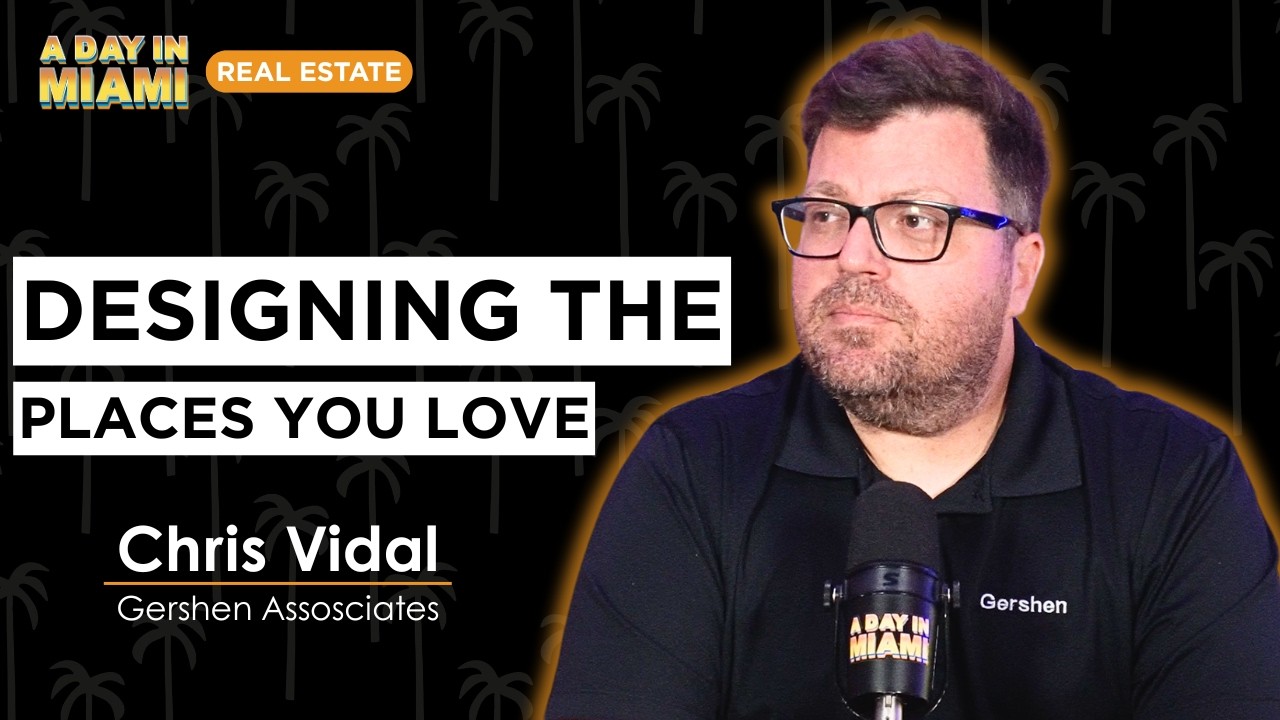
The Man Designing Miami's Restaurants, Strip Malls, and More | Chris Vidal
Chris Vidal of Gershen Associates joins us to break down what actually goes into designing and developing Miami's restaurants, strip malls, and retail spaces. H...
About This Episode
We also get into Miami's infrastructure challenges, the downtown bridge, working with national versus private brands, grease traps, impact fees, the municipal permitting process, and why so many national brand locations never actually make it to market. Plus red flags when taking on clients, his favorite areas to build in, the Waldorf Astoria project, and his top 3 Miami restaurants.
This is what it really takes to build the spaces Miami eats, shops, and gathers in.
A Day in Miami Website:
https://adayinmiami.com/
Manny Alfonso:
Instagram: https://www.instagram.com/mannyalfonso8/
Kiko Suarez:
Instagram: https://www.instagram.com/querikoconkiko/
Eduardo Moya:
Instagram: https://www.instagram.com/mr_moya/
Follow Us! - A Day in Miami:
Instagram: https://www.instagram.com/adayinmiami/
Listen on Spotify:
https://open.spotify.com/show/20WEys6jxiliBCLoo9iSID
________________________
Produced by: Ben Schwede
Instagram: https://www.instagram.com/benthecreatorrr/
0:00 Intro
1:13 Live Shopping Studio
2:42 About Chris Vidal
4:27 Origins of Gershen Associates
7:43 AI in Architecture
9:56 Designing Strip Malls
10:58 Creating Projects and Developing Them
12:36 How Prices of Land Changed Development
14:37 Why Miami Needs to Improve Its Infrastructure
18:05 How New Developments Are Causing Trouble to Infrastructure
21:28 His Thoughts on the Bridge in Downtown
24:08 Working with National vs Private Brands
25:42 Grease Traps
29:52 Second Gen vs New Build Projects
31:21 Impact Fees
33:59 Municipal Permitting Process
35:06 How Most National Brands’ Locations Never Reach the Market
37:11 Red Flags When Taking On Clients
39:02 Restaurant Wars
41:00 His Favorite Area to Build In
41:30 Who Designs Parking Lots
42:39 Waldorf Astoria Building
44:38 His Current Projects
45:41 Miami Spots They Designed
46:29 Top 3 Restaurants
49:18 How He Can Help Restaurants
About Our Guest
Chris Vidal
Chris Vidal of Gershen Associates joins us to break down what actually goes into designing and developing Miami's restaurants, strip malls, and retail spaces.
All right, all right, busy morning today. We got three back-to-backs today.
Yeah, how was your workout this morning?
Workout was amazing. And even though I was a little bit under the weather the last couple of days, I'm still working out. I feel like I feel like Michael Jordan with the flu the flu game, you know?
You're in like you're in like what? Second month of training over there at that gym?
Nah, bro. I'm like but like at 45
Six months in already? I guess two months of post-your workouts.
Yeah, are you realizing it?
You look better, you look good.
I feel great.
I'm down 6 lb as well. I've been with Blue Fox, Melissa.
Yeah.
She hooked me up with some peptides and some stuff I got Uh I spoke with uh your boy Lazaro from Stunners.
Yes.
And I'm going to start I'm going to start Monday. So I'll be going at 6:00 a.m.
That that that post that we did on Tough Gyms absolutely wrecked
They're going to start calling me Ed Moy on the street now.
No, listen. We're going to we're going to start calling him Somebody give me a name for you like "Que rico, que flaco" "flaco" or something like that. Like "flaco que rico"
Yeah, but you can't trust someone who isn't who doesn't eat.
Yeah, yeah, yeah, you can't.
Chito says that.
You know, you can't trust
Nunca confie en un chef flaco.
But I'm reconstructing and rebuilding myself, Chris. That's my segue into
Then do it, man.
Having a We have to our guest, go ahead.
We have to shout out to our business network.
god, definitely. Forgot about that. You're right.
Our business network, man, we love you guys. We keep getting more and more people in there.
Huge, huge, and we got And you posted some exciting news yesterday, I saw. About a new little office that we're getting there in the Row.
Yeah, we're getting a new office The Row, it's Wabu Live. It's going to be a new concept. We're going to be doing our podcast out of there as well. It's going to be a creator studio for live shopping, all right? So we're going to get a lot of TikTok live shoppers there. We're going to get brands involved in there. It's going to be about selling, selling, selling. So kind of like remember like QVC style, but it's going to be in person in the facility. It's going to be out in the Row, so shout out to Christie. They've been asking us to do something in the route. I really complain that we don't go to the route.
Yeah.
So we're going to have an official headquarters in the route for our new concept Wabo Live.
Is my house is my is my office nice?
You will have a permanent office there, right?
[laughter]
With the mobile office, you're tired of it.
I'm going to get out to run point on people over there making sure everyone's running their streams the right way.
I I I love the route. I'm excited for what's to come.
a lot of fun.
Guys, remember to like and subscribe before we get started. It's important to us with the channel continues to grow, but you got to click that little button for us. It helps us out. And uh comment. See what we're doing good. See what we're doing not. And uh and whatever.
I was very I was very happy actually Michi's Kitchen when she posted it she goes, "Man, a lot of people know you guys."
Yeah.
Good. That's a good thing. That's a good thing.
It makes us feel like all this extra work is worth it.
food is good. And the food is good. But again, like I was saying, I'm rebuilding and constructing myself. So what better person to have here? Introduce yourself to the camera.
Uh my name is Chris Vidal. We're from I'm the president and principal of Gershon Associates out of Miami Florida. And right now we've become kind of like the cult following for restaurants in Miami. I can't really say why, but we started off life as a commercial architect. And it just kind of escalated to the point to where everybody has just kind of taken a liking to us restaurant wise. So
Yeah.
That's attractive.
This is a guy who just has major swag, bro. He He's probably the only person that was like I don't I don't even know if I got to be doing this here with you guys. But I'm going to do it have fun with you guys.
No, I am a with funny when we spoke off camera is like you know architects and construction guys that they're no they know the business. They don't know about marketing or they even interested in being in the front of it, right? But having conversations with him and stuff I he both spoken the business. He only He only puts up a lot of restaurants. Which is my thing. So that kind of drew me too. We have friends in common. And bro, what's better not to have a like a good architect construction guy
And it's And it's always it's always the same people. You know, it's it's you know, just a group of GCs, a group of suppliers, a a group of subs. Especially here in South Florida, it's always the reoccurring thing. So, it's like we go from one brand to another, let's say. And there's always two questions that come up. Do you know someone? Yeah, we know someone. And then the second question is is or the the other statement is is that they go, "Well, you know, I have a guy." And then they here he is and it's just the same guy from the other brands and it's like, "Hey, you know, like another Hey, pleasure to meet you. It's been what? Like 24 hours since we last talked." So,
So, how did you start your
the firm start?
of Gershon Associates.
Uh well, I'm I'm not the original founder. Um the original founder, Paul Gershon, was actually an SVP for Burger King, like back in the day. And so, my dad was also a licensed architect. And one of his first jobs as an architect was to work for Burger King because back then, I mean, you like we're in this business. Everybody knows about like the Burger King headquarters like down in Palmetto Bay and stuff like that.
fishing.
Correct.
see the outside.
Yeah, so no matter
Burger King headquarters by the airport?
That one used to be there.
Yeah.
There's a compound in Palmetto Bay that used to be the Burger King headquarters and it has its own lagoon. It was like tailored towards the employees. You can walk around this little And now it's abandoned. So, now it looks like a zombie's on and they put There's two crocodiles that live in the lake.
I didn't know that, man.
No, it was like
a Fred crocodile is?
No, no, no. It's black one. But the crocodile in that I didn't mean to interrupt you. In that lagoon has a monitor like plastered cemented into his head and then you swipe the barcode and you can see when he's swimming underwater.
No way.
god, right on the fence. You scan your phone?
No, you just give a fun fact like Miami fun
Miami Bay, [laughter] everybody knows about it. Everybody knows about it. Go ahead, Chris.
So So what happened was like to to go back to answer your question. Yeah, it was kind of like what the Googleplex or Apple, you know, like the the circular Apple building was. That back then they were owned by a completely different company. And so they wanted to build like this headquarters that had all you know, all the amenities. It had a bodega, it had a care center, it had a preschool, it had a bunch of So it's massive. And I don't think it's it's it's rented out. It's offices now.
There's like one side open that had maybe like four cars, but it's so massive like you said that it's like, "Bro, where did everybody go?"
Yeah. No, it Now Now it's Now it's a you know, a cultural center slash you know, weddings and stuff like that.
Yeah. I'm actually friends with Karen Cunningham, our mayor in Pompano Beach.
Yeah. And I think they're going to rebuild or something. Maybe you can get that contract.
Oh, man, I would love that because that would be ironic because the what I what
Exactly.
to to to continue what I was saying um you know, the company was sold, you know, and the SVP ended up starting up a company, you know, because he knew everybody. And he was like, "Ah, it. I'm just going to keep going." And then that's where the company started. So basically all the people that worked there including my dad started working for him. And then I was just kind of grew up into the business, you know.
So you've been in the business for a long time, your whole life, no? You were born into the architect
Incredible, man.
No, it was like everybody calls me like the the Burger King architect, but it's it's not but it's it's really because it was Yeah, like I was born when my dad was employed for Burger King and then my son was born when I was working for Burger King. So it kind of like And then you meet guys that are old, you know, I mean older. I don't want to say that they're old, but they're in their 70s and they still talk about
I have a I have a question for you, man, because my daughter is studying architectural design
uh in New York, right? And uh she knows how to run CAD. She graduated from Gulliver. She's actually here in town. She's going to come this week. She's She loves it, you know, she's shown me like little projects she's worked on and stuff. But I'm like, "Baby, I don't know what's going to happen with AI, you know, like how deep do you want to get into this?" And she goes, "Dad, there's no way you can replace this." Like she goes, "The two feet that and the distance that
My My Well, you're you're looking at it like the like that. I would say that that would be a tool to amplify an architect's ability. But, you know, in actuality, when you go to build a building, someone has to be liable. Someone has to be held accountable for the mistakes. What are you going to hold a computer company or an AI startup or something like that? They're going to get sued once or twice and then boom, they're gone.
That's a good point.
so that's someone always Someone always has to you know, you can't qualify. So, like when we go So, you know, to as a father, you can probably rest a little easier because when you go to DBPR and you try to get your license to practice, you have to have two licenses. You have to license to be an architect and then you have to have a a business license to practice. And just like a GC, you have to be a qualifier. So, what are you going to do? You're going to leave a computer to qualify it? Because if it you know, if something happens and God forbid something happens to the people on the site, what are you going to hold a computer? What are you going to do? Unplug it? That's his punishment? It's not It's not a What are you going to do? Delete it? You know?
So, I was like, "Baby, like someone's just going to start I'm doing house plans d-d-d-d-d-d Give it to the contractor." That's it.
I wouldn't worry about it, man. I wouldn't worry about it. It's just going to be a tool to amplify it, but then also at the same time, it's going to make everybody's life hell, you know, because it it generates a lot of mistakes.
Right. Yeah, yeah, still not there yet.
So, yeah, so she has a long way to go. And then on top of that, she has a long way to go if she's just starting now. She has a long way to go. She has 10 years for her to really master.
Yeah, she's still in her senior year of college now.
She is
She's a smart girl though.
Yeah. You have to be, yeah.
So, coming from Burger King, you guys basically said, "Let's focus on restaurants, right? And build-ups, correct?
Well, you know, over over the generations, um you know, we were doing shopping centers up up to about 2018. We were doing about I would say about two shopping centers a year.
Really?
Yeah. So, Which one? Broward Plaza, yes. Yeah, that was a smaller one. But, I'm talking about like big ones like over 250,000 square feet, you know, because back then prior to 2028, land value was a lot less.
Yeah.
You know, it was a lot less. Now, uh multi-use
2018.
2018, I'm sorry, yeah. Um so, prior to 2018, you know, uh strip malls and and, you know, like Hi-Li-A Speedway, you know, we did Hi-Li-A Speedway, you know, with the Lowe's and the Target and and I think there's the Applebee's may or may not be there and then the MDC building. Like, we developed all that, you know, like we did
So, so you guys do the architect side? You do the do the development side? You do you're you're what's called the
Well, it yeah, like we do we do a lot more than what a lot of architects want to do traditionally, you know, because architects now, I think because like the the industry has like said, you know, architects basically say like, "No, you do the civil. You do the this. We just want to be part of like we just want to be a consultant, you know, so we just have like through osmosis, we just have a lot of experience doing developments because that's just the way that we were brought up. You know, that's the way that that I was mentored. You know, I've You know, [snorts] I I was an employee for my own company. You know, this will be my 17th year.
Wow.
You know, so I bought it after 10 years, you know, because effectively I could You know, the the original owner was like, "Hey, I'm 70-something years old. I want to leave, you know. So, either you can be out of a job or you can buy my company." And so, I bought his company. I don't know whether if that was the correct you know, but I mean, here we are. But, um you know, the the what I'm trying to get to is is that like around 2018 like around pre-pandemic you know, property values per square foot were a lot less. So, now developers are not doing one and two-story strip centers. Now, they're doing multi-story, multi-use, multi-use, multi-use, you know, live, local, act didn't exist, you know, so we we were doing 250,000 square We were doing probably uh at least one to two a year.
Well, what's the difference between you know, a small spot like a Burger King and then a massive project like that? Like
I mean, the budget. The budget.
Yeah. And the power, does that fluctuate as well? Or I mean, it just
It It all fluctuates. Yeah. Yeah, because Yeah, because you need to I mean, like with with restaurants, it's almost you know, the complexity, the code changes, and stuff like that. And And it just It relatively gets harder. I mean, that's what you want to tell your daughter is that over the years it will get harder incrementally every year. 2028, it felt like we can build almost 2018. I don't know why I keep saying that. Yeah.
future. It's good.
I I'm going to be retired by 2028. That's what it is, man. But, um uh 2018, um you know, we we would have a budget. We would have a handful of people. And now, it's like everybody is fighting over property. Property is just like prime right now. It's a fist fight. And so, we have to like, you know, rely a lot a lot like that. You know, 20 2018, they would just come in and just buy 5 acres in the middle of middle middle of Miami and just say it. Just I want to I want to Hialeah Speedway. I mean, Hialeah Speedway was there for what? Like 60 something years. And then, boom, like that, it got a
Korea, you know?
That was huge property. Yeah. Yeah. Yeah. Yeah, so Yeah, so now
is what everyone is doing now.
Yeah. South land mall. Yeah.
Well, no. And then, also, um even farther down south
in in Homestead. You know, like where the mutiny was? That's going to be completely That that's going to Yeah.
A lot of stuff.
Yeah. That's hopefully
What's your What's your opinion on this crazy boom in Brickell, especially? I think I counted 14 cranes yesterday. Looks like they're stacking them up on top of each other. The infrastructure hold for parking and moving around? Like, what do you think?
I mean, the infrastructure has the the You know, you have to imagine that Miami is built um to certain to to a certain type of understanding that there will be building in the future. You know, but it really just comes down to like, "Hey, you need to figure out how to upgrade our infrastructure." You know, so it's incrementally being upgraded. So, I mean, Yeah. Yeah.
that I feel that can actually get implemented properly and you know, relatively quickly. And I discussed this with people already, and they say it is being done, right? You can't dig underground. Whatever, it takes forever to do that, right? They'll try rail. Everyone wants to try rail in the metro rail to head west. You know, people don't want trains going over their houses. They don't have the infrastructure set up for that. The stations that go down they're going to end up looking like Queens, New York, right? The only thing that I can think of is integrating AI into our traffic patterns, right? And alleviating during rush hour, like set up all the green lights down Broadway Road. And then turn them off, like and they're saying that they're trying to do that. I think because now you're driving and stop. You're driving and stop. You're driving and stop. That's the only way that I can see how we can do something with what's already existing.
Like a 10-minute window or something for everybody to go green.
Yeah, this guy wants to hit like 60 like down in 40th Street.
Have everyone ride 10 minutes later green green
And then it kind of shuts down.
Then it shuts down and then the other then the avenues go on. That's the only way we
And then you got like a schedule when that's happening kind of?
I don't know, but something along those lines like because they could be better because when you're driving you feel it. It's like there's there's no synchronization.
Absolutely. Some of them there's some of them lag and they take forever.
So exactly. So I think that is a very quick I mean, you know, I I don't know what about the traffic side of it. I know there's a lot of work to be done there, but I think that's something that if we really put our minds to it we can implement relatively quickly and could help.
Yeah, I think that I think LA did something like that. Like they basically just hit a switch and then they were like, "Hey, the traffic patterns are 10% better." Like just just turning it on made it made it, you know.
That's a good point.
And so, but um to to answer your question, um you know, the the infrastructure is basically just
It's collapsing.
updated. I mean, it's always collapsing. It always is. You know, like the moment So like you put it put it to you this way. The moment that you put a pipe in the ground, it's going to start it's going to start deteriorating. That's just the way that materials are. Buildings and infrastructure and everything are from the day it's installed to the day it's uninstalled is always deteriorating.
And you need to update it when when you get
And you And yeah, so you can't it it's it's I hit I don't want to but it's it's you know, kind of like this understanding like we need to update our infrastructure. It's just too big. You can't And then let's just say you wanted to update the infrastructure in Miami. Like let's say, you know what? Let's just stop what we're doing, update the infrastructure. It'll take 20 years to do that. And then in 20 years, we don't need it today with it you know, so we're going to be 20 years behind. So basically as these buildings because because I'm friends with a lot of um proj- like senior project architects, you know, like for the big guys, you know, the guys that have offices in in downtown and um and as a la carte basically, like every single time they put up uh the Waldorf Astoria, which is going to be the first super tall like a Manhattan-style building, no one ever thought that that would be in Miami. Here it is. And it's like, "Hey, this the developer basically said, 'Here, this is what I want and figure out the rest of the stuff.'" And that's basically what all the engineers they have to say like if, you know, the the utility companies, "We need this this and this and this." And to in order to facilitate this entire building, you know? So
The situation is that we're we're building up. Everyone always says you want to build up. No, and that has something to do with the Live Global act as well, too. The The higher you build, the more density you increase. The more density you increase, the more cars are on the road first. We need cars, right? The second component to it is this. Since rents are so expensive, families are living together longer.
Mhm. Right? And when families live together longer, what happens? You need to drive your You drive to school. You know, that's just a fact in Miami. Nobody's going to walk anywhere because you can't. You can't. You can't. All right? It's too hot. So, what happens? Now you have a mom, a father, a daughter, and a son. They have four cars. When you go rent one of these apartments, they give you one or two spaces. So, where are these other two cars going? You get what I'm saying? So, now these cars are now flooding out to the streets. It's just
It's so much It's just It's happening, you know?
Well, they have they I think what they would consider that like at the at at the building department level is what's called or at least and also the the developers, you know, like Lennar and and all that They would call that a multi-generational household. And so, and it's not only parents and kids, it's also the elderly because, you know, they also need, you know, help. They need They need to
degree to pick them up.
yeah, and so building departments, um you know, mayors put out initiatives for what's called ADUs, which are adult um additional dwelling units, you know, so you can, you know, what we used to call as efficiencies back in the day, you know, like that is not really an efficiency. Now, you can actually legally convert in some municipalities. I'm not trying to say that it's that it's good everywhere, but you can do that if you're if you own the property and it will be legal and in some cases you can actually have it to where you can rent it out legally,
You have to build it legally though.
But you have to build it legally and it has to be registered with with the tax office.
Which is not the issue. That's why
So, so I'm not trying to, you know, there there are some like ways of alleviating the because not everybody can can buy a home, you know, or or let's just say buy a single-family home. And especially like an older couple or an older family, you know, that just basically needs to live with their kids, move in with their kids and stuff like that. So, they're making some changes kind of like in the suburbs and stuff like that. So,
make whatever changes they want. I mean, people want to live in Miami. I mean, people keep coming to Miami.
Yeah, yeah, absolutely. It's not easy. So,
as an architect and staying in that downtown area, I'm curious to know your thoughts are in the bridge debacle.
Do you already deal with well in the bridge?
Like you see people
Anything that we don't know, Chris?
That
I mean, do you guys talk about these things within your circles or like
Does it affect your
how terrible of a job they've done there?
I mean, it's not it's it's just kind of expected because, you know, it just like with every contract, um you you say like, "Hey, it's going to take x amount of weeks if everything goes correct."
Got you.
And basically simply put, um you know, this project was approved most likely like pre-pandemic, you know? And so, you have uh material and labor escalations, you have this. I'm not trying to justify anything, but but there's this stuff that happens, you know? And um you know, but otherwise, I I heard something about the the concrete mixture or something like that. But, I mean, you know, like it's such a massive structure. It's huge. Like people don't understand. They see photos of it.
Each segment is 2 tons that connects the bridge, 2 tons each segment.
Yeah, and and it's and it's hollow. It has to be precast. They have like two concrete factories or concrete plants like pouring this stuff and then trucking it in. And it's just it's it's going to be a great project. But, getting there is is going to be tough. Like right now, the 395 it sucks. You know, it sucks.
Would you say that most projects are always from the moment that they start to the end are always going to end up being over budget and delayed?
No.
Interesting.
No. I mean, that's that's a generalization, you know, but you have to give it you have to give it the space to know that a 650-ft building takes probably 1,700 people to build. And any one of them could add one or two days multiple times and you're talking about a couple of months right there.
Wow.
You know, you have to put it into real perspectives, you know, because if you're talking about a 1,200 sq ft restaurant that only has, you know, like one super and and two laborers working on it, then you're you're, you know, you're dependent on, let's say, a couple of suppliers and then a couple of people to build it. So, there's not a lot of risk. But like when you're building something as complex as take literally thousands of people. I mean, anything could happen.
That's true. There's so many variables.
so you have to you have to give it the space to to understand that the complexity of the project that there could potentially be. I mean, that's just you know, that's just risk. You
You work with a lot of national brands. Um is it easier working with them cuz they got the dollars, they want things done? Does it help the time frame of your projects in comparison to a [clears throat] private
It's it's So, I do private and I do um nationals, you know, so the national
brands you work with?
Um
Would you care to mention?
Uh You know, like Burger King, Pollo Tropical, um we've done Yeah, Five Guys, um
I love Five Guys.
You know.
I It's easier to work with those
It's So, so what's that?
Is it easier?
It's
with those brands?
It's not easier, it's just different. That's like comparing football to to soccer, you know? It's it's just different. It's it's not easier and it's not harder, it's just different.
Um
Everything?
[laughter]
You know, I I to be honest with you, man, I just I just kind of like doing the work. I don't I don't have a preference in in really I guess to to answer that question I just prefer to have uh people that respond. You know.
We got We talked about that, yeah.
Yeah. And so people Yeah, people people that respond are always the best clients. That that communicate.
I think that's
And it doesn't matter It doesn't matter whether if they're nationals or or locals. I know fantastic people on the national side and I know fantastic people that are single unit operators. You know. And it just comes down to that, you know, because we don't want to make re- We don't want to make this about red tape. Right.
I was going to ask you cuz I hear uh horror stories about this all the time. Uh but for the for the people, can you explain to us why the grease trap is always a mission? You bring me behind the scenes with you.
Is it just
Cuz it's messy, I guess.
No, it's just the It's It's It's So for anybody who doesn't know Miami, Dade has a very specific program of replacing grease traps. You're smiling because you know that you know So anyway, it's just the process. It's an entire handbook. It's probably 20 or 30 pages with instructions and with details pre-specified uh pre-specified what they would call FCDs, which are fog control devices. And you have to do a lot of work. You know, for effectively like and especially it So like if you're a single unit operator, like let's just say you guys say like, "I want to build a 1,500 sq ft restaurant." Like whatever it is. Ice cream and Yeah, like burger Yeah, it's a Oh, well, I don't want to
No, whatever it is.
Oh, yeah. Like I want to start a burger I want to start a burger place. Like Chris, um there's already an existing grease trap. It's a 50/50. It's a toss-up. It You don't even have house odds, you know?
Wow.
Um because we have to go through a lot to prove that the grease trap is doesn't leak, it has to be inspected, it has to be repaired, it has to be, you know, whatever. And then we kind of like, you know, the city doesn't want what are called gravity traps, you know? So, remember back in the day they used to put those big like pool spa size things in the ground? Now those things they found out that, you know, like with the animal fat and all that stuff, it deteriorates the walls.
Wow.
Over time. So, they really only have a shelf life of like 10 to 15 years with good maintenance. So, now they want, you know, hydromechanical traps which are made out of HDPE, you know, they have a lifetime warranty and stuff like that against leaking and stuff like that because the moment that a grease trap is breached, that's it.
Once you get the B-word, that's it.
All You're done.
You're shutting down the restaurant.
Yeah, they'll they'll make you fix the leak in 7 days and you have to replace the grease trap in 30 days.
Okay, one question. Isn't a grease trap just like a cylinder underground that you just put the grease in? And then they they extract it after and that's it and they take it
I mean, it's it's a it's a containment system.
system, yeah.
You know, but the way the I guess the science behind it, back in the day when I started, the gravity traps were basically just
Like a septic tank.
Got you.
It was just like a it was a big concrete tank with with um like two pools in it and it separates, right? And it uses gravity to to separate it. And so now they want this unit which is plastic which separates it and it's more efficient, it's cheap Well, actually it's it's more expensive, but it's it's Yeah, so and it's smaller, you know? Two people two guys can pick up Two guys can pick up one that can handle like a like a Cheesecake Factory.
Oh.
That's how efficient they are. And that's what they want. They want to push you
And that costs again.
Starting.
Starting.
Starting.
That's where the problem is at the local.
With the owners, they can't afford it and
And then and then the second part of that question is
Yeah.
Yeah. And then the second part of that question is is that that I get following that question that I get the most is oh, I'm connected to someone else.
You were working
You went okay, so it's like flipping a coin twice and trying to win both. You know, so you fit you first time you flip it, you have 50%. Second time you flip it, so by then you have a less than 25% chance. I'm not trying to you know, to be pessimistic about it, but it it's you know, and and it's and it's expensive and it takes a while. It They only give you 30 days, let's say if you absolutely need to change it out. It takes
Nothing in 30 days here.
Yeah.
What's What do you prefer there? Do you prefer second gen rebuilds or fresh from scratch builds when it comes to these spots?
So I prefer um second gens just because we know that there's a gas manifold. Uh we know that that if if the grease trap needs to be replaced, then we can just replace it you know, in location. You know, so we basically take out the old one, put in the new one. Um you know, the the Five Guys that we did in in Midtown, like oh, across the street from the old Hurricanes, do you remember Hurricanes?
I've been there. I've been to Hurricanes. It's crazy. Yeah.
Not anymore.
It it's uh I don't know. I don't know. It it I I Yeah, but the Five Guys, um their grease trap is like like 200 ft away, 300 ft away. It was a nightmare getting getting the connection because at the time they built the building and they were like, "Oh, no, we have to connect to those grease traps." And we're like, "Oh, okay, it's not that big of a deal." And then we went out there and it's like a football field away and I'm like, "Oh my god." Uh, you know, so, um, I What what I will say though, to answer your question, is, um, I prefer anything that doesn't kill a project. And and really what what puts projects on hold or kills projects are the impact fees. So, when you don't buy a second gen restaurant, and let's say it was like, you know, a clothing store and like, "Hey, I want to put in a whatever." Impact fees come at the very last second.
Can you explain what impact fees are?
Impact fees are basically like what, uh, the building department decides what they need to charge you in order to to have
[laughter]
It's crazy.
Well,
saying that was like, "Well, let's decide."
Yeah, I'm I'm just explaining. I'm not I'm not the advocate, you know. But, um, the, uh, it's basically like their way of funding their programs, you know. So, like it could be for police or for roads or for whatever. Impact fees across municipalities mean different things. You know, like Broward Broward doesn't have like a long list of stuff that they're paying with your impact fees, you know. So, like a small place, like let's say if you're opening a sandwich shop in Miami-Dade and they haven't paid impact fees since like the '80s, which were like 500 bucks, you know, you can get hit with like $40,000.
So, wait. So, wait.
Like right off the like in the end.
And you got to pay that.
And well, you can you can uh, you can I don't negotiate is not the word, but you can discuss it with them, you know, because they're just kind of going off of the plans, you know, and like the use and stuff like that. So, you can try to refine it with them and try to see whether if there's something that that was over budgeted or something like that. But, that's effectively like what impact fees are.
But, is it a percent of your build out or
No, it's based on the use. It's based on the use. So, like if you have like an eating area, storage area, um impact fees go across not only restaurants, but they they go across you know, like medical, retail, and stuff like that because um I'm I'm not sure why or how like how this how the math works, you know, like how they came up with the science behind it. But, that's basically what what
That just boils my blood, man. They do everything possible to take as much money out of
that it's it's I mean, like we don't know the the interior of the building departments, you know, because when when they give you impact
they're not efficient.
Yeah.
And they're over budget.
Listen.
And they're over staffed. And they don't uh incorporate new technology.
Believe it or not, they're not over staffed.
You don't think so?
No. They're not over staffed. They're They're if my if if if it's anything I have to say, they're under staffed. And they they they've got they've resorted to third-party um reviewers and uh partial um part-time reviewers.
Is that because of the permitting issues? How How are you with the permits? Do they get moved along or do you have problems when it comes to that or
Well, third parties are um they can only do trade reviews, you know, so like if like let's say if you wanted to do um a shopping center or you wanted to do uh something. Like let's say you wanted to build a development.
I want to do a franchise.
Yeah, like if you but free standing.
Right.
Like if you want to do something, you free standing. Um you can you can send you can hire a third-party reviewer and they'll do trade reviews, which is basically like structural, electrical, all the stuff. But when it comes to zoning, when it comes to derm, when it comes to fire, they don't have any jurisdiction. So So you're you're you're splitting your path, you're getting half of it done in half the amount of time, but you're still having to wait the same amount of time for So it doesn't really equate to anything that it doesn't speed up anything because the municipalities would never give up that right to a third-party. It just It wouldn't happen. It would It would
When you're building out these franchises and these brands, how important is location? And And do people like really get into a dog fight and and say this is where I want to locate it cuz I think that's important, right?
It is a dog fight.
Yeah.
It is a dog fight.
over our property.
Yeah. I mean, I've had restaurant closures for nationals and the the new nationals that come in don't even wait for them to pull the signs off the buildings.
That's how valuable the land is, though.
Yeah. The It never like It correct. The The The land leases are so valuable now that they don't even go on the market. So by the time you get to the market, it's not worth
Mhm.
You know, because the the the um you know, the the the land value or I guess the leases, the land leases, because a lot of these nationals want land leases. They don't want to purchase the property. Um you know, and they're willing to sign a 20-year lease. It's a solid lease, right? And um they just have people calling them up. They're just like, "Hey, I I you know, I have this national that that they're not going to re- They have first right to refusal. They're not going to They're not going to renew." And boom boom boom. And they'll get three or four nationals uh
Pick the pick the right away.
Yeah. Yeah. They'll They'll just have them come and it'll never go to market.
Is that Is that a lot of the boom coming down, people coming into Miami, you know, New York companies, LA companies?
It doesn't have anything to do with that.
Oh, no. It's just
No, that's that's the business of nationals is that they have the history, they have the the especially the development history, they have the momentum, and so basically like you know, they they just wait for landlords and property managers and stuff like that to give them one call, and the moment that it gets to their RE team, it gets snatched up months before
So, they're building the market.
Yeah, so the moment that they change the locks on the doors, that's it. The new national is already in, and it never gets to it never gets to market.
Wow.
One day to the next.
Um, what's like a big red flag that you see when someone's trying to hire you, you're walking the space, and you're kind of like, I don't know if I want this job.
Yeah. What scares you, Chris?
What scares me?
You know, are there any jobs that you like, I'm not going to take this?
Um What scares me the most? I would say I would still stick to the communication.
The communication.
You know, I've had I've had people come to me and say, "Hey, um well, okay. The biggest red flag is I've been on previous architects. You know, and so like it it's it's a two it's a two-way problem because there's just like a lot of bad dentists, a lot of bad you know, every you know, I'm not picking on dentists. It's just the first thing that came to my mind.
[laughter]
I I like my dentist, by the way. Um, but um the um you know, the problem is is that there's a lot of bad professionals, you know, so um a lot of people just have bad luck. But then there's also people that create their own bad luck, and that's what So, like when someone tells me like
There's people who create their own bad luck.
Yeah, it's because people try to help, you know, and then there's just some people that just don't want to be helped, you know, they just kind of want to make you do the work, you know, and it's like, "Hey, I paid you, so just do it." And it's like, "Okay, well, if that's the case, then I prefer not you know, not to pursue it."
street.
Yeah, it's it's you know, I'm not looking for like a relationship. I don't want to be taken out to dinner and you know, wine and dine and stuff. But um that's that's what kind of that's the one thing that that I watch out for the most is you know, how many architects have they been through and why, you know, because it could be their fault or it could be not their fault. If that makes sense.
see any like trends right now in restaurant build-outs that maybe are different from before?
Um build-outs, I I would say the type of restaurant always goes through kind of like it's it's tides, you know, so like everybody always always brings up the you know, like 3 years ago, everybody was going crazy over Popeyes. You know, the Popeyes chicken sandwich.
No, you know, I've never tried a Popeyes. You're lying. There were shootouts in the drive-thrus. You remember? There was, people were getting shot.
Dude, that's pretty bad. Yeah, that's pretty bad. Like
For a chicken sandwich, I swear to god.
Yeah. No, they they had they had a um they had a bun shortage. You know, and so like people were were getting angry that they couldn't get chicken sandwiches and they couldn't produce them because they didn't have buns. And it's and
But was was that because of the layout that they selected?
No, no, it's because they they got they got rushed so much because they created these wars, you know, so there's always a war. That's that's what I always say. Like people like the conflict and I don't I don't want to relate it to what's happening today because, you you I I you know, but when it comes to the restaurant scape, um they always like to create these little battles, these little these little conflicts. Who has the best chicken sandwich? Who has the best burger? Who has the best No, it is. It is. But the chicken sandwich war, I mean, that like depleted their their army, so to speak. If we're talking about like yeah, and um and now that that kind of leveled off and now it feels like, you know, the burger thing back is coming back, you know.
Yeah, you got smash burger wars, you got sandwich wars,
Yeah, the cheese the There's there's cheese steak wars, burger wars, barbecue wars. I mean, there's wars on it.
[laughter]
What's your favorite neighborhood to be building out here in South Florida like
Unincorporated Miami-Dade. You don't even You don't even have to complete that question in entirety. Yeah, that's that's
Kendall?
Uh yeah, unincorporated Miami-Dade. Basically just West
nice you've done in Kendall or
[sighs]
I mean, that's that's another question that I always get. Um like I say, it doesn't matter what the restaurant is, it just matters the owner.
Nice. Let me ask you a question. Who designs the parking lots for these shopping plazas? Because why are they so difficult to pull out in and out of?
Uh it's a civil engineer, but a lot of a lot of our parking lots, especially in in older developments, you know, it's it was a different standard back then. No, no, it was just because the standards were a lot looser back then. Our parking spaces were smaller, our count was a lot higher. Well, I don't I mean, I don't know, but now um you know, our parking spaces are bigger, you know, we have to we we have every time and I guess another thing would would be to look out for it talking about parking is um when you go to to a sizable restaurant, you know, so you need 20, 30 parking spaces. You need to do a parking tab.
a roadhouse or like a Chili's or
you need to do a parking calculation because that's like the first thing that the building department that's what zoning is going to ask you to say, "Hey, give us a parking calculation." And if you don't have 30 parking spaces or at least a cross parking agreement, you know, with the rest of the shopping center, you're you're done.
Yeah, cuz it's based off occupancy rate, you know?
Patron area.
Patron area.
What are What are some of the buildings that you like that are coming up in downtown and in Miami?
Waldorf.
Yeah.
That's my favorite.
Yeah.
Really?
Yeah.
What But what stage is it at right now?
Well, I can tell you that it's on its eighth block. You know, like every block is like 20 stories, I think.
Damn.
And right now it's the I think I read somewhere that it's the tallest building in Miami and it's only on its eighth block and it still has like another one or two or something like that. Like that's how obscenely tall
Uh like a thousand feet or something. Like I think FAA limits you to like 1048 or 1045 or something like that. You know, so basically because we have MIA in the flight path and so we're So, they basically just built it up to the limit which I mean was unheard of to people that, you know, like like back before the recession, um I was building I was a construction the site construction administrator for like
Uh 2007, 2008. You know, we were building at one of my my previous jobs that I worked for, um I was in the construction department because I didn't want to sit there doing drawings all day. And so, we had six buildings going up. Like basically what you went through when you counted all the cranes, it was the same thing. I would get in my truck. I would every day I would go to one building and I had three changes of clothes in my truck because of the amount of sweating that we had to do because back then we didn't have internet and like phone and so we had to take notes and take it back to the office and all this And so um but uh like the Miami like the Miami outlook of high-rises would never that like we would have never thought that there would be like a Manhattan style super tall
a unit there or?
What's that?
You going to get a unit there?
I wish, man. Looking for Looking for a sponsor.
Yeah. What kind of What kind of Before we finish, what current projects are you working on right now? Gercy.
Um we're doing a 27,000 sq. ft commissary which is going to be
Any private businesses you'd like to mention, can you or not?
Uh Dutchpot.
Okay.
Um
[clears throat]
and we're we're doing
of What is it? A restaurant or something or
It's a restaurant. It's a Jamaican restaurant chain in Broward and then there's one in in Miami Gardens.
Wow, that's pretty
Which is delicious, actually.
I've seen the Jamaican uh food um start stepping up here. Like you know, Jamaican What is it? Jamaican Juicy Patties is like blowing up here.
Yeah, we're in a lot too, you know. That's that's their their competitor.
projects here you have that you got working on?
Um you know, we the the stuff that's on our IG page like we're working on Azucar. Um
You did Crybaby You did Crybaby Creamery, too?
Suzy Batlle from Azucar, that's my girl. Yeah. I love Suzy. Um but yeah, and then we did the Crybaby Bees and you know, we got
But listen, I want to I want to ask you I actually have a question before we go.
Yeah.
For people out there that maybe don't know that you you know, developed or helped you know um create these businesses and and assist them, what are like you know, give me you know, three, five restaurants that are like real like local Miami restaurants that people do know of that you guys helped develop and you you worked on.
It's the same It's the previous question. The Asukar, Cry Babies, um you know, we did some work with Strange Beast. We did um you know, but like we don't create all the time. Sometimes, you know, we have to maintain, you know, that's that's 50 That's 40% of our business is is maintenance.
Got you. Got you. Got you. Got you. Got you.
It's good that you cleared that up.
Yeah. Yeah. Yeah.
Okay. Now, ready for the toughest question of your life.
Uh
Yes, you are.
[laughter]
Oh, this guy is really easy.
Yeah. Chris Vidal.
You have the perfect personality to be the next
Yeah. Yeah. Yeah. You're sarcastic like Chris Vidal, give me your top three restaurants that you like to dine at starting with number three and why you like it.
Um my favorite is Mondays. Hate Mondays.
Hate Mondays.
Oh, got the shout out.
Can I Can I have 30 seconds to tell a funny ass story?
you can.
Okay. So, I took my parents to Mondays a couple of months ago. They love it, right? My dad [snorts] My dad doesn't drink. So, Carl walks in after a a competition and he's like, "Hey, you know Carl." He's like, "Hey, does anybody want any shots?" And I'm like, "Hey, you know, like I want shots." And so, my dad's like, "Oh, I want a shot." He puts it in like one of the little cafecito things, right? And then so, we all shoot it. My dad's like, "Oh my god, what is this?" He's like, "It's whiskey." And he's like, "Oh, I thought it was cafecitos." Uh all everybody was laughing. That's the first time I've ever seen my dad drink whiskey.
So gross.
And I'm 42. Yeah, so
for Kiko to invite me over there. He invited me over to Hate Mondays.
I will. What do you like to eat then when you go there?
Uh Tomahawks.
The Tomahawk. The Tomahawk.
Yeah.
Yeah. He smokes the first I'll take you, bro. Carl's my boy. He's great. All right. Number two, Mr. Vidal.
Um that's a tough one. Shadow.
Shadow.
Shadow.
Ooh, my boy Al, bro. Alex.
And this doesn't reflect any of my clients, by the way. This is just a
Have you done Have you done Chef's Table in the back?
I have not.
you like to eat at Shadow?
I was got I was I have a story. I I almost died at Chef's Table in the back. You should Whenever you go to Shadow Wagyu, go ask Al what happened to Ed in the back room that I almost died back there. I'll just leave it at that.
Comment below if you've been to that story. What do you like to eat at Shadow?
Um their sandwich. They had a They had a A5 an A5 uh steak sandwich.
Mhm, the $50 Philly or
Yeah, I think that's what it was. And man, that was like stupid. A5 is like
I owe him a visit. You butter
in your mouth, man. I see. So, we're We're all We're equal.
Yeah, but you're the food guy, bro.
I know, but now you now you're a semi food guy. Number one for you, sir, is
And my son's favorite is Big Cheese Pizza.
They They were there every other Friday. They moved from that spot in South Miami. I think it's a Popeyes there now, right?
No. No, no, no, no, you're No, it's It's the same corner on a different block.
But it's been there over 40 years. Got you. That's about it.
What do you like to eat there?
Half cheese, half pepperoni, six garlic rolls with garlic on top.
And they have an amazing seafood pasta that you can split. It's that big.
No, and their and and their their stuffed manicotti and their or their stuffed shells and their manicotti and
I always thought they were only pizza.
And they're great in the community as well.
Yeah. Yeah, everybody knows us there. So
Brother, where can people find your uh firm? I know you don't like to be uh
I don't like to to advertise advert
Besides where they can find you. I mean, they can find you online and on Instagram. That's fine. What is it that you can help with? Give me If you had to give a pitch, what can your business do for a restaurant that's either thinking of opening or thinking of doing something?
Just the best pitch I can give is that if if you have a restaurant and you're thinking about it, just give us a call.
Okay.
And then And that's it, you know. I mean
me and I'll hook you up with Chris.
Yeah.
Yeah. And we're all know each other anyways. Pleased to meet you guys.
right. And I want to give a shout out to Chris for donating to my son's uh football little snap race. Thank you for that.
No problem. Future leaders.
Thank you so much. Another day, man.
Never miss an episode
Subscribe to our podcast and get the latest episodes straight to your favorite platform.
Subscribe on SpotifyMore Episodes
View all 45:09
Everything You Need to Know Before Voting on November 3rd
Oct 26, 2026
 1:04:14
You Might Be Overpaying Property Taxes Without Knowing It
Oct 24, 2026
 44:40
What’s Really Changing in South Miami Right Now
Oct 23, 2026
 57:26
The Senator Whose District Stretches From Key West to Kendall
Oct 18, 2026