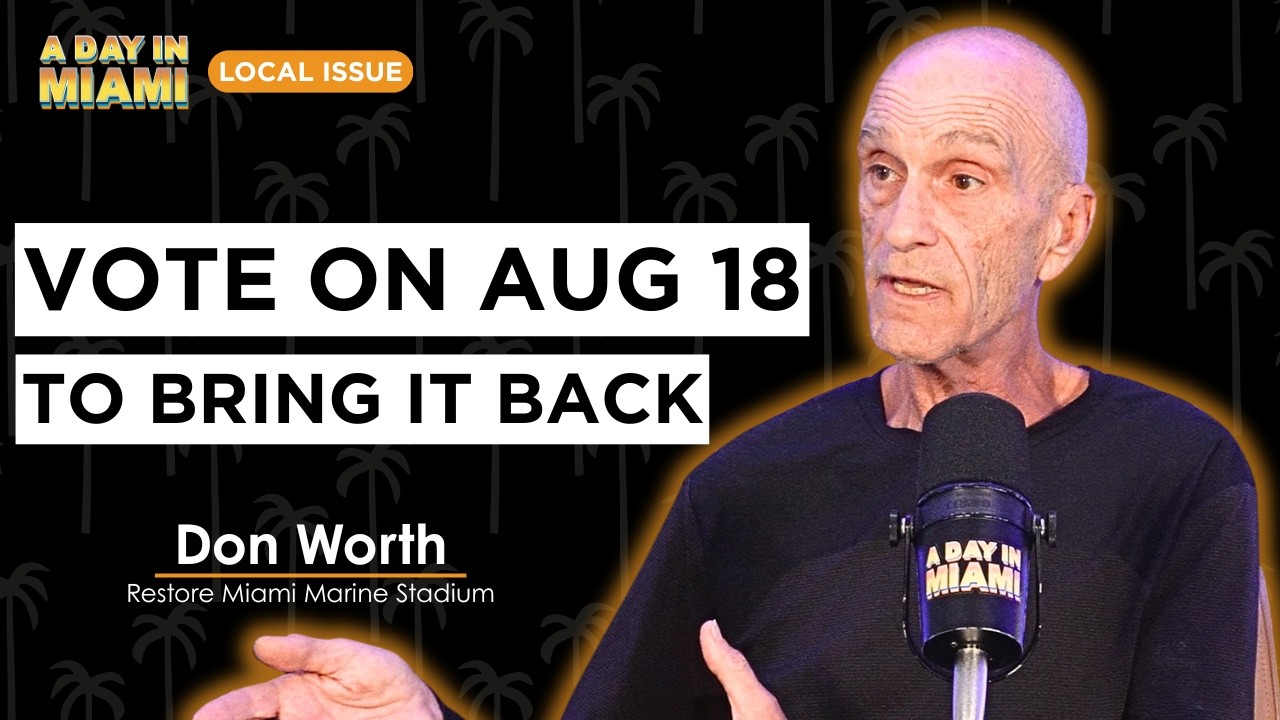
Miami Marine Stadium Could Be Coming Back - Here's How | Don Worth
Miami Marine Stadium was once one of the most beloved venues in the city — and Don Worth believes it can be again. In this episode he breaks down the rich histo...
About This Episode
He covers the feasibility studies, potential hospitality development around the site, why the stadium needs to stay open to everyone, its unique status as a green stadium, and why the timing has never been better for restoration. Plus stories from the stadium's past and what voters need to know before making their decision.
City of Miami residents can vote on restoring Marine Stadium on August 18th. Learn more at restoremarinestadium.org.
A Day in Miami Website:
https://adayinmiami.com/
Manny Alfonso:
Instagram: https://www.instagram.com/mannyalfonso8/
Kiko Suarez:
Instagram: https://www.instagram.com/querikoconkiko/
Eduardo Moya:
Instagram: https://www.instagram.com/mr_moya/
Follow Us! - A Day in Miami:
Instagram: https://www.instagram.com/adayinmiami/
Listen on Spotify:
https://open.spotify.com/show/20WEys6jxiliBCLoo9iSID
________________________
Produced by: Ben Schwede
Instagram: https://www.instagram.com/benthecreatorrr/
0:00 Intro
2:22 Vote on Bringing Miami Marine Stadium Back
5:25 About Don’s Mission to Restore Miami Stadium
6:57 History of the Marine Stadium
14:57 Can Boat Racing Come Back?
17:58 What Other Activities Could Marine Stadium Host
19:29 Why Marine Stadium is Perfect for Concerts
23:01 Vision for Hospitality Around Marine Stadium
24:22 Feasibility Studies
27:59 Stories from the Marine Stadium
29:32 Why the Marine Stadium Has to be Available to Everyone
31:43 Marine Stadium is a Green Stadium
32:26 Preserving and Restoring the Marine Stadium
34:00 Why Restoring Marine Stadium is Such a Good Opportunity
36:16 Treating Marine Stadium Area like a Park
38:07 Why Did Don Make Restoring the Marine Stadium His Mission
39:08 Why the City is Moving in the Right Direction to Restore the Marine Stadium
41:28 Jimmy Buffett’s Involvement
44:21 Graffiti on the Marine Stadium
45:20 Message to Voters
47:00 Marine Stadium as a Historic Landmark
48:29 ADIM Will Visit the Marine Stadium?
52:14 Top 3 Restaurants
56:13 Outro
About Our Guest
Don Worth
Miami Marine Stadium was once one of the most beloved venues in the city — and Don Worth believes it can be again.
Okay, D Miami. So, here we are. We got another This again. I know I always say that we have this is the best one, but I get very excited with all these podcasts that you guys can tell. doesn't take much to excite me, but at the end of the day, I mean, these are good ones because I, you know, we go back to what's happening in Miami and part of Miami history, you know, and I've always seen that we have we do so well with when we do Miami history podcast because believe it or not, doesn't matter what nationality, whatever, people like to know when was that in South Florida. again, you know, and and I always say this, Emmy, I'm a biased guy because I always say I feel bad for the people that not grow up in the 80s because, [laughter] you know, and some people tell me, "Eh, I grew up in the 70s or even better." But still, at the end of the day, 80s were were were a great time for for South Florida. I think so. And in that time, anyway, this podcast we're going to be talking about, yes, this this is this is very good. The Miami Marine Stadium. A lot of people may be saying the Miami Marine Stadium. Yep. A lot of people think as the forgotten thing or or that thing that's there full of graffiti, you know, by by, you know, by the again what we talked about today with um uh by the Rusty Pelican once you you know, you're going towards, you know, uh Kiscane. So, we're going to have two different, you know, updates. We're going to get an update from from Emmy then and the people that know Emmy Gar and this town. uh know the work that Ammy has done, not not because he's a friend of ours and a friend of the podcast, but we we really, you know, admire all the stuff that Ammy has done. Um, and all of us as friends of Ammy grew up going to Emmy's places, so we always had a great time. Uh, we still do, but Emmy can give us an update, but then the best of the best is that we have Don Worth with us today. So, the great thing about it is Don's worth a lot of knowledge. You got that one? Okay. So there you go. There you go. There's my little cheap little 20 cents, you know, little joke. But Don Worth is going to give us the whole history and everything that's been happening. He's been championing this whole thing of the Miami Marine Stadium for almost three decades. Him and his and and his wife.
Two decades.
Two decades. Two decades. Okay. Well, still two decades. Three decades. You I feel like you've been challenging it for such a long time. So before we go, Emmy, where are we with the Marine Stadium? What's like the people that don't know what's a lot of people think the Marine Stadium is like a lost cause.
Wow. So, first of all, thank you for having me here as your guest host. It's it's been a while since I've been back. I
listen, it's a change between and Eddie. So, it's a change, you know. [laughter]
I love them both.
Um and uh and unfortunately, I won't be the one answering what my three favorite places to eat are today.
However, um
don't tell DON THE LAST QUESTION. That's [laughter] okay.
But um Marine Stadium and that's why we're here. So
yes,
this August the voters get to decide August 18th. Okay.
Uh city of Miami voters get to decide what's going to happen with Marine Stadium. And uh there's a strong campaign to bring back Marine Stadium. Okay.
Marine Stadium is a landmark in the city of Miami. So many great memories were were created there by so many people, so many great moments. Um, but it has the opportunity to be the landmark of the city, the landmark of the city, a tourist attraction, um, a place for people to create memories, a public space for people. Um, there's 20 acres uh, surrounding it, plus the stadium itself,
right?
Um, there's nothing like it. And Don could speak to to the rest of it, but but um, we our company, I'm I'm co-founder of Breakwater Hospitality Group. Um, we're partners with Oakview Group. And Oak View Group, we're the local partner to Oakview Group. and Oakview Group um is is won the RFP uh to be the management company um to operate the stadium and help bring it back to life. Gotcha.
And so what's going on is there's a vote to approve their contract uh with the city of Miami. And that is the first step in bringing the stadium back to life. Okay. After that, there's there's other city process and whatnot so that um the stadium can actually get fixed and correct and be be revived
which is in so so much need. You know what I'm saying? Again, for the people that don't know, I mean the MMA Marine Stadium is again as Amy's landmark. It's a beautiful place that I mean we could see so many things happening. But you know with that I I want to bring in Don.
Yes. And and if I may
um our role at Breakwater is to not stand in front of their vision. Our goal is to stand behind them and really to make it happen,
right? Manage that vision.
And and to be honest with you, the guy that's that's been doing this for far longer than anybody else and has put his heart and soul into it for over 18 years is Don Worth and we have him here today.
Well, and before we go to Don, you know, the good thing about it is Don and you can probably, you know, you know, attest when you have a history of of places you you've taken over and make them successful, those are the people you want to work with. And I think that not because you're here, but you know, I always tell you that every place that you guys have touched, the the worth, everything, everything that you guys have done, you know, has been successful. You you do it in a way that people enjoy it. And I think I I think it's going to be a home run. I mean, I'm I'm excited. I mean, I'm
I can't wait. I think it's a great place for our kids, you know, my kids that are, you know, 16, 18 to experience these things. So on that note, Don, Don, welcome to the podcast, you know, and and apart from just the history, you know, we we we love having people like yourself.
Oh, well, thanks so much. I really appre appreciate being here.
Thank you, sir. And just sort of to introduce myself, so I'm co-founder of a group called Restore Miami Marine Stadium. Okay. We're an informal advocacy organization. Uh I'm a volunteer. Okay. Uh I am retired. Uh, I haven't received any compensation for this and I will not receive compensation for this. Uh, and I'm actually very admirable, sir.
I'm actually very lucky that uh, my wife is into this as much as I am because if that wasn't the case, we'd probably have a divorce.
That's what I'm saying.
It would be a problem. It would be a problem.
You guys got good dayight conversation.
Yeah. [laughter] It's what we talk about when we go to bed and what we talk about when we wake up. Yeah. It it has become my passion, our passion, and the passion for many people. And I should tell you, I never went to an event at the Marine Stadium.
Okay?
Didn't get here till a year after it was closed. Uh I'm from Boston. Uh so I am not a native. But as I discovered and learned about this place, I became actually infatuated by it. And uh for myself, it's just become a really important thing to do. Uh and what I've learned is meeting so many people around here. This place means so much to so many people. uh you can't help but get excited about it.
Yes. Yeah, you're 100%. So, on that note, could you take us and take our viewers the little bit of history of the Miami Marine Stadium and and and and the fact of what when you got involved, you know, because I you and I had a conversation. I mean, I I I know of the Miami Marine Stadium because when I again, like I told you, when I worked for for my mentor and my ex- boss, which was Maurice Fer, Maurice was a a person that was involved, you know, when when Mel Ree way back when, I mean, half of these people are going to say, "Who the hell this guy's talking about?" But anyway, Google it. Um, you know, or Chachi PTA, but you know, when they were involved and when the Miami Marine Stadium was was built. So, you know, I wasn't with him at that time because he was mayor of the city of Miami at that time, but I know of it because when you're working with somebody that you know, you you learn the history of what they were involved in. But I would love for people to understand, it's very important people to understand the history of Miami Marine Stadium and and and what happened to it. You know, to the other day, you know, it was it was functional and I I believe that um it stopped fun you're the one that can correct me. it it stopped functioning when Hurricane Andrew or or before Hurricane Andrew?
Sure. So, I'll give you the background. So, in the 1950s and and early 1960s, Miami was a capital of boat racing. And boat racing was a very very big sport. But there was a problem. When the boat racers raced in Biscane Bay, they'd hit coconuts. Uh and when you're going a 100 mile This is true. This is true.
YOU CAN'T MAKE THIS UP.
NO, you can't. Uh, and when and when you're going 100 miles an hour in a very thin skinned boat and you hit a coconut, there's a problem.
There's a problem.
So, Mel Ree, and by the way, uh, I interviewed Maurice Fere.
That's wonderful.
And, and what he told me, uh, he what he said was Mel Ree, who he described as a quote, benevolent military dictator of a Caribbean island nation, came up with a somewhat crackpot idea to create a stadium to watch boat racing. Uh, this was going to be a tourist attraction. So the city did a feasibility study. Uh but in order to create the stadium, you also need to create the raceourse. So they dredged out from Virginia Key uh just three miles away from Miami a raceourse which was the Marine Stadium basin which by the way uh is in the shape of an elongated oval and that's a very ancient athletic shape. It happens to be modeled exactly on the Circus Maximus in Rome. This is where Benhur raced the chariots. It's not the coliseum. The Circus Maximus still exists. The only difference is is our aquatic Circus Maximus is actually four times larger than the original. So, the basin was built at a cost of $900,000. The marine stadium was built at a cost of $1 million. Uh I had the opportunity to know the uh architect Hilario Candela and work with him and the engineer Jack Meyer as well. Uh and they were, by the way, the odd couple. Jack Meyer was the straightlaced engineer from North Carolina and Hilario was the artiste from Havana. And Hilario drove Jack crazy with all of the swoops and curves in that building.
A good Cuban.
Exactly. Right. And and uh Hilario meanwhile at one point told me that uh Jack drove him crazy.
Okay. So anyway, uh the stadium was opened in 1963 and it functioned for about 29 years and people remember all of the wonderful events, the concerts, the boat races and so forth. What happened is boat racing started and it was very very big but it wasn't enough to sustain that place. So Mel Ree came up with another one of his crackpot ideas which was a floating stage. So the city bought a barge at a cost of about $62,000, morted on the opposite side of the lagoon and would tow it in front of the stadium. And initially you would have oh the Miami Symphony, Leroy Anderson, the Boston Pops, and then Jazz, Benny Goodman, Cab Callaway, Ray Charles, and then all the rock groups. Damn. Uh yes.
Uh you had
some good rock concerts.
You had the Who played there? Queen played there, Stephen Wolf. Um, Leonard Skinnard almost caused a w a riot. All kinds of things, Easter sunrise services, Our Lady of Charity events. Uh, this is where Richard Nixon was hugged by Sammy Davis Jr. at a political rally, a very seinal moment of the 1970s. Mel Ree, Mel Ree, Elvis Presley filmed a movie there, 1968 Clambake. But the issue was that the city of Miami ran it. uh and for its last 6 years of operation from 1986 to 1992 it went downhill. Cities are good at providing services. They are not good at running a business. And I and I I'm not trying to be negative.
No, no, you're not. You're not. By the way, I don't want to interrupt you, but you're not the first person to say that on the podcast.
And it it's it's just Yeah. I don't you know, I don't diss them for that, but they shouldn't run a hotel. They shouldn't run a restaurant. And the and running a facility like that is a very complex competitive business. It went downhill from 1986 to 1992. I know I got the ticket manifests for the last six years of operation. It wasn't pretty.
No.
And there were also de and given as the stadium is running downhill, developers are looking at the site and saying, you know,
we could do some very nice things on that site. So the city frankly let it go. Uh I've spoken to people who actually worked there and they would say the same thing. Hurricane Andrew happened. Uh it never damaged the it never damaged that building. Uh it's
it's a strong building.
It's a misconception. I remember when I I spoke to Jack Meyer for the first time, the engineer, and I asked him, uh was the Marine Stadium damaged by Hurricane Andrew? He got angry at me. He said, "No, I designed that building to last a hundred years. Uh, it's uh it's very, very strong. That roof is not going to fall down, and if they blow it up, it'll all come down in one piece." And subsequent engineering studies have proven that to be the case. Anyway, so the city shut it down, appeal appealed to FEMA for a million dollars to demolish it. At that point, the insurance company, which would have been on the hook for some of the demolition costs, said, "Wait a minute. we're not sure this is really damaged. So hired they hired an engineering firm uh and the engineering firm did a study and the last line of that study which came out in 1993 says Miami Marine Stadium was not damaged by Hurricane Andrew. No damage at all and frankly very minimal maintenance issues. But at this point the stadium wasn't working. There was this big uproar. The city just closed it and it sat there for 17 years until we started this effort to restore this building in 2008.
That wow I mean listen did you catch that? The good thing is you guys can rewind on this [laughter] because that was to the point that that that that's just crazy to me. Don so then if I mean and again we're not going to get into that because we everybody says the same thing. Oh, because the apologist apist we're not going to get into what administration who was it happens.
I I don't begrudge I don't begrudge the sea at all. I really don't. It's just not a strong suit for them. That's what I was going to say right now. If you look right now,
they have other things to do.
Between the city of Miami and the city of Miami Beach in the last 15 years, there are five venues in those two cities that used to be run by governments. They weren't run effectively. They're now run by professional facilities operators. They're now successful,
right? They're making money for the city.
Yes, they are. And cities have figured out this is not their strong suit. That's okay.
Yeah. Yeah. That just do do the services what you're paying for. You know what I'm saying? And and again, like I told you earlier that a lot of people were, you know, a lot of people have always said city should just stay out of the business. I just want to go back a little bit on the fact of when when when we talk about the history of the Miami Marine Stadium, you know, what you just said right now, you know, boat racing's back in in in in gear again. We just had it hu I mean, what was it last year that they had the one over here by the
There's another one coming in in October, too. You know,
the offshore racing is coming back again.
That's what I'm saying. So now it's all become I mean again Miami is that center of every event throughout the world like you know I I I keep on saying and I don't care the good thing about it is everybody can always Google it. I've always said this is Miami USA. We're not Miami, Florida. I feel like we're our own country you know I mean they just cut it right there. Boom. And we just float a little bit away. Boom. We can just you know flag it. But because everybody wants to be here you know Miami is like the center. If it's not the if it's not the Grand Prix it's it's the NASCAR. If it's not the NASCAR, it's it's the the the tennis that we're we're here and I know that the boat racing again is coming back. Would that be a facility, an area that the boat racers can hit or it wouldn't work out for boat racing there again? I would love to see boat racing come back and I and I've spent a lot of time interviewing boat racers. I've actually gone uh to the annual meeting twice of the American Powerboat Association, which is a sanctioning body for boat racing in this in this uh in this country. Uh, I actually own a vintage hydroplane which is sitting on our wall up in our house. Uh, and I know the racers would love to come back.
The issues that we have to solve are dealing with marine life. Uh,
and and it's possible to do that. Uh, you can boat race uh in that basin. It's not an endangered species area uh area. uh what we have to do is do it in such a way so that the boat races do not get held up by stopping the boat race for manatee protection. So the possibility of maybe putting a temporary net across the across the edge of the basin is a way to solve that issue. I would love to see it come back. What's interesting about boat racing, it was a very popular sport. It's not so popular now in part because there were really no venues to watch it. The Marine Stadium is the only purpose-built boat racing venue in the world and it's absolutely perfect. Uh you can put 6,000 people there. As you know, we've got a new boat racing circuit, the E1. Those these are the we were invited last year to cover it
and that and those are super excit. And those are not the only uh and I've been in touch with them and we've talked about the stadium. Those are not the only boat racing classes that would love to come back here. And with the the interest in the Formula 1 car races is sort of now interested in all of this. What's interesting is that even uh Miami Dolphins when they stage the Formula 1 races for the first couple of years they had big mega yachts there to watch the boat races. Yes.
How cool would that be? I would love to bring that back.
I mean we could do a little mini Monte Carlo.
Well, you know, aside from the boat races, there's been a lot of great things that have happened on the water as well, right? Um, I believe you mentioned uh the crew, the swimming there, you know, in addition to all the power boat activities that can happen at the stadium. What's happened since then is that basin is used uh by hundreds and hundreds of people every weekend. Skulling races, dragon boat races, sailing races, long longtime swim uh long distance swimming festivals, and the opportunity is there.
Yeah. rowing right next door.
I happen to be a rower myself.
Absolutely. How many parties IRC you one used to do?
And now the Olympics, by the way, are going to have a 20,000 meter uh event uh for Olympics. And the Marine Stadium would be a terrific course for that. And you can basically do events there with all of those races and then with the stadium at an entertainment event at night because what's happened with boat racing and some of these other things with these festival events, they're not just about the race, right? They're about entertainment, concerts and everything and the stadium is just perfect for that. What I think viewers ought to know is that there is nothing like this place in the world. This is extraordinary. Uh it's a magnificent it's a magnificent piece of architecture that's really admired by architecture fans around the world. It has when it was built the longest span of cant delivered concrete in the world. Uh it's a beautiful piece of architecture. Uh and the view corridors from the stadium now are incredible. Maybe some of your viewers will remember how great it was watching an event there. It's better now.
I can
the way Miami has grown up. You walk up that ramp, you look out at the sta, you look out at the city, it knocks your socks off.
I mean, I just, again, these are the things that I say, you know, when I say in my Spanish things, because these are events. These are a place that you can imagine just having, you know, to your point if it's not a racing, but imagine just having like, you know, a beautiful event in the middle of the water.
Yeah.
You know, one of those, you know, those big things that you're doing now with those candle light uh, you know, those concerts. I mean, imagine that in the middle there. How beautiful with people putting their bulge sail bolts or whatever they want to see. People sitting down in the in the in the in the stadium watching.
Manny, I can tell you it cannot be duplicated. What's going on there cannot be duplicated. And he could tell you, you know, in this world, people duplicate things that work. This venue cannot be duplicated because of everything. And he'll he he'll go into it specifically.
You know, I think initially where it's going to get a lot of action, what's going to generate revenue is concerts. It's a mag it is a magnificent concert venue. Uh I spoken to a number of performers who played there and they loved playing there. They would say it was the most incredible experience they ever have. There there you are on a floating stage. Uh uh and uh there is truly nothing like it in the world. Uh so that will be the initial revenue driver for it.
I mean it just gives it that it gives it that that that that Miami vibe. That's that's what it is. I mean, coming to Miami and saying I could do a concert on the water. I mean, granted, how many people fit there, but it you know, you could you know what, 9,000 you said or something like that?
It's 6,000. And basically, you know, the way the thing that's so great about it is that it's not just that the Marine Stadium is a great venue. It's also it's in Miami, which is there is a place where performers want to come. A lot of them have homes in South Florida. Yeah, I had the opportunity to work with some very heavyweight music producers and what what they said was the whole concept here can be what's called a residency. Uh so let's say so let's say so here's the thing. Uh performers they don't love playing at these huge venues because there's a distance between you and the audience. You know that was what that song the wall was all about the disconnect between the performer and the resident. So what happened with residencies is in Las Vegas a performer would come and they'd be there for a month. So it would be easy one setup and one take down. You spend time in this community that you're comfortable with and you do shows for maybe a whole month and that's what it would do.
You're going to get everybody in there one way or the other.
The concept is somebody we'll say like the Dave Matthews Band could come there and and a lot of these guys have homes in South Florida and women too. You stay there for a week and you do a half a dozen concerts and you clear the same dollar amount. You have a great time. You're more connected to the audience. And for the stadium, that's how this thing really takes off. And so you have Miami which can attract the performers. You have the most in one of what I believe will be the five greatest open air venues in the world, the Marine Stadium. Those two things together means it's going to be incredible entertainment there.
It'll be spectacular. So Emmy, you and in in that section, what do we vision so we can give our viewers like more or less what's in that creative mind of the group in renderings more or less? So it would be, you know, could people say, "Okay, I'm going to go have dinner."
Well,
can I have dinner and watch a concert?
That that remains to be seen, right? What where where where the design and everything actually goes. So, so part of this,
well, that's why I said the vision
part of this process, you know, part of this process is is is obviously bringing it back to life, but in that you have to modernize certain aspects of it. You know, food, seating, potentially.
I mean, listen, if I'm going to go, I'm going to be there. I want to go and say I'm going to sp I want to go have either dinner earlier and then see my concert, I want to go have a cocktail and you know what I'm saying? I mean, you want to
Well, the idea is that you could offer a full hospitality experience in the area. But I think the the real advantage of this is not just the stadium. It's it's the area around it and the public use that you get out of it.
Um I I think with with anything that's historic that needs to get um you know, revived or rebirthed, you have to keep its architectural integrity. You also have to bring it up to code. There's going to be, you know, it's a process, right? You have to design it. You have to budget it. And and that's this this vote is begins that process. Now, Don um and and the city and others in the past ran studies, feasibility studies because they weren't going to get behind something that was going to be a dud. And the reports that he got, and he could he could elaborate on it, were spectacular. They compared it to Red Rock um out in Colorado. And and I I'll let Don talk to it comparable because he he knows this he knows this actually better than I do.
That that's a good comparable.
Sure. So for the viewers who don't know what Red Rocks is, it's basically uh an open air amphitheater that was carved outside of a mountain uh outside of Denver, Colorado. Uh it is considered uh the most successful midsize venue in the United States, maybe the world. Uh it draws one and a half million people a year. A half a million of those people are from outside of the state of Colorado. It is an enormous economic boon to the city of Denver. Uh and the uh feasibility study done for uh the stadium by the city pointed to Red Rocks as a comparable. What's interesting about that is the other person who agrees with that is a woman named Nancy May. Nancy was the uh uh assistant general manager and production manager of Red Rocks and she was a member of the consulting team on the feasibility study. After the study was done, she called me up about a month later and she said, "Don, do the people in the city of Miami understand that what the Marine Stadium is is red rocks on the water? I want to help you." So, by the way, on our website, restorestadium.org, RG, there's a strong letter from from Nancy. Uh, everybody is familiar with the Sphere in Las Vegas, this new experiential venue. Uh, and that's great. The difference is that Red Rocks in the Marine Stadium don't need technological gadgetry to provide this immersive, unique experience. Because at the stadium, you're sitting there, you're on top of Yeah. You're on top of the water. You're looking at the at the city of Miami, which is got this incredible view. There are boats around the floating stage, which is its own scene. Uh it's immersive, but in a natural way. So, uh you have that same experience. And what's good about that in my mind, what people are looking for today is authenticity. Uh they want something that's real in this digital world. uh they want to really feel and experience something authentic with the stadium. The architecture gives it the wow, the history, and there's plenty of it, and we continue to talk about that. That gives it its soul. But then you go in there and you get this immersive, incredible experience of walking into all of this, and you haven't even seen the performance. Uh so the sphere, you know, they're planning to build a smaller sphere in Baltimore. Yes. Well, that's great because that's what people do these days. They don't invent something new. They do a sequel.
Yes.
Here in Miami, we don't have to copy anybody. We can come up with something original that's about us.
Authentic point.
And authentic. It's true because think about it. You know, the the stadium was designed by Hilario Candela who was educated perfect Miami. Simple. Educated at the University of Georgia Tech. This is our place. So, the difference is is when this is renovated, other people are going to say, "Hey, wouldn't it be great if we could have our own Marine Stadium and knock us off?" Well, good luck to try to knock this off. So, let's be original.
I I I I I love it. I love that. I mean, listen,
I'm just I'm viewing again. Um I'm, you know, I'm one of those not everybody, but I'm one of those people. I've always been wanting this day to come with the Miami Marine Stadium because I've I've I I I was fortunate enough to see, you know, different things happen there before, you know, it it went out. Not like I didn't see the who or anything like that.
I tell you, I got a story about the who. Yeah.
And I got a few stories about the who. So, we've collected, by the way, 170 stories about the Marine Stadium. Uh my favorite 30 are on our Restore Marine Stadium website. Uh, but there was a guy in the water because there'd always be people in the water on little boats uh around the floating stage and Keith Moon's paisley covered bongo drum floated off the floating stage
and this guy got it and
the guy was in the boat.
The guy in the boat and he's he's about to to basically paddle away with it and the man and the manager for the Who said
come on bring it back. Bring it back. I think my favorite story like that Dave Breubck the jazz musician and his sons. So they're playing at the stadium and there'd always be people around the stadium people on surfboards and canoes and inner tubes and there was this one woman in a bathing suit and she was hanging on to the floating stage and she kept trying to climb up. Every time she did the crowd went wild. Brewck thought they were applauding for him. His sons who were on he played
they wanted to see HER GET ON STAGE. HE HE played six encors. His sons who were on stage with him go, "Dad, it's not about you. It's not about you." You know, all those stories. You know, there's one more important point that I really want to make about the stadium. Okay? And we're going to have concerts and and boat races and all kinds of stuff. Uh and ultimately, I think there's going to be a learning curve on how this place is used. There going to be new things there. They're going to be drone shows. They're going to be things that that we can't even imagine because this is a place that was built for spectacle. Yes. But for me,
it needs to be accessible to the community because one of the reasons why you want to restore this building is to democratize the waterfront. Uh we have a fabulous waterfront, but it's very expensive to people to buy those waterfront condos. But those people deserve to have the same great waterfront experience that everybody else has. And for me, the Marine Stadium needs to be the people's stadium to
come and just watch us, you know, watch our great entertainment.
You what you can even do. And this was suggested by Tony Goldman, who, as you know, uh, was a visionary developer who really helped was the catalyst between South Beach and Winwood.
Treat it as a park. Treat it as a park. You know, we've reimagined parks now. Uh, you know, you used to think of a park as central park, but with something like the High Line, we've learned that a park isn't just trees and stuff, it's a state of mind. You want to be transported. So, for a family, somebody to bring their family there at uh at dusk and watch the rowers row at sunset and watch the buildings light up one by one and maybe there's a flamco guitarist playing at the basin of the stadium. You have a fabulous experience and we need to make that available to all my
and to your point it's doable for a family.
Yes, it is. you know, doable for a family, for a some weekend entertainment for people to go and just say, you know, this is where I want to, this is what I want to do on a Saturday night.
And and there is no reason why we can't have a stadium that both successfully financially because this can be really successful financially, but also can function as a uh a community place for gathering. That's what
we we we are very lucky by the way that uh we have such a long season here even during a hot day like today. Sort of the interesting thing is Princeton University School of Engineering by the way has done made a a a cottage industry out of studying this building and what they discovered
they marine stadium. Okay,
this is the first green stadium. It's naturally airond conditioned. It was designed because uh because all of the seats are in shade from noon all day all year round and it's open on all four sizes all four sides from the ocean breezes. The average temperature inside the stadium is always 10° cooler than the air around it. So we were out there today. It's a bacon hot day today. It's 87° and it didn't melt and we're there and it's shade and we're getting breeze and it's perfectly comfortable during the midday
and we're talking about that we could modernize it a little bit with some nice you know those you know those big fans that they have now which I
you know there there are things to do and what's interesting is there's sort of a fine line there but Hillario Candela what the the architect said the guy who designed it and he said this in this wonderful video says I don't want a mom I don't want to mummify the stadium, you know, I want to I want to have it so that it can work for today for new generations. And what was really cool, by the way, is in the restoration plans, the draft plans that we have now. Yeah.
Hilario Candela, who designed this building in 1962, 60 years later, was a consultant on the redesign of the building now. How cool is that? Uh I'm very confident that we can sort of thread the needle and keep the uh historical and architectural integrity of this building and then keep it uh available to be used for 21st century qualities.
You know, I I I I love what you said a little bit about the new generation that we talked about that off camera. There we talk about it. I say it all the time here. The gener our generation of kids don't have the places that we used to have. I think this would just give them even more places for people to visit, more places and more, you know, more activities for people to have within the schools. Imagine all the different schools, universities that, you know, with M and FIU and all these schools that can do joint ventures with the with the stadium, you know, with all the programs that they have of concerts and everything else. I mean I did I I tell you Emmy you know on that part again you know if if this could become you know to Don's uh point I really want to say I love the fact of like the residency like what you talked about you know Vegas because this could be our our our thing of the sphere you know but it's on the water I mean the acoustics the the sound everything just sounds beautiful the opportunities of making that area
well I think there's there's There there's opportunities that come in in many different levels here. Aside from the entertainment factor,
yeah,
I think a lot of it draws on the potential to increase tourism for the city. Um there's this city of Miami depends a lot on tourism. South Florida in general depends a lot on tourism
and we have a lot of great things in Miami. Obviously, the beach, you can't beat that. You know, the water, you know, everything, right? the the the the food scene, the the entertainment, everything in general in Miami is has definitely stepped up in the last um six, seven, eight, let's call it the last decade.
Correct.
Um what this does is it it gives us another catalyst in a few years uh by the time it's it's redone and rebuilt where um there is yet another reason to come to Miami and experience it. there there there's really nothing like it and and when you have some originality like Don has pointed out it it really helps. I think the other thing that it does is it gives an a great platform for um for for organizations and and those in the city to to to have a place that they could call home and not just music. I think if you look at that stadium specifically, it's located what I believe to be the center of fitness in South Florida. If you're there any Saturday morning or any Sunday morning um and you look there are exercise
hundreds if not thousands of people
riding bikes, running and whatever that is.
That to me can be another fitness hub for Miami for people to watch sporting events and not just um and sporting events that either take place on the water or on the uplands around it. Um, and and I believe with with the proper redesign of the areas around it, you're going to be able to achieve that and make it feel like he said, you know, Don said something earlier um about a park and not every park needs to look like Central Park. Could you could you tell them that because it really it it it it really struck a chord with me at least a good chord obviously when when you mentioned um the use of that?
Sure. You know, a park is a it's not a physical thing. It's a state of mind. You want you want to be transported away from your everyday cares. And that's what the stadium is. Think about it. It offers shade, seating, fabulous views, uh a wonderful place for contemplation. Uh
yeah, not only that, but uh you know, just disconnect. You know what I'm saying? Reset.
Yeah. No, there there's there's so much that can come from it. Um, to me at least, we're just happy to be part as Breakwater. We're just happy to be part of a of a legacy type project like this. Um, but really it's the vision that that these guys have set forward that we're here.
Again, we have spoken about the Marine Stadium here so many times in our 200 and some episodes. It's come up so many times and and and the fact of when they told me we're having a program today regarding the Marine Stadium and the updates and and and and Don attending to talk about this. I mean, I was happy because this really just finally it's like saying finally we've reached that day. I mean, I finally I know finally it's going to be the day after it gets vote, you know, voted in August and passed and then we can move forward. But again, I you know,
it's I have one question for Don that I would love to ask because I've I've gotten to know Don in this whole process now over the last several months and and year really.
Um but I I've never asked him this and it's why you you've been at this for quite some time. Why? This is an opportunity to do something great. This is an opportunity to to affect people in a wonderful way. you know, in this fearful world we live in to provide joy for people because that's what the stadium does. Uh, you know, when I I talk to people who've been to the stadium, it's very interesting. Their eyes light up. So, wow, what a great place. And the word that always came up was magical. It's magical. And I've spoken to over a hundred groups. I've never had a bad presentation. And what I love is so many different types of people like this building for so many different reasons, whether it's concerts or boat races or architecture or just anything. And it just sort of carries you along. You get that much personal affirmation to so to be involved in something like this. And look, we've had a lot of ups and downs. Uh but it's been a hell of a ride and I wouldn't trade it for anything. And we are in a very good place right now. Some people say, "Oh, it's 18 years. is what the heck is going on and what I said believe it or not the city is doing this right they are doing this right if you look at the 18 years it's sort of very methodical first a master plan then architectural work then a feasibility study then a then a search for an operator and that's always been that's the thing that's always held it up because I've learned you know from my 18 years if we don't have a legitimate successful experience operator who sees opportunity and wants to run the stadium, then we have nothing. And now we have it.
And it's funny because we just talked about that. You said, "Why is the city in that?" That's what the city has to be doing. The city, what they're doing is due diligence.
And they and they are and they've done it and they are doing the right way. Now, now you should know this is still a step in the process. If we get approved on August 18th, and come on guys, go out there and vote. Uh what then happens is uh the operator uh gets a management agreement and they continue developing the plan uh which ultimately is presented to uh Miami City Commission. It's not big promises without a whole lot of information. It's a stepbystep bystep thing and this is the way it should be done and I think the city is doing a very good job. Yes, it's taken longer than I want but you know what? We're here now and we're exactly at the place that I want to be. And I thank all of the city employees and I thank some of our elected officials and administration for taking us here because we got a hell of a shot.
That's that's
You know what? This is this is crazy. You know, the city uh commission unanimously voted for this
and this has now been through several
administrations, right? So, usually one administration, you know, has a different agenda than the next right?
We talked about it today. It's politics
and and it is what it is and that's why things that things take a time take time to move to the city because everyone has
has a different vision for what they want to see their city to be and that's understandable but what I what is refreshing and feels great is that it's continued to move through and through and and that's very exciting. I have one more question for Don. we've talked about a lot, but there's one name that always coincides whenever you hear about Miami Marine Stadium, you hear about one individual um who sadly is no longer with us here today, but his name always goes side by side with it, and that's Jimmy Buffett.
Yeah, of course.
So, Don, can you paint the picture for the viewers of what it was like potentially for like a Jimmy Buffett concert and what what was so special and why does that name always synonymous with it? And I know we had his daughter with us earlier today. Um, it just seems like something so special. I I feel like it it deserves a mention.
It's funny. I mean, I've just heard I was never at any Jimmy Buffett concerts, but what was interesting is of all the presentations I would make, I usually start by saying, "Well, what did people see at the Marine Stadium?" And I swear half the people in this city were there at the Buffett concert when he jumped into the water.
I mean, I mean, come on. It just goes with the whole vibe. Jimmy a margarita. I mean, beer.
And what was interesting is we reached out to him very early in this thing to get involved. Uh, and he did. Uh, he first wrote us a letter of support. Then, uh, he did a, uh, video for us. Then he came to the Coral Gables Museum and played with Coral uh, Gloria and Alio Estifan. But what was also interesting in 2022, we were going to city commission for an approval, which we didn't get at the time, but that's okay. we're here now. But anyway, I reached out to uh Jimmy through his manager and I said, "Gee, we could really use a letter from you." And I wrote sort of a very simple preuncter draft letter.
I got something back that was much different. It was thoughtful and deep and vintage Jimmy. Yes. And he was probably ill at the time, but very very reflective. Uh this place meant a lot to him.
That's what I was going to say. And and in fact, the famous photo of him jumping off the floating stage, he had that behind his desk in Palm Beach. Uh and we met Savannah this morning and she gave I thought a wonderful meaningful presentation. Uh and it's it's just so special that that she's involved and we want to carry on that legacy.
And who doesn't know Jimmy Buffet?
I mean, I I listen to it on the car on the Who doesn't know Jimmy Buffet? You could I mean I was just down in Universal for my daughter's last dance competition and you know you're there in the plane right there in in the whole Margaritavville area. I mean who doesn't know Jimmy Buffer and the fact that you're saying that he wrote that letter it's he's writing it from a place that it meant a special place for him because he came to the to the Miami Marine Stadium at the beginning of his career.
That's exactly right. That's what he said.
So at the same time, you know, and the highlight when he started becoming Jimmy Buffin, I mean it it just it comes all together. I mean, you're not in the Keys, but you're right there in the Miami Marine Stadium.
And I think what's exciting to me is I look forward to future generations reinventing this place.
What one thing that we haven't talked about is after the stadium closed in 1992, it actually had a whole new chapter. Graffiti artists went in there and began painting uh and photographers went in there and began following them. I mean, we've got hundreds of photographs on here.
Yes, I I've seen them. And in in a certain sense, the creatives kept this building alive and really gave it a new life. One of the things we did, by the way, is we had some extra chairs uh from a promotion that Heineken did and we gave them to artists to reimagine them as artwork. And you can go on our website and see 58 seats that are now artwork and they are really, really cool. What gets me is this building just inspires people in so many different ways [snorts]
that everybody has a story with it. Anybody interacted with, everybody has a story with it.
If you're from Miami, this building means something.
Yes.
And and Don, for those people that can vote on August, what is one thing you want them to know?
City of Miami residents.
City of Miami.
Anybody at City of Miami residents because everybody's going to ask us, oh, who can vote for
City of Miami residents? For anybody who could vote in August in the city of Miami, what is the one or two things that they should know before they fill out the ballot to vote yes on 172 for Marine Stadium?
If you want to see what will be one of the truly world's great open air venues, if not the greatest one, come back to life. Vote yes. That's it. I mean,
simple.
What What else you want to see it? Uh and and if you're not sure about it, learn more about it. Watch some of the videos if you're not familiar with it. You will see how incredible this place is. What gets me is I've taken so many people into this building. Uh initially when I began doing it, I began taking PE and I was sort of worried when I took in promoters and producers and facilities managers. What are they going to do? They're going to they're going to come in and look at it and say, "Uh, oh, it's an interesting building, but I'm sorry. Uh, it's really not going to work."
Yeah.
People are blown away. You know, you look up, you see the roof, you look to Miami, you see the skyline, you just take it all in. There's nothing like it in the world. We can do something truly spectacular here. It's just so hard to be authentic these days. And this is something authentic. Money can't buy what we can do.
Yes. And and and money cannot buy that view anymore, by the way. And we're and and that area. And I said this earlier today when we had some other people when we're talking about that whole area. I feel that the Miami Marine Stadium should be put as another historic area. I mean, we should be up there.
Well, let me let me tell you what it is.
As you know, as a freedom tower, you know, symbols that represent what South Florida Miami is.
It it already is a symbol. Remember this. It's designated historic by the city of Miami.
You got that charge, didn't you?
Well, a lot of people did. It's design, it's on the National Register of Historic Places, which means it's eligible for historic tax credits, which is going to generate a lot of money. It is been declared a national treasure by the National Trust for Historic Preservation, which has put a lot of weight behind this building. It is on the World Monuments Fund watch list. This is an organization that saves the palaces of Anger, Watt, Luxor Temple, worldwide. Of course,
it is a priority for the World Monuments Foundation. The Getty Institute, the most famous architectural foundation in the world, provided a huge grant to help finance some of uh feasibility studies for restoration costs. This building is admired. It is
like the Sydney Opera House in Sydney, Australia, which symbolizes that city. This is the perfect symbol for the city of Miami. Designed by Hilario Candela, a modern building on the water, by the way. fabulous views of the city from the stadium. This takes off on social media every single time we put it out there. Well, I mean, listen, you just you gave me a little bit of idea and and and before August 18th, you know, I I I shoot myself sometimes because I always, you know, I'm the one that comes up with these things and all of a sudden then my producer says, "By the way, uh but I want to take
I want to take our camera people and I want to do like a little
just a little tour in the sense before August 18th because one thing is what we're talking about, but we're going to do like a little we'll meet over there one day and we'll just go and and view it and you know, I would love for Don to be there too. Just, you know, and show people what we're talking about and show that and show that picture so when when everybody's watching the podcast, you know, you can also go and see that whole, you know, the video that we're going to do, not the fact of what you got to go and research and Google it. No, no, no. We're going to go and and videotape it just short and everybody can see of how beautiful and iconic this place is because I think it's really going to make a huge difference. Again, this is one that um uh you know, we here in the day in Miami, we we don't we bring everybody on. We like to bring anybody from any party, any any any referendum, anything that's happening, we bring everybody on. We let the people make the decision. We like to put it out there. But I tell you, this this one for me is special because I I support this. I think this is a must. I think this is something that we that we have to move forward with in in in in the city of Miami and voters should vote on this because I mean you're just you're just relighting that spectacular you know fire again in in in in the Miami.
When was the last time you were there?
I have not I I can't tell you. Let let me tell you
nine 10 years. I don't know when's the last time I was there. I will tell you I have in my slide presentation I have, you know, pictures of the city of Miami from the stadium from the 70s and now most things maybe some things in life don't improve. It's better than you remember it. It's better.
That's awesome. That's awesome.
You walk in there, we walked in there today for uh for our campaign kickoff and press event and I got goosebumps just walking through there, Danny. It's it's really a special place. I can't wait for the people of the city to experience this once uh once this happens and everyone votes yes on August.
Well, and I'm happy you guys, you know, decide to come to the number one podcast in Miami, coming to day in Miami and sharing the, you know, the the news and after the press and coming over here and sharing with us. But I think again, it's our responsibility from the podcast, you know, standpoint to go and take a look at it and for us to to for our people to through through our lens with you guys talking about it. And I tell you, when people see it, at least everybody lives in city of Miami and say, "We we love this." You know, they're going to love it. They're going to love it.
You know, and all you got to do, Manny, is what I began doing after I saw enough of this. Yeah.
Walk in there,
bring people up,
don't say anything. Just let them gas.
Yeah. Yeah. Well, and I tell you, really, you know, not many people, like you and your wife champion things like this. You know, a lot of people just there there's a sense of of of dedication and you know, however, you know, anybody embodies this, however they like it, they sense of gratitude to you for taking this initiative for so many years. You know what I'm saying? And not even being a native, you know what I'm saying? Because one thing, you know, you come in here and you fell in love with this place and you said, "This is what I'm going to do. This is my responsibility." You know what I'm saying? This is what this is what I'm fighting for here in Miami. I think I think that's awesome.
I've had a hell of a ride. loved it. You know, for all the ups and downs, for all the frustrations, I've met great people. I've had great experiences. It makes you feel alive.
Oh, I mean, listen, just the fact of the knowledge that you're giving people out there
has to bring people back alive. You know what I'm saying? But before I let you go, Don, we have a very special segment and this is the this is even harder for you than the fact of the stadium. And it's going to be, you know, what is a place that Don and his wife like to visit? three good restaurants that you guys like in Miami. You know what I'm saying? It doesn't have to be, you know, it has to be something that you guys any, you know, your go-tos. It could be the smallest cafe. It could be the
the top three.
The whatever you like, Don. Top three.
Oh god.
Give me some good ones that you and your wife says, "You know what? I'm in I'm in the mood for
I don't know. I like Saison and North Beach."
Okay. You see, we I love the fact that we're getting all these new restaurants.
So, what is it? Siss. S A Z O N Cuban place. Just
Cuban place.
Youubet. Yep. Just sort of just sort of a local
God.
It's in where? North Beach.
North Beach. And this is the northern part of Miami Beach. Like 70.
Have you been there?
Oh, god.
So, you know, Don Don also runs the uh uh uh the uh the band shell in Miami Beach.
Oh, okay. I'm on the I'm on the board there. And I love it. And that that's given me great insight into that because that's followed a very similar trajectory to the Marine Stadium facility built in 1962. Yeah. Not financially successful one run by the city of Miami Beach. A not for profofit called the Rhythm Foundation took it over. Uh now doing 140 events a year. Wow.
Doing uh live streaming around the world, etc., etc. It's been a wonderful learning experience for me.
Okay. Give me another one. Oh god.
You got
I don't know.
I don't know.
I had a pretty good lunch today AT JOHN MARTINS.
THERE YOU GO.
It was It wasn't plugged. THAT ONE JUST CAME OUT NATURAL.
John Martins, baby.
That one. That one worked game today. That's our staple there.
Very nice place to go. And I have to tell you, I'm a bag piper, so maybe I'm biased. We had our uh 40th anniversary party at John Martins there a few years ago. You know, again, not because Emy's here, but when when you know, listen, I'm I'm a guy I'm an old school guy from John Martins way back in J Martin and when they when Emmy said I'm, you know, taking back John Mart and we're going to help, you know, re bring it back and love the fact how he kept the John Martin name
and everything. Some other people come and want to do whatever. I I think it was fabulous and really again you know listen great place for anything corporate after hours you know work but I love it with the family as I mean we go with a little group of friends on a Saturday and Sunday and just and just hang out great place all right give me give me a number another call your number one all right look I'm not a fine dining guy okay I mean frankly on the beachless sandwichery hell of a good sandwich you can go that's that's Don I love it you you gave Three great ones, brother.
The sandwich is amazing.
Sanctuary.
I have so many memories of the one in the beach.
Memories. The beach. I was, you know,
little window right there.
Right after the club 3:30 in the morning. That was your little
after or when you leave the sand. Yes. A little sauce. Little sandwich sauce. But when you're leaving the sand on the beach on a Saturday,
that's it. You know, it's you were that that water opened up your appetite, son. Surprisingly good.
That is awesome, brother. Don, listen. This has been worthwhile. So
Oh, God. [laughter] Listen, growing up, growing up,
CAN I GET A SHOW ON THE STAGE ON THE WATER? NO.
BECAUSE growing up, all I heard is Don Worth. Worth worthless. Huh? I just made a joke. Yeah. Great. You're only the six person, by the way. I know. That's all I heard growing up.
Manny, if we can make this happen for the city, you and I are going to do a cannonball off that thing.
Oh, for the love of God.
Sounds like a plan.
There's
Let me know there what's not swimming around. [laughter] Can I have a boat near?
Listen, I'll do the cannonball.
I'll do it. I'll do it. I'll do it.
I'll join you.
I'll do it. We'll do it. Well, you know, I got a couple of knuckleheads in the office. I'LL GO OH, WE'LL DO IT, TOO. YOU KNOW WHAT I'M SAYING? WITHOUT an issue. Listen, guys. August 18th. But before that, I'm we're going to go we're going to shoot a quick little video. We want everybody to see the beauty of the Marine Stadium so everybody can see it. Listen again, Emmy.
Thank you, brother. Thank you for for for you know being part of this of this this group and and Don really uh what a pleasure what a pleasure and and and would love to have you
as many times I love bringing all these people I know history in Miami because half of these people some people don't know you know you just can't get the history like that in
you know is a relatively new city for a lot of people but there is actually some old culture here that hasn't been brought to light% and um and we're excited to to to be part of.
That's what we're here in D Miami for, man. We bring it to the people.
Thank you for having this great platform.
No, no, thank you guys. Thank you
having us here.
And we're out.
Never miss an episode
Subscribe to our podcast and get the latest episodes straight to your favorite platform.
Subscribe on SpotifyMore Episodes
View all 1:07:52
The Attorney Saving Miami Businesses From Expensive Mistakes
Nov 17, 2026
 56:27
What Miami Could Learn From Denmark | Jesper Møller Sørensen
Nov 16, 2026
 1:04:23
How Bizzy Is Changing the Way Miami Students Save Money & Go Out | Evangelos Milionis
Nov 16, 2026
 52:42
How to Actually Get Your Child Accepted Into a Top Miami School
Nov 5, 2026